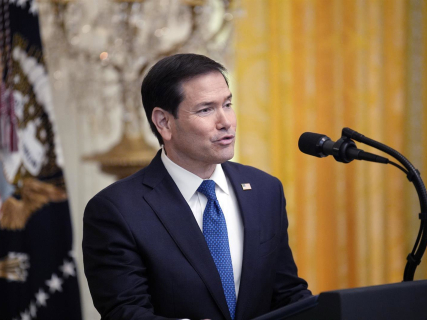

The Secretary of State and National Security Adviser to the White House, Marco Rubio, defended this Sunday the current U.S. military offensive against Iran as a “necessary” operation, despite admitting that it is not “popular,” alluding to those who link the conflict to the defeat of the Republican Party in the last midterm elections.
"Sometimes when you do what’s right you don’t know whether it will be popular or not, but it is still right," he said to the press. "Presidents are elected to do hard things, sometimes difficult ones, but necessary ones," he added.
Along these lines, he insisted that the U.S. president, Donald Trump, “identified a very real threat to this country and took care of it.” “What is right for the country is not necessarily popular, but necessary,” he argued, underscoring that, in his view, the Government’s priority is national security.
Rubio reiterated that “the United States acts defensively.” “If there is a threat to our forces in the region, we act. We have the right to defend ourselves,” he said, defending that military decisions respond to specific risks against U.S. troops deployed in the Middle East.
At the same time, he took the opportunity to flatly reject the conditions put forward by Tehran. “The demands of the Iranians are simply unacceptable and in some cases also outrageous and ridiculous, really unreal,” he explained, ruling out that Washington could take on those proposals within the framework of negotiations.
In line with this assessment, he pointed out that the talks held to date with Iran “have not been very productive.” “I wouldn’t say we’re on the verge of making a breakthrough. Trump always prefers to resolve problems through diplomacy. Sometimes it’s not possible. But if there’s an opportunity, we’ll explore it,” he said, indicating a limited margin for the path of dialogue.
On the other hand, Rubio downplayed the Democratic Party’s victory in the recent midterm legislative elections. “It’s not unusual to have a division of powers in this country. We’ve seen it before. Elections go in one direction and a few years later, in the other. It’s a characteristic of our system,” he said, presenting this result as part of the usual functioning of U.S. politics.