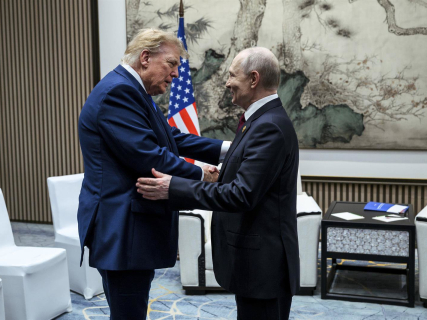

Russia has rejected the possibility of offering Ukraine security guarantees similar to those of NATO, after Donald Trump’s envoy, Jared Kushner, said that Moscow was comfortable with a formula based on Article 5 of the Atlantic Alliance. The Russian deputy foreign minister, Sergei Riabkov, has described as unacceptable any formula that assumes a kind of indirect adherence by Kiev to the military organization.
The contradiction shows the differences between Washington and Moscow on one of the main points of the negotiations to end the war. While the United States proposes guarantees that would allow Ukraine to be protected against future aggression, Russia maintains its rejection of the country joining NATO or being linked to its collective defense mechanisms.
What the United States announced about guarantees for Ukraine
Jared Kushner, Donald Trump’s son-in-law and the U.S. envoy for the negotiations, said in Berlin that Washington had managed to make Russia feel comfortable with the idea of offering Ukraine security guarantees inspired by Article 5 of NATO.
This clause establishes that an attack against one of the member countries will be considered an attack against all, which obliges allies to respond and provide assistance. The formula that the United States is studying would seek to transfer a protection mechanism similar to that to Ukraine without it necessarily becoming a member of the Atlantic Alliance.
Kushner argued that President Trump is open to this type of guarantees, although conditioned on their being part of a broader agreement and also responding to U.S. interests. The envoy insisted that any negotiation must include Ukraine and European countries, without imposing a pact on them unilaterally.
The announcement came after talks held in Berlin with European representatives and Ukrainian President Volodímir Zelenski, as part of diplomatic efforts to reach an agreement that brings an end to the conflict.
Moscow denies having accepted protection similar to that of NATO
The Russian response has come through Deputy Foreign Minister Sergei Riabkov, who has rejected the possibility that Ukraine obtain guarantees that could be interpreted as a form of linkage with the Atlantic Alliance.
Moscow considers any “quasi-adhesion” formula from Kiev to NATO unacceptable and maintains as a condition that Ukraine renounce entering the organization. Riabkov has noted that security guarantees could be addressed in some way once Ukraine recognizes that it will not be part of the Alliance.
In this way, the Russian position contradicts the interpretation that Kushner had conveyed regarding the outcome of diplomatic contacts. For the moment, there is no confirmation that Moscow has accepted a protection mechanism based on Article 5, nor that the parties have reached an agreement on security guarantees for Ukraine.
Trump cools the announcement: first, a peace agreement must be reached
The U.S. president has also avoided considering security guarantees to be settled. Donald Trump has pointed out that he does not want to address his conditions before reaching an agreement to put an end to the war, which leaves the negotiation open regarding the scope and characteristics of the protection Ukraine would receive.
Security guarantees are one of the main diplomatic obstacles, along with territorial conditions, the future of the occupied areas, and European participation in a potential agreement. Kiev is seeking to prevent a ceasefire from turning into a pause before a new Russian offensive, while Moscow insists that the European security architecture must take into account its own demands.
The gap between U.S. and Russian statements reflects that talks continue without a consensus on how to guarantee Ukraine’s security once the conflict ends. The Article 5 formula remains on the table as a diplomatic reference, but Russia’s acceptance of it has not been confirmed.