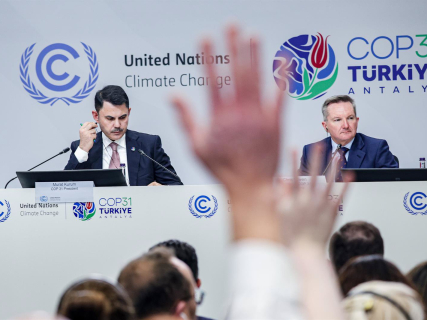

The 31st United Nations Conference on Climate Change has concluded in Turkey without a final agreement, after the latest draft declaration submitted to the participating States was rejected by a majority. It is the first time that an ONU-sponsored climate summit ends without a consensus text.
"This conference ends here (...). We have done everything we could. The decision is up to 196 countries and we are going to respect their decision (...). There will be no more text proposals," explained the President of the Conference and Turkey’s Minister of Environment, Murat Kurum, from Antalya, the venue of COP31, after several failed extensions in an attempt to close a commitment.
The conference procedure requires that resolutions be adopted by consensus, which in practice grants veto power to any delegation. "Unfortunately some countries have gotten stuck on a word or expression and have brought other issues unrelated to climate into the negotiations, which has prevented progress," he added.
Ireland’s Climate Minister, Darragh O'Brien, has stated the European Union’s rejection of the fourth and final proposal, considering that it does not mention fossil fuels and does not respond to the seriousness of the current climate crisis.
O'Brien has expressed his "deep disappointment" with the so-called Anatolia Pact and warned that the text falls short given the urgency of halting global warming. "It is not up to the moment we are living in," he lamented in a message published on social media.
Along the same lines, he has argued that the Union will not support an agreement that overlooks scientific evidence, the gap between climate commitments and their real implementation, nor the indispensable measures needed to get back on a pathway compatible with limiting the increase in global temperature to 1.5 degrees Celsius. Europe will not back "a COP that serves to whitewash the image of fossil fuels," he stressed.
Germany’s Environment Minister, Carsten Schneider, has pointed directly to oil-exporting countries for blocking progress, despite the fact that a large majority of States favored a pact. "Some people are still getting big benefits from oil and gas and are not willing to reduce their production," he said.
For the Marshall Islands, a country especially vulnerable to rising sea levels, the latest proposal is "the worst possible response" to the climate crisis, while delegations such as those from China, Pakistan, or several African countries have also shown their frustration at the lack of agreement.
The longest negotiations in a COP
On the other side, oil producers such as Saudi Arabia and Russia tried to reverse previous commitments aimed at limiting the planet's warming.
The talks in Anatolia have gone down in history as the longest of all climate conferences, with more than 40 hours of delay compared with the planned official closing time, thereby surpassing the record of the COP25 held in Madrid in 2019, whose discussions were extended for two additional days and two additional nights until reaching an agreement.
From non-governmental organizations, there has been regret over the lack of an outcome, although it has also been clarified that this does not necessarily imply an absolute failure. "It is a sign that most countries allow those who block the end of fossil fuels to kneel them," Oxfam spokesperson Jan Kowalzig has said.
Kowalzig also reproached the EU for its limited flexibility in the chapter on financial support for the poorest countries affected by climate change, which, in his view, has made it difficult to build new alliances.
For Ani Dasguputa, of World Resources Institute, the meeting has meant "a failure of political leadership." "At a time when the science cannot be clearer, it is indefensible that countries cannot even agree on mentioning fossil fuels, the main driver of climate change," he has argued.
From WWF, Manuel Pulgar-Vidal considers that governments "have failed their responsibilities." "Once again, many have avoided the toughest decisions, such as how to turn their commitment for a transition away from fossil fuels into real actions," he argued.
Mohamed Adow, of Power Shift Africa, believes that COP31 is "the worst COP." "Rich countries and polluting governments cannot continue coming with empty hands," he said.
New alliances and contradictory announcements
Despite the final break, new alliances have been forged during the summit, such as that of some thirty countries that have announced plans to achieve zero consumption of fossil fuels, or that of thirteen States which, together with the EU, have committed to drastically reduce the use of sulfur hexafluoride or SF6, a powerful greenhouse gas used in the electrical grid.
Dozens of countries have also backed Turkey’s proposal to accelerate electrification, with the aim of raising the global share of electricity energy consumption from 23 to 35% by 2035.
These commitments contrast with other messages issued during the conference, such as that of the Turkish president, Recep Tayyip Erdogan, host of the summit, who announced at the opening the discovery of two new oil fields and his intention to put them into operation.
Likewise, the presidents of the United States, Russia and China, Donald Trump, Vladimir Putin and Xi Jinping, gathered in Shenzhen, agreed to promote the production of crude oil.
For its part, the EU communicated on Thursday the postponement for two years of the entry into force of new environmental regulations on methane emissions.