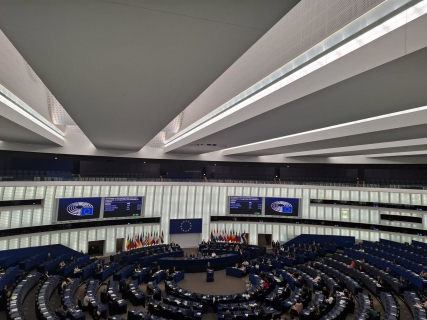

The plenary session of the European Parliament has censured this Thursday the European Commission's decision to extend an invitation to representatives of the Taliban regime for a "technical" meeting in Brussels, with the aim of advancing talks aimed at enabling the deportation of Afghan migrants who have arrived irregularly in the European Union and are considered a security threat.
The resolution, approved by a large majority of 480 votes in favor, 5 against, and 83 abstentions, calls on the Council and the Community Executive chaired by Ursula von der Leyen to maintain the "non-recognition" of the Taliban regime as the legitimate authority of the country and to refrain from "not normalizing" relations with said regime.
A few days ago, Brussels admitted to sending a formal letter with the invitation to Taliban members for a meeting "at a technical level," although the date or rank of the attendees has not yet been made public.
At that time, a Community spokesperson justified the initiative by the need to "maintain operational cooperation with the 'de facto' authorities in Afghanistan," while insisting that this cooperation "does not constitute recognition (of the regime) in any way."
In this context, MEPs meeting in Strasbourg (France) condemn the recent approval by the Taliban of the Code of Criminal Procedure for the Courts, considering that it promotes the systematic persecution of women and girls in Afghanistan and institutionalizes massive violations of fundamental rights, including gender 'apartheid,' slavery, and corporal punishment.
Therefore, they demand the immediate repeal of said Code and the cessation of public floggings, executions, and other restrictions imposed on particularly vulnerable groups such as women, girls, LGTBIQ+ people, and religious minorities.
Consequently, the European Parliament calls for a more forceful response from the EU, which includes the execution of arrest warrants issued by the International Criminal Court (ICC) and the expansion of human rights sanctions against those responsible for the persecution of women and girls. Likewise, it emphasizes the urgency of increasing humanitarian aid for those fighting famine in Afghanistan and for human rights defenders, as well as for judges, lawyers, journalists, activists, and organizations led by Afghan women.
Harsher sanctions against Iran
The plenary of the European Parliament has also approved this Thursday, through another resolution, to request harsher sanctions against the authorities of Iran in response to the brutal repression exercised against the population demonstrating in the streets.
Specifically, the European Parliament urges the EU to further extend sanctions against Iranian officials responsible for the repression, including the Revolutionary Guard and entities linked to the Supreme Leader, Ayatollah Mojtaba Jamenei, and to prohibit entry into community territory for both these individuals and their loyal family members.
Finally, the European Parliament maintains that member states must close Iranian diplomatic missions involved in transnational repression and strictly apply all existing sanctions.