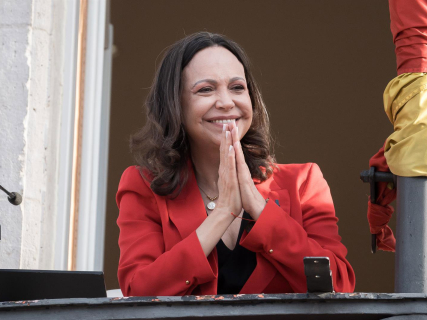

The Venezuelan opposition leaders María Corina Machado and Edmundo González have expressed this Thursday their disappointment because the XXX Ibero-American Summit in Madrid has not been set up, in their view, as a forum in which freedom and democracy are clearly and forcefully promoted. They point out that, given the participation of official delegations from Venezuela, Cuba, and Nicaragua, they, like many citizens of those countries, do not feel represented.
In this regard, they have questioned that the possible achievements of the meeting and the challenges to be addressed "lack full meaning if freedom, democracy, and respect for fundamental rights are not assumed as a prior and necessary condition for cooperation".
Machado and González have warned that "renouncing the defense of such values means tolerating, in silence, the violation of the most basic rights of millions of Ibero-Americans" and have presented themselves as "legitimate representatives of the sovereign will of all Venezuelans".
Both have insisted on their rejection of the governments in the region that they consider authoritarian and have stated: "We condemn the regimes that oppress Venezuela, Cuba, and Nicaragua, and we call for making the Ibero-American Summit a space for unequivocal defense and promotion of freedom, democracy, and Human Rights in the twenty-two countries that make up our regional Community".
Alongside this criticism, they have again demanded the holding of new elections in Venezuela and have backed the roadmap put forward by the United States, according to which, once the new authorities of the Supreme Court of Justice and the National Electoral Council are named at the end of this year, the population must be called to the polls again.
"We endorse this plan as a reasonable path to move toward the full overcoming of the constitutional order in Venezuela," the two opposition figures have emphasized, who see in that eventual electoral process "a horizon of hope for the whole country".
Likewise, they have stressed to the other countries in the region that "before the region we maintain that neither Venezuela nor the continent will be truly free while the sister republics of Cuba and Nicaragua are not. We will not cease our efforts until all of Ibero-America lives together in full freedom".
Meanwhile, the Ibero-American Heads of State and Government have gathered this Thursday in Madrid on the occasion of the XXX Ibero-American Summit, from which a final declaration has emerged in which rejection is expressed of “coercion” and of violations of the United Nations Charter in the region. This point, however, has not been supported by Argentina, Colombia, Costa Rica and Paraguay, which have chosen not to sign it.
The conclusions document has been approved despite the fact that several countries have distanced themselves from certain sections, especially those related to political interference in the region, with some of the agreements reached and with the language used regarding gender equality.