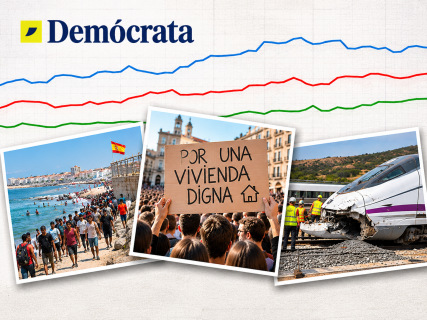
Democratic Party polls at Atresmedia: the evolution of the vote since June

The chain, week by week, reviews Demócrata's aggregator and shows how polls and voting intention have changed since June.

encuestas democrata atresmedia

encuestas democrata atresmedia

Add DEMÓCRATA to Google

Ask FREN

Published

Last updated

2 minutes

Most read

Elecciones 29N · Encuestas

La media de las encuestas

Media a 4 de noviembre de 2026 · 15 institutos

  • PP31,0 %
  • PSOE26,3 %
  • Vox19,5 %
  • Frente Amplio6,5 %
  • ERC2,5 %
  • Podemos2,2 %
  • SALF2,2 %
01020304050ene 2024jul 2024ene 2025jul 2025ene 2026jul 2026

Media del último estudio de cada instituto en 30 días y su evolución semanal desde el 23J. Partidos con al menos un 2 %.

Todas las encuestas

Elecciones generales del 29 de noviembre · Demócrata

The electoral polling aggregator of DEMÓCRATA is the focus of a report by Atresmedia on the evolution of voting intention ahead of the general elections of next 29 November. The network has used data from the tool to review the movements of the main parties since June and analyze how political events from the past few months have influenced them.

The report included the participation of Adrián Lardiez, Director of Parliamentary Information at DEMÓCRATA, who explained how to interpret the evolution of the polls and what differences exist between the punctual movements of a single survey and the trend reflected by the overall set of polling companies.

The aggregator makes it possible to bring together the estimates published by different polling firms and build "a common picture", Lardiez explained, who warned that changes are not always perceived immediately when all the polls are observed in aggregated form.

Ceuta and housing, among the events that have shaped the polls

The analysis begins in June, when the PP stood at around 32.4% of the vote estimate, compared with the PSOE’s 27.1%. Vox reached 17.3% and Sumar, later integrated into Frente Amplio, recorded 6.3%.

One of the first events that altered the projections was the Ceuta’s migration crisis from late July. During the week of 18 August, the PP reached 33.9% in the aggregate, while the PSOE fell to 26.1%. Vox held at 17.2% and the alternative left space dropped to 5.8%.

Lardiez has pointed out that the situation in Ceuta did have an impact on electoral estimates. However, he differentiated that movement from the subsequent evolution, during which the polls maintained a relatively stable trajectory.

The housing crisis and the protests in Puerta del Sol were another of the episodes captured in the chart. The encampment began in late September and coincided with the processing of two housing decrees that were rejected in Congress. Shortly afterward, Pedro Sánchez called early general elections.

The electoral call changes the evolution of the blocks

For Lardiez, the electoral advance marks a separation between two stages. Until the call, the estimates for the blocks had remained relatively stable; after, the aggregate began to reflect greater dynamism.

"The PSOE is on the rise from those," the director of Parliamentary Information said when describing the developments after the call. For its part, the PP had started a downward path, while Vox advanced in the estimates.

In the week of October 13, the PP stood at 31.7% of the vote estimate and the PSOE had closed the gap to 26.8%. Vox reached 18.6% and Frente Amplio was at 6.3%.

The analysis also addressed the possible effect of the railway tragedy of Urda, Toledo, on electoral behavior. Lardiez has avoided anticipating its consequences and has said that it will be necessary to observe how events are incorporated into the next polls, as well as how the parties evolve during the campaign.

The vote is also decided during the campaign

Beyond the vote estimate projections, Lardiez has focused on the role of election campaigns and at the moment when citizens finish deciding their ballot. "In my view, election campaigns increasingly decide the vote," he said.

The director has distinguished between prior identification with a political formation and the final decision of how to vote. He recalled that there are studies that place part of those decisions in the last days, and even on the day of the election itself.

DEMÓCRATA's election poll aggregator makes it possible to follow that combined evolution as new polls are incorporated, in an electoral process in which the movements of the last few weeks and the development of the campaign can still modify the estimates.

More key points, information and questions with FREN

AI-GENERATED CONTENT

What is the status of the processing of the housing decrees rejected by Congress?

The two housing decrees rejected by Congress on October 2, 2026, were repealed and their processing concluded. However, the Government approved two other texts on October 6 to recover those measures. Therefore, it is necessary to distinguish the original decrees, whose course ended, from the new ones, published in the BOE and whose validation corresponds to the Permanent Deputation.

The rejected decrees: processing closed

The rejection affected these two regulations, both dated September 29:

  • Royal Decree-Law 26/2026, which adopts urgent measures for the protection of the social function of housing and the expansion of affordable housing supply. Congress rejected it on October 2 and published the rejection on October 9. It has no pending amendment procedures, commission, or referral to the Senate. This is stated in its parliamentary tracking.
  • Royal Decree-Law 27/2026, which adopts urgent measures to strengthen the stability of contracts for habitual residence leases. It was also rejected on October 2, with the rejection published on October 9. Its processing is likewise concluded, according to the Congress of Deputies.

The rejection did not leave those texts paralyzed awaiting negotiation of modifications: it closed their course. They also did not automatically continue as bills. The offer to process them quickly to introduce corrections, reported by Demócrata on October 2, must be distinguished from what actually happened: both were repealed.

The new decrees: a different processing

The Council of Ministers approved two regulations again on October 6, published in the BOE on the 7th. Although they substantially recover the subjects of the rejected texts, they are new provisions, with their own numbering and course:

  • Royal Decree-Law 28/2026, of October 6, which adopts urgent measures to strengthen the stability of contracts for habitual residence leases. It is the new text related to rental stability. It can be consulted in the BOE of October 7.
  • Royal Decree-Law 29/2026, of October 6, which adopts urgent measures for the protection of the social function of housing and the expansion of affordable housing supply. It recovers the broader package of protection and housing supply. It is published in the same official bulletin.

The distinction matters: the decree on contractual stability went from number 27 to 28, while the package on social function and affordable supply went from 26 to 29. It is not about reopening the rejected files.

What parliamentary decision remains to be certified?

After the dissolution of the Cortes, it is up to the Permanent Deputation to decide its validation, that is, to vote whether to maintain the new decrees or repeal them. Demócrata explained this change of body in its information of October 6.

The latest information found about its schedule, from October 20, still placed that vote as pending inclusion on the agenda. This was reported by Demócrata that day. In the sources consulted, there is no record of a subsequent vote that allows stating that the new texts have been validated or repealed.

In conclusion, the originals are definitively closed; the measures were recovered through two new decrees, but the outcome of their validation is not recorded here. Their approval by the Government and publication in the BOE should not be confused with subsequent parliamentary endorsement.

What are the main responsibilities of the Parliamentary Information Director at DEMÓCRATA?

The Parliamentary Information Director of Demócrata has as their main task to lead the journalistic coverage of parliamentary activity and help explain how laws are made and political decisions are taken. The position is held by Adrián Lardiez, identified as such in the presentation of the editorial structure of the medium published on February 18, 2026. No closed public catalog of attributions has been found: it is advisable to distinguish between the responsibilities derived from that structure and the documented specific activities.

1. Leading parliamentary coverage

Their central scope is information about the activity of the chambers and the work of parliamentary groups. In editorial terms, this means guiding and coordinating specialized coverage, paying attention to the content of initiatives, their course, and their political relevance. This interpretation corresponds to the position of the role within the editorial management, although the public presentation does not detail their powers over teams, assignments, or content approval. The main reference is the announcement of the new editorial structure.

2. Explaining legislation and negotiations

Another substantive responsibility is turning parliamentary information into understandable content: what an initiative proposes, what changes it undergoes, and what consequences agreements or disagreements between groups have. The editorial approach announced by Demócrata combines anticipation, analysis, and depth. It is not only about telling the final result but also explaining the process leading to it and connecting legislative activity with public policies.

There is a specific precedent of this explanatory aspect: Lardiez participated in the writing and preparation of information for A Mano Alzada, a project presented in December 2024 to disclose the votes of groups in commissions. That participation demonstrates experience in legislative monitoring but does not prove that he currently directs the project.

3. Coordinating with other editorial areas

Parliamentary information is integrated into an editorial office that has differentiated heads of Politics and Territorial, Current Affairs, and Economic Information, as well as a Brussels correspondent. Therefore, their function should be understood as a specialized direction, connected with those areas, and not as an exclusive responsibility over all political, economic, regional, or European information. The joint coverage seeks to relate legislation, government action, and sectoral effects.

4. Providing analysis and dissemination outside the newspaper

Their documented public activity also includes explaining Demócrata's content and informational tools in other media. For example, they appeared on Atresmedia to explain how to interpret the newspaper's poll aggregator. Likewise, they have presented analyses based on Digital Power. These are examples of dissemination and editorial presence, not proof that the position has been assigned a general spokesperson role for the medium.

5. Moderating debates on public policies

Lardiez has also moderated specialized meetings, such as the one organized by AMETIC and Demócrata on the future Digital Networks Law. At the meeting on cooperation between China and Spain, he moderated the panel and presented the conclusions. These actions show a dimension of the position linked to leading conversations among public officials, companies, and organizations.

In summary, their main responsibilities are specialized journalistic direction, legislative monitoring, analysis, and dissemination. It is an editorial position at the newspaper, not a post of the Congress or Senate. The sources do not allow attributing business, commercial, or general management powers of Demócrata to them.

What legal requirements must a polling company meet to publish electoral surveys in Spain?

A polling company must primarily comply with the obligations of transparency, truthfulness, and publication schedule established in Article 69 of the Organic Law of the General Electoral Regime (LOREG). This special regime applies from the call until the holding of elections and obliges both the entity conducting the survey and the medium publishing it.

1. Is a special authorization needed?

Article 69 of the LOREG does not establish a polling license, special registration, or prior authorization from the Central Electoral Board (JEC) for a private company to publish surveys. Its control focuses on compliance with legal obligations, not on prior approval of each survey. This does not replace the company's general obligations nor those related to personal data protection.

2. Information that must accompany the publication

During the electoral period, the company must accompany each survey, under its responsibility, with the following specifications. The law requires that every publication of the survey also includes them:

  • Identification: name and address of who conducted the survey and who commissioned it. The provision requires identifying the contractor; it does not impose a separate obligation to identify any possible funder.
  • Technical characteristics: sampling system, sample size, margin of error, level of representativeness, procedure for selecting surveyed persons, and date of fieldwork.
  • Questionnaire and non-response: full text of the questions asked and number of people who did not answer each one.

Therefore, it is not enough to publish voting intention percentages and the name of the consultancy. Article 69 also does not set a universal minimum sample size: it requires explaining the study's characteristics.

3. Truthfulness and electoral supervision

The JEC must ensure that published surveys do not contain forgeries, concealments, or deliberate modifications. It may also request complementary technical information from those who conducted them to verify them. This power has a limit: it cannot extend to data content on matters that, according to current legislation, are proprietary to the company or its client.

4. Prohibition of publication before voting

Article 69.7 states: "During the five days prior to the voting day, the publication, dissemination, or reproduction of electoral surveys by any media is prohibited." The restriction affects publishing, disseminating, or reproducing results; it does not by itself establish a prohibition on conducting interviews for internal use.

Additionally, Instruction 3/2019 applied this prohibition to surveys of other electoral processes called in the event of concurrent elections it regulated.

5. Corrections and consequences of non-compliance

Media that disseminate surveys violating the law must publish corrections required by the JEC within three days, indicating their origin and reason, in the same spaces or pages. If their periodicity prevents this, the director must have them published at their expense in another medium of the same area and similar reach.

Article 145 contemplates, for those who commit the offense of violating the regulations on electoral surveys, imprisonment from three months to one year, a fine of twelve to twenty-four months, and professional disqualification from one to three years. Specific responsibility requires assessing the conduct; not every irregularity automatically results in a conviction.

6. Difference regarding public bodies

Instruction 1/2024 obliges public bodies to communicate certain studies to the JEC at least 48 hours before the fieldwork and to provide results to requesting candidacies. This is not a general prior communication obligation for all private companies.

Play

Test your knowledge with FREN!

How much do you know about this topic? Answer the following 3 questions.

What percentage of vote estimation did the Popular Party have in June according to the DEMÓCRATA aggregator?

Question 1 of 3

What event marked one of the first significant changes in electoral projections during the analyzed period?

Question 2 of 3

According to Adrián Lardiez, what aspect is increasingly decisive in the final voting decision of citizens?

Question 3 of 3