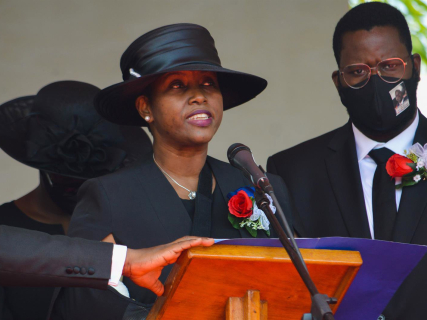

Martine Moise, widow of former Haitian president Jovenel Moise, assassinated in July 2021, has formalized her registration to run in the first presidential elections that Haiti will hold in more than ten years, according to the registration platform of the Provisional Electoral Council.
For the moment, Moise has not made any public statements about her bid for the Presidency in the elections scheduled for July 2027. Her name appears among the 33 registered candidacies, a list that also includes former presidents Michel Martelly and Jocelerme Privert, as well as former Prime Minister Claude Joseph.
The widow of the head of state was injured during the assassination of her husband—who led the country between 2017 and 2021—carried out by Colombian nationals posing as agents of the Drug Enforcement Administration (DEA, for its acronym in English) to break into his residence.
Moise’s killing further exacerbated the already delicate political and security situation in the country, which has been governed since then by successive transitional executives who have not managed to stop the advance of powerful armed gangs and gangs, some of which have come to control large areas of the capital, Port-au-Prince.
In this context, the Gang Suppression Force (GSF, for its acronym in English) has reported in the past few hours the death of five alleged gang members in an operation carried out in Carnifice, in the Artibonite department (west), where "the gangs had turned a church and a school into strongholds."
"The GSF troops cleared and secured these places and their surroundings, restoring access along a crucial corridor," the force said in a statement released on social media, before detailing that in the area barricades have also been removed and several weapons have been seized.
It has also reiterated that its units continue working to "restore freedom of movement, reopen access to public institutions, and reestablish the presence of the State in communities that have suffered years under the control of the gangs," with no, for now, identities of the deceased or the armed group to which they would belong having been made public.