
The Democratic Party of the United States has confirmed Troy Jackson as its candidate for the Senate from Maine for the legislative elections in November, after the hard setback that the party faced with the resignation, two weeks ago, of Graham Platner, accused of rape.
At an extraordinary convention organized urgently in Bangor, around 600 Democratic delegates gave their support to Jackson, a fifth-generation lumberjack and former president of the state Senate. The meeting had a clear objective: to try to unseat Republican Senator Susan Collins in November, who has held her seat for nearly three decades in a territory that rejected Donald Trump in the 2024 presidential elections and where no Republican candidate for the White House has won in the last 40 years.
The Democrats arrive at the so-called 'midterms', the midterm elections, with good prospects to regain the House of Representatives, but the outlook in the Senate is much tighter: the party must retain all its current seats and add four more to take control.
Jackson takes on the candidacy with a speech inspired by the social-democratic progressivism that initially propelled Platner, although his trajectory points to a somewhat more moderate profile. In his early steps in politics, Jackson aligned with the traditional Republican and anti-abortion wing, but in this campaign he has shifted to support the federal enshrinement of the right to voluntary termination of pregnancy.
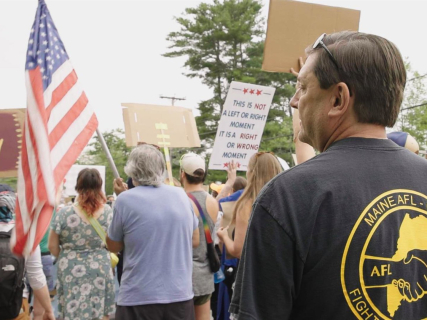
In his first speech after the nomination, Jackson appealed for the unity of the electorate against Collins and called for setting aside ideological trenches to prioritize class consciousness. "We are neither left nor right. We are the bottom and we are rising," he proclaimed. "And when the people in power refuse to listen, we must organize and remain united in solidarity. That is how we will face Susan Collins," he added.
At 58 years old, Jackson advocates for a program with clear progressive elements, including Medicare for all and a tax increase on large fortunes. He has the support of Our Revolution, the liberal group linked to Vermont Senator Bernie Sanders and California Representative Ro Khanna. The first polls, such as the one from the University of New Hampshire released this week, give him 49% of the voting intention compared to Collins' 46%, with 3% undecided.
Despite this, Collins maintains a position of strength in the economic field. Until July 20, three external Republican organizations had invested 44.9 million dollars in her support, according to data from AdImpact, and the conservative committees had already committed 59.3 million dollars in advertising space in Maine until the day of the vote.