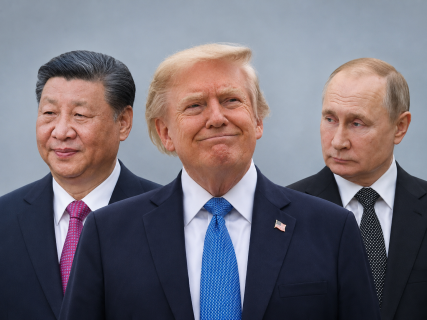

For the umpteenth time, Donald Trump talks about the end of the war in Ukraine. Although this time, unlike the previous ones, he does not take it for granted. On this occasion, the U.S. president wants to include this point in his talks with Vladímir Putin and Xi Jinping. The Republican leader has assured that he will address the conflict with his Russian and Chinese counterparts during his stay in Shenzhen, where the three leaders are taking part in a trilateral summit on the sidelines of the APEC leaders’ meeting.
Before the three-way meeting, Trump and Putin have held a separate meeting of about 40 minutes at the Kylin Villa complex, although the conversation was not initially on the agenda. Upon receiving the Russian leader, Trump expressed his confidence in the outcome: "We’ve had a great relationship for many years, we’ve known each other for a long time and I think that many wonderful things can come out of this, or at least start. But I think that they will come out."
The White House had initially pointed out that the three-way meeting would focus on reducing nuclear arsenals and that it did not expect to address the Russia-Ukraine conflict in that format. Trump, however, said before traveling to China his intention to talk about the war with Putin and Xi.
The meeting takes place after the resumption of the negotiations between Russia and Ukraine in Abu Dhabi, with U.S. mediation, although without substantial progress to end the war. Moscow and Washington maintain contacts regarding the American proposals for a way out of the conflict, while Kiev calls for being able to take part in any negotiation that affects its future.
Nuclear disarmament, the other central issue of the meeting
The Shenzhen summit also addresses control of nuclear weapons. Washington has placed the reduction of arsenals among its priorities. Beijing, for its part, demands that the United States and Russia reduce their arsenals first—considerably larger than China’s—before raising a negotiation that includes the three powers.
The meeting is held at a time of international tensions and uncertainty about the future of relations among the three powers. The war in Ukraine, the conflict in Iran, nuclear control and differences on trade form part of a scenario in which each leader arrives with their own priorities.