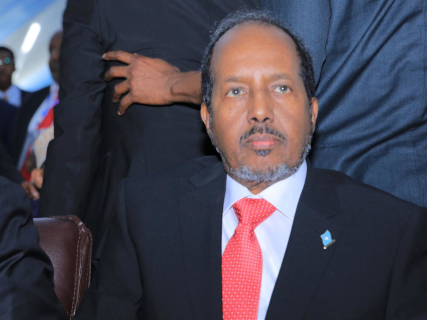

United Nations, the European Union (EU) and about fifteen countries, including Spain, have launched a joint appeal this Monday for the resumption "as soon as possible" of political dialogue in Somalia and for an agreement on an electoral calendar, in a context of growing tension after the expiration of the mandate of President Hasán Sheij Mohamud, who decided to extend it, alleging the need to avoid a power vacuum in the country.
In the statement, the signatories emphasize: "We call on all parties to resume dialogue as soon as possible and to quickly reach a consensus on an electoral calendar, in the interest of the Somali people," and also express "their concern about the current situation in Somalia."
The text further emphasizes that "the international community is prepared to assist in Somali-led talks, should it be requested" and concludes with a direct message to the Somali political class: "At this delicate moment, we call on all Somali leaders to prioritize the national interest and to avoid actions that could lead to an increase in tensions."
Among the signatories are Spain, Austria, Belgium, Finland, France, Germany, Ireland, Italy, the Netherlands, Norway, Poland, Portugal, Sweden, Switzerland, the United Kingdom, as well as the EU delegation in Somalia and the UN Transitional Assistance Mission in Somalia (UNTMIS), which are coordinating their support for this call for de-escalation.
The Somali president announced the extension of his mandate until May 15, 2027, after the failure of negotiations between the Government and the opposition to resolve the political crisis, a decision rejected by his adversaries, who maintain that he should have left office on May 15, even if elections had not been held.
Attempts to organize elections before the head of state's mandate concluded have been frustrated by disagreements over constitutional reforms aimed at implementing direct elections with universal suffrage, a process that has led to clashes with the authorities of the semi-autonomous regions of Puntland and Jubaland.
In parallel, in the Southwest state, clashes have been registered in recent days between the Army and militias led by former regional president Hasan Mohamed Laftagareen, after the authorities terminated his mandate and loyal forces advanced towards Baidoa, all framed within the current electoral disputes.
The Somali Parliament approved a new electoral law in November 2024 that reintroduces universal suffrage under the principle of "one person, one vote," following a prior agreement between political leaders to establish a framework that would allow the reinstatement of this direct election model.
Currently, Somalia maintains an indirect system in which clans and regional parliaments designate their representatives in the federal Parliament, which is in turn responsible for electing the president. The current head of state was chosen in May 2022 through this mechanism, which he pledged to reform to make way for universal suffrage.
However, different opposition sectors have rejected the Government's plans to implement this suffrage system —suspended in 1969, when Siad Barre took power through a coup d'état—, which has fueled strong political tensions and raised fears that the country could slide into a large-scale conflict.