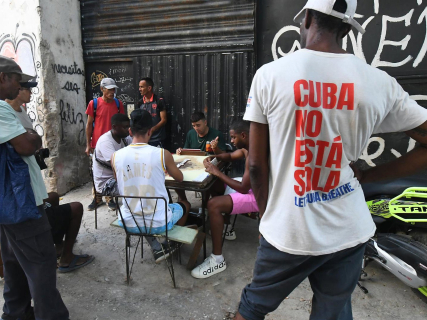

United Nations Human Rights experts have condemned this Thursday the new packages of sanctions from the United States against Cuba, considering that they constitute an attempt to "alter the constitutional order of a sovereign State" through "threats and coercion." At the same time, they have appealed to civil society and the international community to act "quickly" to prevent "a silent Gaza" from being unleashed on the island.
The signatory rapporteurs have warned that "the humanitarian consequences are already turning into a full-blown crisis that threatens the rights to health, life, food, and development," referring to the impact of the measures adopted from Washington against Havana.
Among the signatories are the independent expert on the promotion of a democratic and equitable international order, George Katrougalos; the special rapporteur on the negative impacts of unilateral coercive measures on the enjoyment of Human Rights, Zaina Jallad; the special rapporteur on the right to food, Sofía Monsalve Suárez; the working group on peasants and other people working in rural areas, and the special rapporteur on the right to development, Surya Deva.
These special rapporteurs, independent experts, and working groups are considered "independent human rights experts," appointed by the UN Human Rights Council, and therefore carry out their mandate in a personal capacity and without depending on any government or organization.
Food as a "tool of political pressure"
According to the statement, the unilateral sanctions from the United States, tightened since June 2026, aim to "affect key sectors" of the Cuban economy, including energy companies. They denounce that this has led to greater obstacles for the purchase of fuel "even for humanitarian reasons," in a context of "acute" fuel shortages and increasingly frequent "large-scale" blackouts.
As an example, they point out that uncollected garbage "is piling up in parts of Havana," which "aggravates the risk of disease spread."
The experts add that the energy sector, transportation, irrigation, and essential services "are failing simultaneously," which disproportionately affects women, children, the elderly, and other vulnerable groups, including peasants and rural workers.
The UN agencies in Cuba have also warned of "growing risks of food insecurity and shortages of medicines and basic necessities," in a scenario of repeated collapses of the national electrical grid and prolonged outages that "interrupt health services and cause a critical shortage of medicines and capacity for cancer treatment."
In this context, experts have emphasized that "food should never be used as a tool of political pressure. Measures that deliberately deprive a population of the means to survive violate the most basic guarantees of the right to life and undermine the core of human dignity."
An alleged "threat" to the US "without evidence"
The rapporteurs have also referred to a report released at the end of July by the United States Department of State, titled 'Cuba: the capital of 21st-century communism,' in which the Caribbean country is presented as a "singular threat to US national security."
The document states that "confusing Cuba's poverty with its harmlessness is a complete misinterpretation of the threat. Its material weakness was never the measure of its danger. Its power has always been ideological, subversive, and parasitic, and has proven to be extraordinarily durable, surviving the Soviet empire that helped to build it and grafting itself onto every new enemy of the United States that has emerged since then," according to the text consulted by Europa Press.
Furthermore, the report promoted by Washington describes Cuba as an enclave that "acts as the connective tissue of a broader anti-American coalition, a scenario in which the ambitions of Moscow, Beijing, and Tehran converge with the radical movements that operate within" its "own borders."
In the face of these claims, independent UN experts emphasize the absence of "concrete" evidence that Cuba "supports terrorism or subversive activities." At the same time, they stress that the "illegal unilateral coercive measures" of the United States against the island "contravene Article 2 of the UN Charter and are part of a broader regime change strategy that encompasses the decades-long embargo against the island."
For this reason, they have demanded from Washington to "cease all threats and hostile acts against the sovereignty of Cuba and revoke all measures that it has imposed on the country and that are contrary to International Law," and they have asked the Security Council and the General Assembly to "urgently address these threats as a matter of international peace and security."
This same Thursday, the United States Department of State, led by Marco Rubio, one of the main critics of the Havana Executive, has announced new sanctions against five companies and eight individuals linked to the Cuban military industry, including the Chief of the Army General Staff, Roberto Legra, and the Minister of Defense, Álvaro López.
The decision is announced in a week marked by partial cuts and general blackouts in the island's electrical system, a situation that the Cuban Foreign Minister, Bruno Rodríguez, has described as "a direct consequence of the genocidal blockade of the United States against Cuba."