
In diplomacy, the word “reliable” is worth more than a joint statement and less than a phone call. A reliable partner does not have to share all its secrets, but it must warn when tens of thousands of people are moving through its territory towards the neighbor's border. If it does not, it remains to be determined whether it could not, did not want to, or somehow participated in the maneuver. All three possibilities are serious. None fits with the reassuring portrait that the Spanish Government continues to paint of Morocco.
Fernando Grande-Marlaska has defined the Alaouite kingdom as an “absolutely reliable” partner, has denied that it constitutes a threat, and has praised its cooperation in receiving those who were returned. But accepting returns after the border has been overwhelmed does not equate to preventing the overflow from occurring. Morocco collaborated when the crisis was already inside Ceuta; the unknown is what it did beforehand.
The governmental version rests on a comfortable mix of mafias, social networks, and jurisprudence. According to this account, an interpretation of the ruling of the Supreme Court spread like wildfire and caused an impossible-to-calculate call effect. But the more the Executive insists that the call went viral, the harder it is to explain that no one detected it. Social networks are public when they serve to justify an avalanche and mysteriously invisible when they should serve to prevent it. And Spain, by the way, has various services dedicated professionally - precisely - to scrutinizing them.
It also does not seem that the mobilization occurred in the clandestinity of a night. The published information describes trains coming from Casablanca loaded with young people traveling north with swimsuits, flip-flops, and even fins; they talk about concentrations known for days, about messages spread in media and networks, and about movements towards Castillejos from different points in Morocco. It was not a meeting of conspirators in a basement, but a human current advancing in plain sight of everyone.
Here begins the diplomatic problem that José Manuel Albares must explain. Morocco has a police, administrative, and intelligence apparatus sufficiently penetrating to know what happens in its stations, roads, and border cities. And even beyond. If Rabat knew about the accumulation and did not warn, it failed the basic duty of loyalty among neighbors. If it did warn, the Spanish Government is hiding or poorly managing that information. And if it really knew nothing, then Spain would have entrusted the protection of its southern border to a partner incapable of detecting the movement of tens of thousands of people across its own territory, and it would be confirmed that in our country, few things that should work, work.
The Foreign Minister cannot take refuge in the usual liturgy of “excellent relations.” Spanish diplomacy has been presenting each meeting with Morocco for years as the beginning of a new historical stage. The traditional position on the Western Sahara was modified; there was talk of a roadmap, mutual trust, concertation, and absence of unilateral actions. The practical result was supposed to be a more predictable relationship. However, commercial customs have suffered closures and delays, border crises are repeating, and cooperation seems to depend on the political temperature of Rabat.
The experience of 2021 had already demonstrated that migration can be used as a lever of pressure. Then, more than 10,000 people entered Ceuta amid Moroccan passivity, in the midst of the crisis over the reception in Spain of the leader of the Polisario Front. Then came the Spanish turn on the Sahara. Those who do not want to see a causal relationship can at least recognize a disturbing political sequence. In 2026, the Government again asks that any Moroccan responsibility be ruled out in advance while pointing to judges, mafias, social networks, police, or Spanish intelligence services.
La Moncloa seems determined to shield Rabat even when it does not yet have a convincing explanation. Interior claims it did not receive any report that anticipated the avalanche. The Government Delegation maintains that no one had information until they saw people entering. Defense responds that border control belongs to Interior. Thus, the great tombola of responsibilities is organized: everyone looks at the neighboring ministry and no one looks to the other side of the border. And this despite the fact that we have resources, even in space.
The Moncloa seems determined to shield Rabat even when it still does not have a convincing explanation
Albares should answer a simple question: when did Morocco warn? Not when it accepted returns, nor when it restored controls, nor when it issued a statement attributing what happened to misinformation. When did it communicate to Spain that thousands of people were gathering near Ceuta? If there was no warning, a formal explanation must be demanded. If there was, it must be known which Spanish authority received it and what was done with it.
The issue goes beyond the bilateral relationship. Twenty-two European countries have warned of the danger of mass crossings, migratory instrumentalization, and hybrid threats. While a good part of Europe views the southern border as a common security problem, the Spanish Government continues to treat Morocco as if pronouncing its name could break a porcelain vase.
A reliable partner informs. A responsible Government asks. And a sovereign State does not only appreciate being helped to close the door after having allowed the crowd to enter. In Ceuta, the alert from the south failed and the reaction from the north failed. They did not inform from there, or they did not listen from here. Perhaps both. The only thing incompatible with the facts is to continue calling silence reliability. By the way, Spain has magnificent public servants who were not in "airplane mode".
about the author:
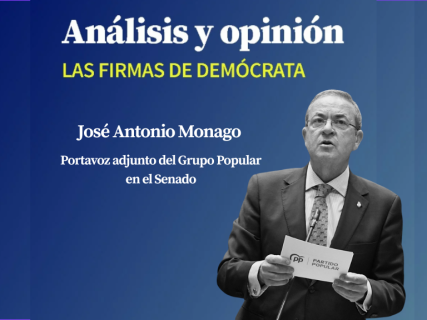
José A. Monago Terraza is the deputy spokesperson of the Popular Group in the Senate, a member of the Joint Commission of National Security, Defense, and spokesperson in the Foreign Affairs Commission.