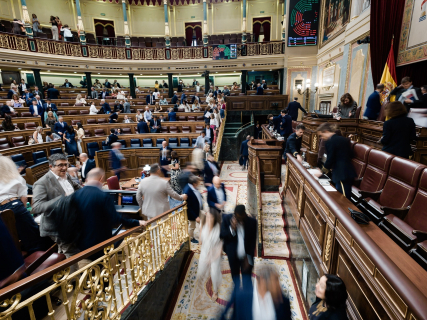

The Constitution states in its articles 68 and 69 that the elected deputies and senators serve a term of four years or until the day of the dissolution of the Chamber in the case of early elections. However, since the day the XV Legislature was constituted (August 17, 2023), there have been 84 resignations from the position of deputy or senator.
Last January, due to the end of the second ordinary session period of 2025 (September to December), DEMÓCRATA conducted a review in which it concluded that, compared to the first half of the legislature, where there was a significant reshuffle of seats, in this final stretch the resignations of the parliamentarians are very punctual.
Now, with the first session period of 2026 concluded, which spans from February to June, it is pertinent to update the figures in light of the start of the new political course, but the trend seems clear: low profile and resist. There is one year left until the elections if Pedro Sánchez keeps his word to exhaust the legislature, and the Cortes are the best showcase to repeat on the lists.
Since January, only five deputies and five senators have resigned from their positions.
Add and continue
In January, the Valencian Carlos Gil (PP) left his seat in Congress to join the Consell of Juanfran Pérez Llorca as the new regional secretary of Institutional Politics and Territorial Cohesion. His place in the Popular Group has since been occupied by Evarist Aznar.
In February, the Lower House experienced the closure of its particular plot with José Luis Ábalos. The former minister and former secretary general of the socialists resigned from his position after losing the appeal against his provisional imprisonment for the Koldo case and the PSOE was able to recover a deputy from Valencia. Since the scandal became known, Ábalos had clung to his seat, although his expulsion from the Socialist Group led him to perform his duties as a parliamentarian from the Mixed Group. Ana González, mayor of Llaurí (Ribera Baixa), who was next on the Valencia list, then made the leap to national politics.
In total, in the XV Legislature, there have been 60 departures, of which five have occurred in 2026. The breakdown by parliamentary groups is as follows:
- 14 from the PP (10.21 % of the parliamentary group)
- 36 from the PSOE (29.03 % of the parliamentary group)
- 1 from Vox (3% of the parliamentary group)
- 5 from Sumar (19.23 % of the parliamentary group)
- 1 from ERC (14.3 % of the parliamentary group)
- 1 from Junts (14.3 % of the parliamentary group)
- 1 from EH Bildu (16.6 % of the parliamentary group)
- 1 from the PNV(20% of the parliamentary group)
Electoral echoes
Although there is a year left until the end of the legislature, in recent months we have experienced a cascade of regional elections: Extremadura, Aragón, Castilla y León, and Andalucía. These events have also had their replicas in the Congress and in the Senate.
Starting with the Lower House, in January, the representative of the Chunta Aragonesista and deputy for Sumar Jorge Pueyo said goodbye to the Carrera de San Jerónimo to be the candidate for the presidency of Aragón. In his place entered Laura Vergara, who during the acquisition of her status as a deputy made her institutional priorities clear: “To expand rights, to improve road safety for the cycling community, and for the environment. Yes, I promise.”
Andalucía also had its echoes. María Jesús Montero, who was Minister of Finance and one of the few survivors of all Sánchez's governments, left the Council of Ministers before the elections and resigned from her position as a deputy in the days leading up to the constitution of the new Andalusian parliament. Montero, who took on the challenge of being the PSOE candidate for the Junta de Andalucía, said goodbye after eight years of her work as a national parliamentarian. The first deputy mayor of Osuna (Sevilla), Brígida Pachón, has occupied her place since June.
The departure of the popular José Ignacio Romaní has also been motivated by the elections in Andalucía. In his case, to debut as a parliamentarian for Cádiz in the regional chamber. In Congress, his departure has allowed the entry of Inmaculada Marín.
And in the Senate?
In the Senate, there have been five resignations since January 2026, but there are also up to 13 changes resulting from the renewals of the regional parliaments and, consequently, of the senators by regional designation. There are already 44 parliamentarians who have left Plaza Marina to face other professional exits since the XV Legislature began.
At the beginning of the year, Javier Remírez (PSOE) said goodbye to the Upper House to return to the regional government of Navarra as first vice president, councilor of Presidency and Equality, and spokesperson for the Navarre executive. He was replaced by Sergio Barasoain.
In April, Laureano León (PP) who had been a senator designated by the Assembly of Extremadura for just two months, was appointed counselor of Culture, Tourism, and Sports of the Junta de Extremadura. He was replaced by Ángel Pelayo Gordillo, a parliamentarian from Vox, as a counterpart to those of Santiago Abascal for their support in the investiture of Juanma Moreno.
Also due to an appointment in her territory, Lucía Yeves Leal (PP) resigned from her position, who just a week ago was elected territorial delegate of Health and Consumption of the Junta de Andalucía in Málaga. Yeves still does not have a formally registered substitute in the Senate, but the next on the electoral list of the 23J was Carmen Díaz.
Office Agreements
In July, Laura Castel said goodbye and Josep Maria Reniu was received back in the Senate. The movement is framed in the internal dynamics of ERC, which had already decided that both would split the mandate.
Also, the resignation of Juanjo Ferrer occurred to fulfill the coalition agreement Eivissa i Formentera al Senat, according to which the final stretch of the legislature should correspond to a representative from Formentera: Neus Massanet.
On the other hand, the renewal of four autonomous parliaments has caused a significant shuffle among the senators who are designated by the territorial chambers. Nevertheless, they have repeated under this designation Javier Arenas (PP), Susana Díaz (PSOE), Juan Espadas (PSOE) for Andalucía, and Gordillo (Vox) for Extremadura.
In Numbers
The Constitution establishes that each autonomous community designates one senator and another for each million inhabitants, so the number varies depending on the population.
These representatives are not directly elected in the general elections, but by the regional chambers, proportionally to their political composition: the Parliament of Andalucía designates nine senators, while the Cortes of Aragón elect two and the Assembly of Extremadura, another two.