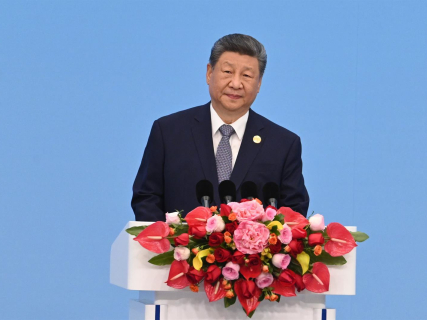

The President of China, Xi Jinping, said this Thursday that the Asia-Pacific community "sails on the same ship," calling for unity, greater cooperation and "free trade and open investment" in the region during his remarks to the plenary session of the Asia-Pacific Economic Cooperation Forum (APEC, for its acronym in English).
"We members of the Asia-Pacific family sail on the same ship," Xi said, who urged "betting on openness and integration" within a "cooperation framework." Along these lines, he called for "promoting free trade and open investment, eliminating obstacles that hinder the movement of factors of production and facilitating the economic cycle."
With regard to regional integration, he emphasized that "the Free Trade Area of Asia-Pacific (FTAAP, for its acronym in English) is a shared vision among APEC members" and asked to move forward with its implementation in order to achieve "a higher level of openness" and strengthen "political dialogue" around the FTAAP. He also backed initiatives that help "promote the convergence of regional trade agreements, improve trade and investment facilitation, thúc digitalization, and reduce barriers to trade and investment."
As for connectivity, Xi advocated for "strengthening the connectivity pillar" both on the physical level, "by improving infrastructure networks and promoting the development of customs and intelligent transportation systems," as well as on the regulatory level, "by promoting coordination of policies and regulations, deepening cooperation on cross-border payments, and ensuring the stability and smooth functioning of industrial and supply chains."
The head of state has also defended that "innovation constitutes the main engine of development" and has stated that the forum must "foster an entrepreneurial spirit (and) strengthen APEC's role as an incubator". Immediately after that, he highlighted that "the digital economy and artificial intelligence act as engines of growth based on innovation" and has considered it "necessary to reinforce the development of digital infrastructure, improve the regional governance of data and collaborative cooperation, in order to achieve cross-border data flows that are efficient, practical and secure". "We must create an open innovation ecosystem, promote the widespread application of artificial intelligence and drive industrial transformation and modernization toward a new model of development," he added.
In his speech, Xi also placed the focus on "the fight against cross-border corruption" and defended the "coordinated development of resources, the environment and the population," along with the "rational use and protection of natural resources". He added to these priorities "cooperation on ecological and low-carbon emissions matters," with the aim of "achieving sustainable economic growth".
To back up these commitments, the Chinese president reiterated that his country "will continue to firmly support cooperation" in the region and announced that "China will allocate 20 million dollars (€18.2 million) to finance practical cooperation within the framework of APEC". As he explained, with these funds the Government will establish in Shenzhen a Community Research Center of Asia-Pacific "intended to carry out studies and exchanges on policies, as well as to provide intellectual support". He has also committed to promote "collaboration institutions in areas such as digital technology, cross-border data flows, clean energy and the development of small and medium-sized enterprises (SMEs)".
Xi’s intervention, without direct references to nuclear weapons, has taken place at a summit where the presidents of the United States, Donald Trump, and of Russia, Vladimir Putin, have also spoken, on the eve of what is considered a historic meeting among the three leaders of the world’s main atomic powers. Control of these weapons is listed as a central matter of the meeting, which unfolds in the context of the expiration in February 2026 of the New START treaty between Washington and Moscow and the buildup of China’s nuclear arsenal.