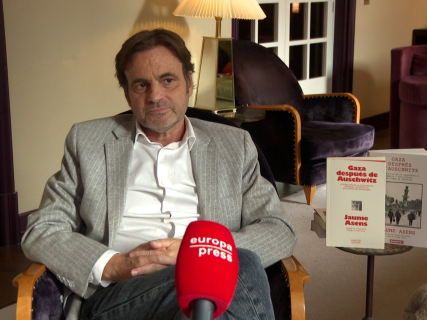










The deputy of the Comuns and Sumar in the European Parliament, Jaume Asens, argues that the Podemos euro-deputy, Irene Montero, must play a central role in the Broad Front of the left in the face of the upcoming general elections: "People would not understand, now that no one is vetoing Irene Montero, that she is not there."
In an interview with Europa Press on the occasion of the publication of her book 'Gaza after Auschwitz' (Finestres Ensayos in Spanish and Manifest in Catalan), she emphasized that no one conceives that political space without the leader of Podemos.
"She is a woman with a great political capital, I have a very good friendship with her because we are together in Brussels, and she has to be there. We are no longer in the era of vetoes," she stressed.
Towards a unique left candidacy
Less than two days before the deadline to register electoral coalitions expires, he pointed out that the different left-wing formations are "obligated to do everything possible" to articulate a unitary candidacy, which he considers an essential condition to reissue the progressive coalition government.
"It seems that there are some who have thrown in the towel and are already thinking about a government of PP and Vox and how to position themselves in that situation. We are not going to throw in the towel. The last time the agreement was made in the last 24 hours, against the clock," he recalled.
Asens denies that there are significant discrepancies between the programs of spaces like Podemos and the Comuns: "If there were, they would be insignificant," especially in the current context, and attributes the tensions to power struggles and egos that, in his opinion, demobilize and frustrate the left electorate.
ERC-Podemos pact and relationship with the Comuns
Regarding the agreement between Podemos and ERC in Catalonia, he assured that it has generated great disappointment, and that many feel "defrauded" by the republican spokesperson in Congress, Gabriel Rufián.
"I never believed that Rufián was serious," he said, pointing out that he knows him well enough not to be surprised by his move, although he admits that there is a large sector of dissatisfied voters with whom they must reconnect.
He lamented that ERC has even refused to sit down to talk with the Comuns about the Broad Front, although he thanked the republican leadership for the frankness shown and that they have not delayed the conversations: "Junqueras does not try to deceive us."
Asked about the possibility of an agreement with Podemos that would leave out some provinces, he assured that he does not know if such a scenario would be feasible, but he made it clear that the Frente Amplio will only sit down to negotiate as a block: "I know that attempts have been made to divide the parties of this block, but what we try to do is not divide, it is to multiply."
Colau, Montero, and the leadership of the space
In relation to the gesture of the former mayor of Barcelona, Ada Colau, to offer to step back in the leadership of the space if that facilitates a pact, Asens considers that it precisely demonstrates her suitability: "It shows that she is the best possible candidate we can have, precisely because she is willing not to be one," and highlights that she is the figure that generates the most consensus.
He has described it as difficult to understand that Montero and Colau could end up on separate lists: "We have been together in the past, we have governed together, we have been stopping evictions together, we have been in the flotillas, we come from the same places."
Criticism of the suspension of the Grandchildren's Law
Asens has also referred to the decision of the Supreme Court to provisionally suspend the Grandchildren's Law ahead of the November elections, which he has defined as a "legal aberration": "It is a will to alter the electoral roll," which he has linked to what he calls judicial coup by the right.
"A descendant of a Sephardic Jew from the 15th century can vote for the law that the PP made in 2015, and a grandson of a republican exile who fled from Francoism cannot do so despite being a law approved in Congress, because a judge has imposed his will above the popular will," he has denounced.
The amnesty and the return of Puigdemont
Regarding the Amnesty Law, he has pointed out that in the two years since its approval, the same pattern has been repeated: "We started (the legislature) with the Amnesty Law, we end with the Amnesty Law, with the same prominence of Junts in opening the way and now closing the way."
He has celebrated that the regulation makes it possible for the former president of the Generalitat and leader of Junts, Carles Puigdemont, to return, for which he has thanked him for not reappearing during the electoral campaign: "I think that is a gesture that honors him."
However, he has warned him that he returns to a Catalonia marked by protests over housing, but where evictions like those of Maricarmen will no longer occur "despite his position and his will for that not to happen."
Gaza, Europe and Historical Memory
About Gaza, the MEP has indicated that there are parallels between the situation in Palestine and what happened in Nazi Germany, although with nuances: "We cannot say that we did not know, nor can we even say that we did not participate," referring to the role of European institutions, which he considers a necessary collaborator, even a co-author.
He has pointed out that once again there is a dehumanized population, confined in ghettos, exterminated or expelled, which he interprets as a sign of the failure of the international order that emerged after World War II: "When we allow Gaza, then comes Greenland, comes Venezuela, comes Lebanon, etcetera."
At the same time, he has admitted that Gaza has served to awaken consciences, also in some executives: "They are small cracks, but they are getting bigger and bigger. We see it in Spain. The PSOE had a position that has been changing and has finally recognized Palestine."