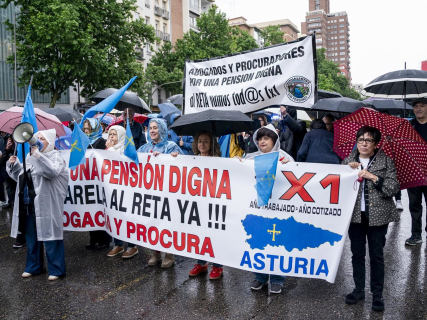

The legal reform that will allow mutualist members to transfer their accumulated economic rights in mutual societies to the Special Regime for Self-Employed Workers (RETA) faces this Thursday, July 23, its final review in the Congress of Deputies, a prerequisite for its entry into force.
In this session, the Lower House will debate and put to a vote the amendments incorporated by the Senate during the parliamentary processing of the bill. Once this procedure is completed, the text will be ready for its imminent publication in the Official State Gazette (BOE).
The central purpose of the regulation is to respond to the situation of thousands of professionals who, after years attached to an alternative mutuality system, have ended up in clearly unprotected scenarios, with very low pensions.
To this end, a pathway is structured that will allow mutualists to transfer to the RETA the years of activity contributed in the mutuality, in order to increase the final amount of their pension.
The retirees are excluded from the pathway
During its processing in the Senate, the text underwent significant modifications at the initiative of the PP, which has an absolute majority in the Upper House. The changes focused especially on the situation of mutualists who are already retired, the so-called retirees, after the 'popular' party had initially supported in Congress that they could benefit from the pathway.
Finally, in the Senate, Núñez Feijóo's party promoted through an amendment a legal modification to exclude retirees from this reform. Thus, the current wording establishes that the pathway will only apply to those who are not pensioners of any public regime or of the alternative mutuality itself, except in the case of those receiving a widow's pension.
Improvements in pensions and conversion coefficients
In the Upper House, the coefficients that will be used for the transfer of economic rights to the RETA have also been adjusted. In this way, an improvement of between 0.67 and 0.87 is expected over the minimum contribution base that would have corresponded in the self-employed regime.
These coefficients will not apply to professionals who are 52 years old or older as of December 31, 2026, who will be able to choose the 1x1 formula, which implies that each month contributed to the mutuality will be counted as a full month in the RETA. This same option will be available for those who started their professional activity before November 10, 1995.
The text also establishes that the Government will have a period of three months from the entry into force of the law to approve the regulation that details the pending aspects of the transition, including whether the CPI will be taken into account in the calculation of the economic contributions that will be transferred.
All adjustments introduced in the Senate must now be ratified or rejected by the Congress, which will be responsible for granting the final approval to the regulation before its publication in the BOE.