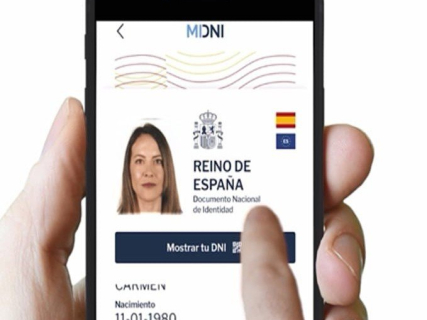

The Central Electoral Board (JEC) has agreed to accept again identification via the MiDNI application on the election day of November 29, after the Ministry of the Interior assured that in all polling stations there will be devices capable of reading QR codes.
In its first ruling, the JEC had given the go-ahead for the use of both the digital version of the DNI and the driver’s license to prove identity at the ballot boxes, by understanding that they include the voter’s photograph and that they have the same official validity as physical documents.
However, the leadership of the PP argued that it was not enough to show the digital DNI on the screen, but that the voter had to be required to open the application on their mobile, generate a unique QR code, and proceed with its verification. In the regional elections in Extremadura, Aragón and Castilla y León, the JEC maintained the possibility of using the DNI photo on the phone, but, under pressure from the PP, it ended up reversing and invalidating that criterion.
Condition for secure verification
From the Andalusian elections onward, the arbitration body established that the digital DNI could not be used to identify oneself until a “sufficiently secure” checking system was guaranteed. The responsibility for equipping polling stations with QR code readers lay with the Government, which until now had not managed to implement that technical rollout.
Ahead of the elections to the Cortes Generales on November 29, the Executive has decided to bet again on the use of the DNI application and instructed Correos that, in addition to distributing the usual election documentation, it should also distribute the previously contracted QR readers.
For this additional task, the Government has set compensation for Correos of 28.06 euros for each shipment and collection of the QR readers, according to a recent ministerial order that Europa Press has obtained access to.
With this situation, and on a proposal from the Directorate General of Interior Policy, the Central Electoral Board has approved this Thursday an agreement that lifts the suspension of the digital DNI “by confirming Interior that the polling stations will have a device with a camera and browser that has built in the QR verifier from the official MiDNI website”.
Use of MiDNI and exclusion of MiDGT
The system, however, will be slower than the check with the physical document, since the voter will have to generate a temporary QR code in the application and show it to the table, whose members will verify it using the corresponding reader.
The resolution will be sent to the local election boards so that they inform more than 60,000 polling stations distributed throughout the territory. Despite this change, the use of the MiDGT application to certify the driving licence at the time of voting continues to be prohibited.