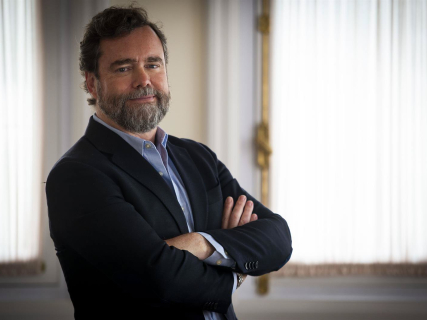

The president of the 'think tank' Atenea and former Vox leader, Iván Espinosa de los Monteros, argues that the shortage of middle-level executives in training will make it difficult for him to be able to take charge of certain ministries if he finally manages to put together a coalition government with the PP after the general elections of November 29.
Espinosa de los Monteros has spoken in these terms during the presentation of the report "Votar con criterio," prepared by Atenea, a voting guide for the next elections that seeks to offer a detailed analysis of the proposals of PP and Vox, the two political forces called upon to be an alternative to the Executive of Pedro Sánchez.
The document lists the opportunities and risks of supporting both parties and, in the case of Vox, highlights that it has "few managers." "Governing Spain requires filling hundreds of positions: ministries, state secretariats, general directorates, public companies" and "Vox does not have today a bench of experienced managers to do that," the think tank warns, adding that the party "has lost along the way a good part of its most prepared technical and parliamentary profiles."
For Espinosa de los Monteros, this lack of qualified personnel represents a "handicap" when it comes to taking on responsibilities in a possible joint cabinet, especially in more technical portfolios, such as the Economy or Finance. He recalls that "they require specialized people and if you don't have them and you take them on, you'll have certain difficulties" and that "it doesn't work with just one person," since those profiles must occupy "the top levels" of the ministries.
Atenea does not detect this problem in the PP, which it highlights as having "thousands of people with management experience" spread across the entire country, including regional councillors, mayors, senior officials, and technicians. The report also emphasizes that the popular party has governed Spain on two occasions, something that for Espinosa de los Monteros constitutes a "advantage."
Risks and strengths of Vox and PP
The analysis identifies other risks associated with voting for Vox: the scant precision of some of its proposals, which do not include an economic memo, a calendar, or details about how they fit within the legal framework; the strong concentration of internal power in "a small circle"; and the fact that some of its European allies, such as Viktor Orban, are "highly disputed."
Among Vox’s strong points, Atenea highlights its message clarity; its ability to place certain issues at the center of public debate; the pressure effect it has exerted on the PP, pushing it to harden its positions; and its steadfastness in the face of separatism.
In the case of the PP, the report draws attention to previously unfulfilled commitments, the corruption episodes it carries, and the risk that its bid for centrality results in a “renunciation” to defend with clarity the principles that “the electorate itself demands”.
Against this, its ability to articulate governing majorities is put forward, its credibility on economic matters —referring to the management of the 2012 crisis—, its weight in European institutions, and the fact that its ballot does not generate rejection among the moderate voter disenchanted with Pedro Sánchez, who would not consider supporting Vox. “Without that voter, you don’t win a general election in Spain,” the text underlines.
Programmatic comparison and electoral scenarios
The report includes a comparison between the measures set out in the PP and Vox programs and the proposals that Atenea has put forward in previous work on pensions or housing. The contrast extends to areas such as the Rule of Law and institutional quality; Ceuta and Melilla and their geopolitical context; immigration and borders; pensions; housing; the economy and taxation; employment and self-employment; and education.
During the presentation, Espinosa de los Monteros has admitted that the programs of both parties seem to him “abstract,” although he уточizes that “the voter” does not need that much “specificity”. From a more technical perspective, he misses “economic reports” or “numerical support” in some sections.
The work also incorporates projections based on surveys from about 20 institutions, with special attention to the impact of the electoral system in each province. In three participation hypotheses of high, medium, and low, the combined total of PP and Vox seats stands at a range of between 190 and 197 deputies, with different internal breakdowns. Atenea also develops its own estimate —without including data from the Centro de Investigaciones Sociológicas (CIS)— that raises the combined total to 198 seats.
One of the annexes examines the last contested seat in each province so that the reader can identify where the distribution between blocs is decided and can guide their vote with the objective of maximizing the options of the right. As an example, in A Coruña the last deputy is decided between BNG and PP.
Espinosa de los Monteros emphasizes that Atenea calls for support for the right-wing bloc with the objective of removing Sánchez from La Moncloa, which it considers "the priority", but avoids explicitly requesting the vote for PP or Vox. Yes, it clarifies that it does not advise supporting "parties that have emerged recently" within that ideological space. "Voting for PP and Vox is the best for Spain", it summarizes.
Governability and political future
The study dedicates a section to what could happen after the elections, focusing on the teams that would be in a position to carry out the programs. "It is not simply a change of government, taking the others out to put mine in", it warns.
In this context, the former Vox leader considers it "foreseeable" that a legislature supported by PP and Vox "will not reach term", referring to the difficulties that coalition executives typically face around the world. Stability will depend on the governing formula and on its capacity to implement the reforms, which, in his view, should be pushed forward as soon as possible.
Asked about the possibility that Vox opts for external support for the Executive, Espinosa de los Monteros considers that the result attributed to it by the polls, around 70 deputies, would make it "very difficult" to justify that option.
He has also assessed the campaign of both parties. In his view, he sees Feijóo and the PP in a good dynamic, while he describes as "a mistake" that Santiago Abascal stepped away from the already closed interview with the content creator Jordi Wild, whose audience largely matches the profile of the Vox voter.
Likewise, he points to the "assimilation" of Vox's discourse and recalls that in 2023 they talked about applying article 155 of the Constitution in Catalonia and that pensions were at risk, while in this campaign Abascal appeals to "Catalan identity" and guarantees that pensions will be paid "no matter what". This evolution also includes that the program for the 2N does not mention repealing the laws on abortion or euthanasia.
Finally, Espinosa de los Monteros leaves the door slightly open to returning to the first political line, considering that there is currently an “orphaned” ideological space. He reveals that surveys commissioned after the election advance gave him between eight and ten seats if he had decided to run with a new formation. However, he understands that the context was not the right one. In his view, at this appointment with the ballot boxes “people vote against something, not in favor of something.”