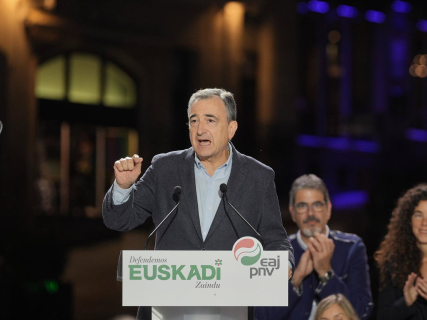

The president of the EBB of the PNV, Aitor Esteban, has expressed his fatigue at “the power struggles” that, in his view, PSOE and PP leaders, Pedro Sánchez and Alberto Núñez Feijóo, maintain, and has urged them to “think less about who is in charge in Madrid and give answers to citizens’ problems”.
Along these lines, he reproached the socialist candidate, saying that “governing does not consist of putting out one scandal after another; it consists of having a project, building agreements, and providing solutions.” “Sánchez has been more occupied with surviving than with governing,” he stressed.
Esteban launched these criticisms at a rally held in the Gipuzkoa town of Eibar, where he spoke together with the Lehendakari, Imanol Pradales, and the current spokesperson for the Basque Group and head of the list to the Congress for Gipuzkoa, Maribel Vaquero.
During his speech, he recalled that Feijóo also recently visited Eibar, although “he didn’t even have it planned to come to Gipuzkoa.” “Let’s not forget that the PP has renounced presenting a candidacy to the Senate for Gipuzkoa in order to support Vox,” he said.
After that, he emphasized that the popular formation “wants to remove the hearing aids in order to listen to Euskera in Congress; it does not support its official status in Europe and it opposes moving forward with our self-government,” and he described the PP as “a lost party.” “Feijóo came with the Madrid agenda under his arm. And from Euskadi, as in the face-to-face with Sánchez, not a page: zero,” he criticized.
Regarding Sánchez, he said that he must offer explanations because, as he pointed out, “this has been the Ábalos legislature in the Mixed Group, of Santos Cerdán in provisional prison, and of a Government that has not managed to approve new budgets.” “In the debate with Feijóo we heard many reproaches, many excuses, and few answers about the future,” he added.
The jeltzale leader reiterated that “governing does not consist of putting out one scandal after another; it consists of having a project, building agreements, and providing solutions.” “Sánchez has been more occupied with surviving than with governing,” he stressed, insisting on this idea.
In the final part of his speech, Aitor Esteban has insisted that “Euskadi risks its future on November 29 because, as he has said, we decide what Euskadi we want.” “We do not risk who governs Spain. We risk how Euskadi faces the State’s policy, who defends Euskadi, what voice we want to have in Madrid,” he has highlighted, to put the emphasis on the need to have “a strong Basque group, because it is the voice of Euskadi.” “That decision is ours, yours, nobody else’s,” he added.
He concluded by calling for autonomy in the vote: “Let no one tell us what we have to vote for, what we have to think, what we have to feel or what we have to be, let no one want to put us into blocks that are not ours. We are Euskadi and we are going to defend what we are, whoever governs, whoever it may be,” he concluded.
“Stone in the shoe”
For his part, Lehendakari Imanol Pradales has warned that “it suits PP and PSOE to have a weak PNV and a weak Euskadi in order to stop being the Basque stone in the Spanish shoe.” In this way, he has warned against those who appeal to the “useful vote” in the elections of November 29, since, as he has denounced, “neither the conservatives nor the socialists are putting forward concrete proposals to protect the well-being of Basque society.”
“They talk about a useful vote and they don’t have a single measure, a single concrete proposal for Euskadi. They only care about power in Madrid. Every day I ask: And what about Euskadi? What do they propose? What do they offer for our well-being? Nothing at all. They come here, they ask for the vote and they leave,” he has criticized.
In this context, he has addressed citizens directly: “I ask you, Basques: if things go badly from Madrid—and it has every appearance of that, judging by what we’ve seen in the polls—what is the best way to defend your interests? What is best to defend the Basque house? Is it better to have a strong PNV or a weak PNV? And if they could govern the same people as now, which is very but very unlikely, who is going to be more demanding in Madrid?” he has questioned.
Pradales also criticized “those of the lentil-plate, those who promise to stop the far right, those who ever since they step onto the carpet in Madrid give their support ‘free of charge et amore’ to every Spanish initiative from a Sánchez who continues to not pay the debts pending with Euskadi. Is that how you defend the Basque house?” he pointed out.
In his opinion, "neither anti-fascism nor anti-Sanchism pay mortgages or salaries to people" and "nor do anti-fascism nor anti-Sanchism create a single job position". "So fewer lessons, fewer placards, and fewer slogans," he has emphasized.
He has said that "this town is going to respond with its vote on the 29th. Because the women and men of this country know that the PNV is the only guarantee for Euskadi and that, even if we sometimes fail, we always defend the country".
Along the same lines, he has claimed that Jeltzale training is "a guarantee of a project for Euskadi, a commitment to industry and a productive economy to live well; and an ambition to keep growing as a country and in well-being".
Thus, he has defended that the PNV promotes "project and enthusiasm, Euskadi, and Basques; a commitment to industry and the productive economy. That is to say, sow in order to reap; ambition to keep growing as a country and in well-being". "That is our recipe, the Basque recipe, the recipe of a country that works and will continue to work, whatever happens," he has said.
"That is the useful vote and not the vote for Sánchez or Feijoo," the Lehendakari has underlined, stressing that, in the case of Euskadi, it is "vital" to have its own group in the Congress of Deputies to "defend Basque industry," citing as examples Talgo, the strengthening of the power of the electrical grid, or the push for decarbonisation, among others.
"Vote Euskadi"
Finally, Maribel Vaquero has urged to "vote Euskadi" next Sunday and has said that the PNV goes to Madrid "with the green shirt on to defend the interests of Euskadi, to strengthen self-government, and to build the future of those who live and work in this country".
In this sense, she has put concrete examples on the table, such as the increase in the new electricity planning approved this Friday that "will make it possible to maintain 70,000 jobs in Euskadi," the prevalence of Basque collective agreements –"an achievement that was not easy because we ran into the Ministry of Yolanda Díaz, a textbook centralist disguised as plurinational"–, or the revaluation of pensions that "the PNV has always supported".
"We have clear ideas. We know what Euskadi needs and we know that defending it requires working, negotiating, and not giving up. Because our commitment does not change depending on who governs in Madrid. Our compass always points to Euskadi," he has said.
In this way, the top of the list for Gipuzkoa has emphasized that "that is the difference". "We are not going to Madrid to engage in follow-the-leader, we are not going to Madrid to say yes to everything or to confront for the sake of confronting; we are going to defend what Euskadi needs, with responsibility, with firmness and with capacity for agreement," he has claimed.