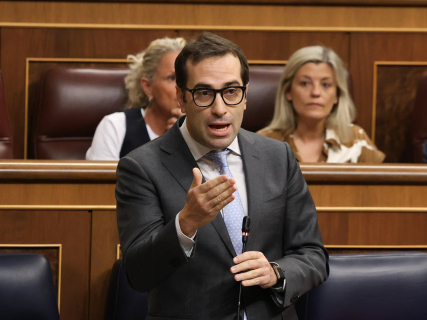

The first deputy vice president of the Government, Carlos Cuerpo, has called on citizens to carefully reflect on which of the “two models of country” they want to support in the general elections on November 29 next.
“It is extremely important that everyone is aware of the importance of going to vote; we have a lot at stake,” he said to the media before taking part in a campaign event held in Maó (Menorca).
The Economy minister as well has again contrasted the “two models of country” that, in his view, represent the different political blocs, and he has asked voters to consider which of them they would prefer to take charge of managing today’s and tomorrow’s challenges.
“Let’s think, for this decision, about what we want for the people who matter most to us and for ourselves in the areas that are most important for our lives,” he stressed. “It is extremely important that we think, that we ground the options that the different parties give us, and that we think about which is the model that comes closest to what we truly want,” he reiterated.
When referring to the “model” defended by the PSOE, Cuerpo put the emphasis on “reinforcement of the welfare state, the situation in the labor market, the evolution of wages and opportunities.”
In the same vein, during his speech at the rally he warned that in this appointment with the ballot boxes “rights, opportunities and freedoms” are also decided which, in his opinion, “have to do with the economy and with day-to-day life.”
“Many challenges lie ahead and we have to be aware of who we want to manage them. For example, artificial intelligence—how it affects our children and young people, or in the labor market. If we stop to think about who we want to manage the change, there’s no comparison,” he said.
The minister also explained that he turned to artificial intelligence tools to analyze whether in the Congress of Deputies there “has always been this negative atmosphere or whether it was a matter of recent years.”
“I asked the AI to download all the speeches and to analyze whether there were insults, by party and by members of parliament, and it shows an increase in the aggressiveness of the speeches, with insults and accusations, in some of those that we already know who they are,” he said.
In his view, all this “noise and aggressiveness” is because “when there is a discussion about the forms, people stop discussing the substance.”
"When I say that you have to compare models, this is the key. There is a model that proposes noise with the sole objective of getting there, because we do not know in many respects what they want to get there for, and another model that has clear what the path is, which we have already walked but that still remains to be walked," he has concluded.
Economy, housing, renewables and migration
The discussion, moderated by the president of the PSOE in Menorca, Pepe Mercadal, and in which the PSIB general secretary, Francina Armengol, has also taken part, has focused largely on economic issues.
Given the upturn in inflation linked to the wars in Ukraine and in Iran, Cuerpo has claimed the reaction of the Executive, aimed "at protecting."
"We have to protect citizens’ pockets and their disposable income," he has emphasized, highlighting the aid packages approved to support both the entire population and sectors such as industry and agriculture.
The head of Economy has also defended that these support measures should be accompanied by macroeconomic "growth." "We have heard these days that growth does not fill your stomach, but I do not agree," he has said.
"In the end, growth means wages and profits; we swallow them at home and businesses eat them when they manage to improve their results. We have to keep growing to make the pie bigger, and we have to do it responsibly," he added.
In analyzing the housing crisis, Cuerpo has pointed to three main factors: the lag between the increase in households and the pace of construction, the scarcity of funding to build affordable rental housing, and the desirability of pushing measures that "simplify life" in the application of the land law.
He has also referred to the rollout of renewable energy in Spain in recent years, until reaching "a 60% share in the energy mix." "It is an indisputable bet," he has defended, emphasizing the decrease in foreign dependence and in prices, as well as the increase in investments.
As for migration, the first vice president has argued that the arrival of foreign people "is a blessing for this country, no matter how you look at it," and has attributed part of the social rejection to mistaken perceptions.
"Migrants are making an essential contribution to growth. Per capita GDP is rising and this human capital is helping us to achieve that. We have to ensure that they integrate as well as possible into our country," he has defended.
In any case, he has argued for maintaining regulated migration flows and strengthening cooperation and development aid to prevent young people from countries such as Senegal or Mauritania "from finding themselves in the terrible situation of having to flee their country and risk their lives to reach the Canary Islands."
Lastly, he briefly referred to the pact among five European countries to open a migrant deportation center in Rwanda. "We cannot normalize taking people to a country that is not theirs without their consent," he added.