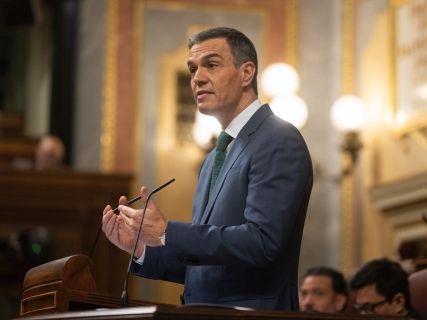

The Congress of Deputies took into consideration on June 23, by 175 votes in favor, 171 against, and one abstention, the proposal to reform the Rules of Procedure regarding control sessions of the Government presented by the People's Party Parliamentary Group. This is the first initiative that seeks to enshrine in the Rules of Procedure of the Lower House a quality obligation in the Executive's responses: after the concise formulation of each question, the Government must answer "the question" posed, "without evasions or digressions unrelated to the question being admissible".
The proposal also introduces a new paragraph 5 in article 188 of the Rules of Procedure, which obliges the Government to communicate, at least 48 hours before the deadline for submitting questions, which ministers will not be present at the next control session, accompanied by an individualized, reasoned, and accredited justification. Admissible causes would be limited to acts of unavoidable attendance or unforeseen and unpostponable matters related to the organization of the Government. The text, registered after a Plenary control session in which up to seven ministers announced their absence, is now being processed in the Rules of Procedure Committee, with the amendment period open. Its final approval will require an absolute majority, a demanding threshold given the tight result of the consideration stage.
An instrument with constitutional and regulatory basis
The so-called control sessions do not exist as an express constitutional category: they are the practical translation of the control function of the action of the Government that article 66.2 of the Constitution attributes to the Cortes Generales, along with the Executive's duty to submit to questions and interpellations (article 111) and the Chambers' power to request the presence of their members (article 110).
In the Congress, the regime is developed in Title IX of the Rules of Procedure (articles 180 to 192): interpellations, on matters of general policy, can lead to a motion voted by the Chamber; oral questions in Plenary, limited to five minutes per question, constitute the core of the weekly face-to-face with the Government, to which article 191 reserves a minimum of two hours in weeks with ordinary sessions. In the Senate, Title Six of its Rules of Procedure regulates questions (articles 160 to 169) and interpellations (170 to 173), the latter with longer turns, of fifteen minutes.
The Senate was ahead in 2025
The PP's initiative in Congress replicates a logic that its majority already applied in the Upper House. The reform of the Senate Regulations in June 2025 rewrote the block of questions to the Government to establish a detailed catalog of grounds for inadmissibility, rules for the distribution and substitution of questions for current affairs, the obligation for the Prime Minister to respond in the Plenary at least once a month during ordinary periods, and the reservation of a minimum of 60 minutes for questions in each plenary session.
Already in November 2023, another reform had strengthened the regime of appearances by the Prime Minister and ministers before the Senate Plenary. In Congress, however, recent reforms had been of lesser scope for control: the use of co-official languages (2023) and the review of inclusive language in July 2025, which formally rewrote articles 180 to 192 without altering times, quotas, or format.
The backing of the Constitutional Court
The strengthening of parliamentary control has a first-rate doctrinal endorsement. In judgment 124/2018, which resolved the conflict between constitutional bodies raised by Congress after the refusal of Mariano Rajoy's acting government to an urgent appearance by the Minister of Defense in 2016, the Constitutional Court declared that the Government—even in an acting capacity—is subject to the control of the Chamber provided for in article 66 of the Constitution, and annulled the acts of rejection for invasion of powers.
The rule established by the High Court—all government activity must be subject to parliamentary control—is today the legal backdrop of the debate: the condition of a government, full or acting, limits what the Executive can do, but does not exempt it from explaining it to Parliament.
It remains to be seen how the mandate to respond "without evasions or digressions" would be applied in practice: the text does not specify who would assess non-compliance or with what consequences, an indefiniteness that will predictably focus the debate on amendments in the coming months.