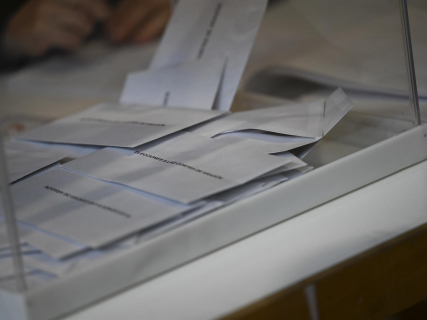

A total of 38.61 million Spanish citizens are called to the polls this Sunday, where they will constitute the seventeenth general elections of the current democratic stage. With their vote, voters will elect the 350 seats of the Congress and the 209 of the Senate among the 895 candidacies competing in these elections.
Key figures from the electoral roll
The legally registered population in Spain stands at 49,114,494 people, of whom 38,616,949 are registered on the electoral roll and, therefore, are called to vote.
More than 2.6 million voters abroad
Of that total of potential voters, 35,953,542 live in Spain and 2,663,407 live abroad. The communities with the highest number of Spaniards residing abroad are, in this order, Galicia (516,669 electors), Madrid (498,874), Catalonia (344,356) and Andalusia (313,373).
By sex, the roll of electors with residence in Spain records more than 1.2 million women than men: 18,598,253 women versus 17,360,458 men.
In these general elections, 1,615,034 young people will be able to exercise their right to vote for the first time, which represents 4.49% of the roll of residents in Spain. Most voters are concentrated in the age range between 40 and 64 years.
Andalusia is the community with the most electors, at 6.53 million, followed by Catalonia (5.58) and Madrid (5.03), which are also the ones that contribute the most deputies to the Congress. Next come the Valencian Community (3.72), Galicia (2.21) and Castile and León (1.91). Among the constituencies with the smallest rolls, without counting Ceuta and Melilla, La Rioja stands out (238,491 electors), Cantabria (473,210) and Navarre (500,413).
895 lists for 559 seats
On November 29, 559 seats will be allocated: 350 deputies corresponding to the 50 provinces plus Ceuta and Melilla (52 constituencies in total) and 209 senators distributed among 60 constituencies.
895 lists are competing in these elections, of which 534 seek representation in the Congress and 361 in the Senate. For the 350 seats of the lower house, 3,820 people will compete, which means an average of ten candidates per seat, while 802 candidates will vie for the 209 seats of the upper house.
Of the 3,820 candidates for the lower house, 1,881 are women (49.24%) and 1,939 are men (50.75%). In the case of the Senate, among the 802 candidates there are 447 men (55.73%) and 355 women (44.26%).
During the day, 22,493 schools or polling stations will open, spread across 8,132 municipalities, where 61.033 boards will be set up. Voters will be grouped into 36.761 electoral districts and will be able to deposit their ballot in about 210.000 ballot boxes.
Likewise, around 59.000 voting booths will be installed for those who prefer to place the ballot into the envelope in a reserved manner. The General Administration of the State has provided 86 million voting envelopes.
To this allocation, the envelopes and ballots that political parties print and send by mail to citizens’ homes must be added, the so-called "mailing".
Close to 23.000 mobile devices to transmit data
For the constitution and operation of the polling boards, 183.099 full members have been appointed (a chairperson and two members in each board) and 366.198 alternates. The full members will receive 75 euros net as a per diem and will have 930.000 instruction manuals published to ensure the proper performance of their duties.
In these elections, the General Administration of the State will distribute 22.716 mobile devices, which will be used to collect information from 56.654 polling boards and send it electronically to the Control Center, Centralization and Totalization for the Dissemination of Information.
The overall budget foreseen for organizing these elections amounts to 243.408.647,68 euros.
More than 100.000 personnel from the State Security Forces and Corps, made up of agents of the National Police, the Guardia Civil, autonomous and local police forces, as well as emergency services and Civil Protection, will ensure security throughout the day.
The cleanliness and guarantees of the electoral process will be supervised, as since the start of the electoral period, by the Central Electoral Board, based in the Congress of Deputies, together with 50 Provincial Electoral Boards and 303 District Electoral Boards.