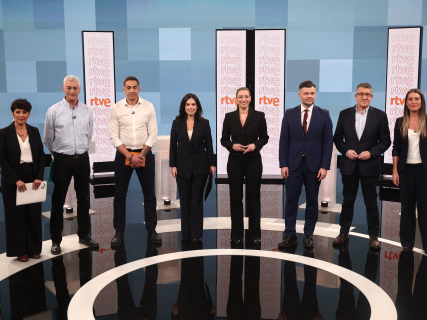









RTVE electoral debate, live | Latest update from the debate with the eight spokespersons for the elections on 29N

PP, PSOE, Vox, Frente Amplio, ERC, Junts, EH Bildu and PNV participate this Monday, starting at 22:00 hours, in the last big televised election debate before 29N. Follow the meeting live in DEMÓCRATA

EuropaPress 7938705 portavoz junts per catalunya congreso miriam nogueras posa llegada debate

EuropaPress 7938705 portavoz junts per catalunya congreso miriam nogueras posa llegada debate

Add DEMÓCRATA to Google

Ask FREN

Published

Last updated

2 minutes

Most read

Poder Digital · Carrera digital

La carrera digital de los candidatos

El Poder Digital de cada candidato a la Presidencia, de 0 a 100, desde junio · cambio en las últimas 4 semanas

30405060708090100julagoseptoctnovSánchez 93,8Montero 86,3Alvise 82,2Rufián 80,8Feijóo 79,1Abascal 78,4Colau 76,5Nogueras 58,0Valido 39,0
  1. 1Sánchez93,8▼ -0,2
  2. 2Montero86,3▼ -1,7
  3. 3Alvise82,2▼ -1,8
  4. 4Rufián80,8▼ -1,2
  5. 5Feijóo79,1▲ +0,1
  6. 6Abascal78,4▼ -4,6
  7. 7Colau76,5▲ +4,5
  8. 8Nogueras58,0▼ -5,0
  9. 9Valido39,0▼ -7,0

Pendientes de que su partido anuncie el candidato: Adelante, BNG, EH Bildu, EAJ-PNV y UPN.

Ver la carrera completa

Mide presencia e influencia en redes, no intención de voto.

Six days before the general elections of November 29, the spokespersons of eight political parties meet this Monday at RTVE to discuss housing, the economy, immigration and possible Government pacts. The meeting, moderated by journalist Xabier Fortes, will begin at 22:00 and is scheduled to last 90 minutes.

Ester Muñoz (PP), Patxi López (PSOE), Pepa Millán (Vox), Emilio Delgado (Frente Amplio), Gabriel Rufián (ERC), Míriam Nogueras (Junts), Oskar Matute (EH Bildu) and Maribel Vaquero (PNV) will participate. It will be the second major televised election debate of this week, after the face-to-face between Pedro Sánchez and Alberto Núñez Feijóo on Thursday.

The debate will be organized into three thematic blocks that will make it possible to learn the parties’ proposals on some of the main issues of the campaign. Housing, health care, pensions, rail safety and alliances for a future investiture will be among the issues to be discussed during the meeting.

Starting at 20:45, RTVE will offer special programming presented by Pepa Bueno, while the debate can be followed on La 1, Canal 24 Horas, Radio 5 and RTVE Play.

Watch the RTVE election debate live in DEMÓCRATA, with the main statements by the spokespersons, their proposals, references to the election programs, and the positions of each party on any possible agreements after 29N.

The topics of the RTVE election debate

Housing and the welfare state. The first block will last 28 minutes and will address the parties’ proposals to make it easier to access housing, rental and construction policies, health care, education and immigration. Part of the discussion may also be the migration situation in Ceuta.

Economy, employment and infrastructure. During another 28 minutes, the representatives will confront their positions on wages, pensions, taxation, energy and public investments. The train accidents in Adamuz and Urda and the management of the Spanish rail network will be among the current issues that could come up during the interventions.

Socio-political climate and pacts. The final block, 24 minutes, will be devoted to relations between the different formations and their possibilities for agreement after the elections. Spokespeople will be able to explain their red lines for a possible investiture and the conditions they would require in order to support a future Government.

Once the three blocks are concluded, each participant will have a golden minute to address voters directly.

What time does the debate start and where to watch the eight

The debate will begin at 22:00 on Monday, 23 November and is expected to end at around the 23:30 mark. It can be followed on La 1, Canal 24 Horas, Radio 5, RTVE Noticias and RTVE Play.

The special programme La gran decisión, presented by Pepa Bueno, will start at 20:45 with the preliminary analysis and will continue after the debate with the first assessments.

Who will take part in the debate

The event will bring together eight parliamentary spokespeople, three of whom already took part in the equivalent debate for the 2023 general elections: Patxi López, Gabriel Rufián and Oskar Matute.

This edition will also include the participation of Junts, which was not present in the 2023 spokespeople debate and will be represented tonight by Míriam Nogueras.

The meeting will take place as parties face the final days of a campaign marked by housing, the economic situation, railway accidents and parliamentary negotiations that could open from 29 November.

More key points, information and questions with FREN

AI-GENERATED CONTENT

What is the usual parliamentary procedure for government coalitions after general elections in Spain?

In Spain, government coalitions are political agreements between parties, not an independent parliamentary procedure. The decisive legal process is the investiture: the Congress grants its confidence to a person to preside over the Government. Therefore, it is important to distinguish the negotiation of support from the formal steps to obtain that confidence.

1. Constitution of the Congress

After the elections, the Congress holds its constitutive session on the date and time set in the royal decree of convocation. Initially, the session is chaired by an age-based board; then the Board of the Congress is elected, including who will serve as its President. Deputies take an oath or promise to uphold the Constitution, and the Chamber is declared constituted.

Parliamentary groups are formed within the following five working days. These steps organize the Congress, but electing its Presidency does not equate to investing the President of the Government. This distinction is made in articles 1 to 4 and 24 of the Congress Rules of Procedure.

2. Negotiation of support

Parties negotiate which candidacy they will support and under what conditions. It is important to separate the political agreement from the parliamentary act: confidence is granted to the candidate through a vote, not by signing a document between parties.

The program serves to explain what Government the candidacy intends to form and to obtain support. It does not replace the vote nor does it by itself produce the appointment. Constitutional jurisprudence emphasizes that confidence is placed in the candidate, although their program is essential for the debate.

3. Proposal of candidacy and convocation

The proposal procedure is framed in article 99 of the Constitution. Once the proposal of candidacy for the Presidency of the Government is received in Congress, the Presidency of the Chamber convenes the Plenary, according to article 170 of its Rules.

This is the step that transforms the political search for support into a formal parliamentary procedure. The decision on whether to grant confidence corresponds to the Congress.

4. Investiture debate

The session begins with the reading of the proposal. The candidate presents, without time limit, the political program of the Government they intend to form and requests the confidence of the Congress.

Then, representatives of the parliamentary groups who request it intervene, each for thirty minutes. The candidacy may respond and groups have reply turns. The Presidency sets the time for the vote. These rules are in article 171 of the Rules.

5. Majorities and second vote
  • First vote: an absolute majority is required, that is, the favorable vote of more than half of the members of Congress.
  • Second vote: if that majority is not reached, another vote is held forty-eight hours later. A simple majority suffices: more favorable votes than opposing.
  • Public vote: deputies are called individually and respond "yes," "no," or "abstention." It is not a secret ballot.
6. Appointment or new attempts

If the candidacy obtains confidence, the Presidency of the Congress communicates it to the King for the appointment. If it fails in both votes, successive proposals may be processed through the same procedure.

The limit is two months from the first investiture vote, not from the elections. If no candidacy obtains confidence within that period, the dissolution of the Cortes and the calling of elections proceed, according to article 172 of the Rules.

Meanwhile, the outgoing Government continues in office until the new Government takes office, as recalled by Judgment 124/2018. In summary: negotiating allows gathering support; investiture converts it into parliamentary confidence.

What are the functions and competencies of a parliamentary spokesperson in the Congress of Deputies?

In the Congress of Deputies, the parliamentary spokesperson of a group is the political figure who directs and represents the group in the ordinary activity of the Chamber. They are not just "the one who speaks the most," but the main intermediary between their group and the governing bodies of the Congress, and the one who organizes the daily parliamentary strategy.

1. Representation of the parliamentary group
  • Official representative before the Chamber's bodies: the spokesperson acts as the visible face of the group before the Presidency of the Congress, the Board, and the Board of Spokespersons.
  • Political spokesperson: sets and expresses the group's position in the most relevant debates (plenaries, key appearances, institutional declarations), unless they delegate the intervention to another deputy.
  • Signing and formal communications: usually one of the regular signatories in writings and requests on behalf of the group (requests for appearances, creation of investigative commissions, reconsiderations before the Board, etc.).
2. Participation in the Board of Spokespersons

The Board of Spokespersons is the key political body of the Chamber, where the organization of work is agreed upon. Each group is represented by its spokesperson (or by whomever they delegate), and several practical competencies are concentrated there:

  • Setting the agenda of the Plenary and, partly, of the committees: the Board discusses and, with the proportional weight of each group, agrees on which matters are debated and when (considerations, bills, interpellations, motions, appearances, etc.). The spokesperson defends the priority of their group's initiatives.
  • Distribution of speaking times: decides the allocation of times among groups for specific debates (for example, complex legislative debates, relevant appearances, or thematic debates). The spokesperson negotiates these times and the debate format.
  • Calendar and work pace: the Board deals with scheduling plenaries (session weeks, extraordinary plenaries, thematic sessions) and the spokesperson influences whether the calendar is more or less favorable to their group's interests.
  • Political agreements on functioning: many practical decisions (additional turns, relaxing rules, ordering votes, agreeing on single readings, etc.) are negotiated in the Board, and the spokesperson is the protagonist of those negotiations.
3. Direction of the group's parliamentary strategy
  • Coordination of legislative action: although each deputy or thematic area works on their texts, the spokesperson supervises the group's general line on projects and bills, key amendments, and especially sensitive votes.
  • Assignment of speakers: decides (usually together with the group's leadership) which deputy intervenes in each debate, who defends an initiative, who responds to the Government or another group, and with what tone.
  • Voting discipline: does not "legally" command the deputies' votes, but in practice is the one who transmits and enforces the position agreed by the group (or party), negotiates exceptions, and manages possible dissent.
  • Monitoring of processing: ensures the group is present in relevant committees, that questions, amendments, and political initiatives (PNL, bills, etc.) are registered on time in accordance with the general strategy.
4. Political interlocution function
  • Relationship with the Government: if the group supports or is part of the Government, the spokesperson coordinates the parliamentary position with Moncloa and ministries; if in opposition, is one of the main counterweights in parliamentary sessions.
  • Relationship with other groups: negotiates transactions, support, abstentions, and joint positions in legislative initiatives, motions, or institutional declarations.
  • Public projection: usually one of the main voices of the group before the media, explaining voting decisions, assessing the legislative agenda, and setting the political narrative to be conveyed.
5. Limits and legal basis
  • Internal designation: the spokesperson is chosen by each group according to its own internal rules (party statutes or group regulations). The Congress Rules recognize the figure of the spokesperson of each group but do not impose how they must be chosen.
  • Not a Chamber body by itself: legally, formal competencies lie with the Congress bodies (Board, Board of Spokespersons, Presidency, committees). The spokesperson exercises their functions "as" a representative of the group within those bodies and channels.
  • Political responsibility, not legal: their decisions are fundamentally political; they answer to their group and ultimately to the party leadership and electorate, rather than through specific legal mechanisms.

In summary, the parliamentary spokesperson in the Congress is the axis that articulates the political will of a group with the concrete functioning of the Chamber: they negotiate the agenda, organize the group's presence in debates, set the political line in the Plenary, and act as the main interlocutor with other forces and the Government.

How is a parliamentary group internally organized to support the spokesperson's work in the Congress? What differences exist between the spokesperson's role in the Plenary and that of the spokespersons in the various committees? Can a deputy be removed as spokesperson and what procedure is usually followed within the groups?

How many housing-related bills have been presented in the current legislature?

In the 15th Legislature, at least 15 housing-related bills have been identified in the Congress: 13 parliamentary initiatives and two popular legislative initiatives. This is a documented minimum, not a closed total: sources also mention other proposals on land and occupation that do not allow for an exhaustive count without duplications.

I interpret "current legislature" as the 15th, corresponding to the Chambers elected in 2023. These were dissolved in October 2026 by the royal decree of electoral convocation. Therefore, the count refers to initiatives presented during that legislature, not only those still being processed at its end.

The 15 identified initiatives

The criterion used includes housing, rent, mortgages, horizontal property, and taxation directly linked to residential use. The dates indicated are publication or conclusion dates when available, and should not be confused with the presentation date.

  • Prevention of speculation and guarantees of housing as a social good, 122/000102. Linked to the Mixed Group and Podemos; published May 31, 2024. Its presentation is recorded in the Demócrata analysis.
  • Temporary reduction of mortgage differential, 122/000042, from the Mixed Group. Aimed at vulnerable households with variable mortgages; expired in October 2026.
  • Temporary and room rentals, 122/000136, from Sumar, ERC, EH Bildu, and Mixed. Its urgent processing was agreed in June 2025; expired with the dissolution.
  • Investments for leasing in the Canary Islands, 122/000146, from the Socialist and Mixed groups. It was definitively approved and its approved text was published July 30, 2025.
  • Reform of urban leases, 122/000162, from Sumar. Published February 28, 2025; expired with the dissolution (initial text).
  • Modification of the Housing Law, 122/000178, from Sumar. Published April 2025; Congress rejected starting its processing in November that year.
  • Tenant's preferential purchase in joint sales, 122/000193, from Vox. Published May 30, 2025; expired in October 2026 (initial text).
  • Affordable housing rentals, 122/000196, from the Socialist Group. Expired with the dissolution.
  • Advertising and contracting of tourist apartments, 122/000214, from EH Bildu. Expired with the dissolution.
  • Modification of horizontal property, 122/000240, from the Popular Group. Published November 21, 2025; expired in October 2026 (initial text).
  • New modification of the Housing Law, 122/000251, from Sumar. Published January 30, 2026; its processing was rejected in September.
  • Reform of the IBI linked to the right to housing, 122/000278, from Sumar. Expired with the dissolution.
  • Residential use and fight against speculation in the Balearic Islands, 122/000289, from Sumar. Expired with the dissolution.
  • Option to purchase housing under surface rights, 120/000007, popular initiative. Admitted November 2023; expired October 2024.
  • Modification of real estate credit contracts, 120/000036, popular initiative. Expired October 2, 2026.
How to interpret the figure

Questions, motions, or non-legislative proposals are not counted because they are not legislative text proposals. Government projects are also not included. The same bill that passed through Congress and Senate is counted only once.

In conclusion: at least 13 parliamentary bills, or 15 including the two identified popular initiatives. The figure of four that appears in some compilations is incomplete compared to this list.

Play

Test your knowledge with FREN!

How much do you know about this topic? Answer the following 3 questions.

When will the general elections referred to in the debate be held?

Question 1 of 3

Who moderated the electoral debate broadcast by RTVE?

Question 2 of 3

What issue did Emilio Delgado (Broad Front) defend regarding the Spanish economy?

Question 3 of 3