
As every July 25, Santiago de Compostela has celebrated its big day and also that of Galicia, turned into a stage where the most playful acts, such as the parades of cabezudos through the streets, mix with the political aspect of the BNG demonstration and the institutional protocol, closely followed by neighbors and visitors.
In the Praza do Obradoiro, there was also anticipation this Saturday, although with somewhat less intensity than in other years, both before and after the traditional Offering to the Apostle in the Cathedral. From early on, the cheers of the military could be heard as the authorities took their places in the stand for the liturgical act.
Access to the Obradoiro was very restricted due to strong security measures —entry with a backpack was not allowed— so that even when the mass had already begun, it was complicated to reach the square. Around noon, long lines of pilgrims and tourists formed to enter the most emblematic site of the Galician capital, one of them advancing along the Rúa do Franco.
Among those who managed to enter the square or follow the start of the events from nearby areas, there were opinions for all tastes: from those who celebrated the military display early on to those who expressed their anger at the difficulties in viewing the facade of the Cathedral.
As usually happens, the authorities concentrated much of the public's curiosity. There were questions to the accredited journalists about who was attending and some confusion among those who were unaware that this year no member of the Royal House was attending. The royal delegate at the Offering this time was the president of the Parliament, Miguel Santalices.
The absence of Felipe VI caused disappointment among some tourists from early on —the monarch last presided over the Offering in 2022— and also throughout the morning. This happened to a visitor to whom a priest friend communicated the news during the mass. "He's not even here, Perry," he lamented. "Well, man, Feijóo is here," his companion replied.
Santalices' request to the king and Feijóo's pull
To try to compensate for the lack of representation of the Royal House, one of the messages that Santalices launched inside the Cathedral was precisely his plea to the king of Spain to once again head this event in 2027, when it will coincide with a new Holy Year. He also took the opportunity to ask for the Apostle's intercession in order to achieve a visit from the pope.
Awaiting what the next Xacobeo and July 25 of next year will bring, the public rallied around the present authorities. The president of the Xunta, Alfonso Rueda, was in high demand, but the one who garnered the most requests for photos, greetings, and brief conversations was the leader of the PP, Alberto Núñez Feijóo.
Institutional Deployment in the Obradoiro
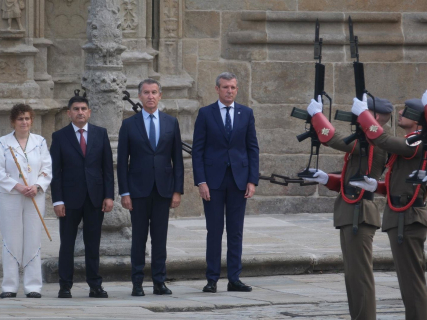
On a more formal level, the troops made their punctual entrance into the Obradoiro from the rúa de San Francisco, by the side of the Hostal dos Reis Católicos. Meanwhile, dozens of public officials posed aligned under the porticoes of the Pazo de Raxoi, the seat of the City Council, where they began to gather before 10:00 hours.
In front of the Pazo, conselleiros and regional deputies gathered, in addition to representatives of the municipal groups, in an atmosphere already marked by the pre-campaign for the local elections of 2027. As is customary, the members of the local government (BNG and Compostela Aberta), led by the nationalist mayor Goretti Sanmartín, abstained from participating in the liturgical part inside the Cathedral.
Upon arrival, the president of the Parliament posed before the military delegation as a royal delegate, elevated in the tribune. Next to him were the Galician president, Alfonso Rueda; the leader of the state opposition and former president of the Xunta, Alberto Núñez Feijóo; the Government delegate in Galicia, Pedro Blanco; and the mayor of Compostela.
After reviewing the troops, the royal delegate headed towards the porticoes of Raxoi. The rest of the authorities who accompanied him at the beginning of the event had already done so, greeting each one individually. Around 10:30 hours, all, except for the mayor, entered the interior of the Cathedral to attend the solemn mass.
Prior to the entrance, and after the greeting of the regional delegate to the public officials, the meeting between the civil and ecclesiastical procession took place in the center of the Obradoiro, along with the greeting to the Archbishop of Santiago, Francisco Prieto. The attendees of the ceremony left the temple around 12:00 hours, making the reverse journey to the Pazo de Raxoi.
Reception at Raxoi: Compostela as "a place of peace"
Once the religious ceremony was concluded, the official delegation was received at the Pazo de Raxoi by the mayor, Goretti Sanmartín, and the Municipal Corporation.
Goretti Sanmartín defined the city as "a place of peace, of memory, and of dignifying the signs of identity, which is universal heritage and welcomes all people without distinction" and defended "diversity." She also took the opportunity to call for "weaving networks" among all the present institutions in order to "deepen dialogue and cooperation" for the benefit of the citizens.
The mayor also highlighted the tribute that this year's festival poster dedicates to Camilo Díaz Baliño, author of the famous poster in defense of the Statute of Galicia, whose plebiscite turns 90 years old. She recalled that that process was cut short by the coup d'état of 1936, which that summer ended the life of this pioneer of Galician design and thousands of people, including that of the mayor Ánxel Casal.
"Ninety years is too long a wait to re-signify, dignify, compensate, and recover what was destroyed in just a few days," she stated, before appealing to "keep the past in mind and not to be swept away by the winds of hatred or polarization."
Prominence of the suits and the national team jersey
The Obradoiro was also a showcase of styles: the formal suits of the authorities and guests at the official events of July 25 shared space with numerous attendees dressed in the national team jersey. The pull has skyrocketed after the conquest of the World Cup and has a Compostela component thanks to Borja Iglesias.
The expectation is that Borja Iglesias will have his own reception at the Pazo de Raxoi, although the date is yet to be confirmed. In any case, he maintains contact with the councilor for Sports, Pilar Lueiro, who has already conveyed her congratulations and the interest of the City Council in receiving him, according to municipal sources.
Along with the jerseys of the National Team and some nods to traditional Galician clothing —like the neck scarf worn by the socialist deputy Patricia Iglesias— symbols of Spain were also seen in different 'looks'. This was the case of a guest who combined her white suit with a flag-belt.
However, the styling that generated the most comments was that of the mayor herself. For this day, she chose a suit made from linen sheets in homage to Begoña Caamaño, designed by Melania Freire and in which the artisan jeweler Rosa Méndez collaborated.