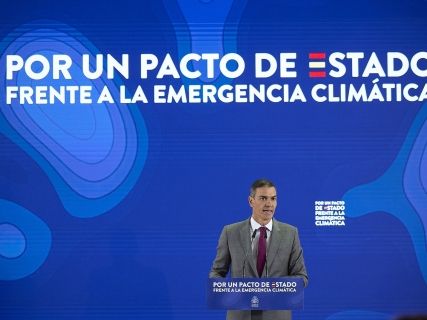

The devastating fires that have ravaged nearly 70,000 hectares between the provinces of Ávila and Madrid have reopened the debate on whether Spain needs a State Pact against forest fires. This time it has been the mayors who have managed the emergency on the ground who have made the request.
In a report published by El País, mayors from different political parties have publicly called on Pedro Sánchez and Alberto Núñez Feijóo to set aside confrontation and reach a national agreement that allows addressing a problem that becomes more complex each year due to climate change, the abandonment of rural areas, and the accumulation of vegetation fuel in the mountains.
The mayors call for political unity to tackle major fires
The request was made by Vanessa Muñoz, mayor of Casavieja (PSOE); Jerónimo López, mayor of Cenicientos (PP); Lucía Moya, mayor of Chapinería (independent); and Soraya Blázquez, mayor of Mijares (PSOE), all of them leading municipalities severely affected by the largest fire recorded to date between Ávila and the Community of Madrid.
Despite belonging to different political formations, the four agreed on one idea: the fight against forest fires must be placed above political confrontation.
The mayor of Casavieja summarized that request with a phrase that has become one of the most repeated messages after the tragedy: "They should take off their party shirts now. Either we sit down, or we will disappear". The mayors demand a stable agreement that includes all administrations and also incorporates the experience of those who manage emergencies from the local level.
Almeida joins the call and asks for collaboration between administrations
The proposal has also found support from other institutional leaders. The mayor of Madrid, José Luis Martínez-Almeida, defended the need to strengthen collaboration between administrations to improve prevention and response to forest fires and demanded that any proposal for a State Pact be specified in effective measures and true institutional cooperation.
His statements came during the crisis caused by the fires that forced the Government to declare, in an unprecedented manner, the emergency of national interest in several areas of Ávila and the Community of Madrid.
The pact was already approved in 2022
While mayors and political leaders demand the signing of a State Pact against forest fires, the professor of Administrative Law at the University of Alcalá, Blanca Rodríguez-Chaves Mimbrero, argues that this roadmap already exists.
The expert recalls that the Strategic Guidelines for the management of forest fires in Spain were initially approved by the Forest Fire Fighting Committee (CLIF) in 2019 and ratified by the Sectoral Conference on the Environment on July 28, 2022, with the support of the Ministry for Ecological Transition and all autonomous communities.
Rodríguez-Chaves argues that this document constitutes a consensual strategic framework to reduce the risk of fires, improve forest management, and strengthen coordination between administrations. In her opinion, the problem is not the absence of a pact, but that many of the measures outlined in that agreement remain undeveloped, which is why she believes that the priority should be to implement the already approved strategy rather than to draft a new document.
The debate focuses on prevention rather than extinguishing
One of the main messages shared by both mayors and the strategic guidelines approved in 2022 is that prevention must take on a greater role. The document recalls that for decades, most public investment has been allocated to improving extinguishing means, while preventive forest management has been losing weight.
According to this strategy, the current devices work correctly against conventional fires, but are insufficient when large fires occur, favored by extreme temperatures, drought, and strong winds.
In this line, the European Commission has also recently argued that active and sustainable forest management is one of the fundamental pillars to reduce the risk of fires and increase the resilience of ecosystems against climate change.
What is a State Pact and why is it being demanded now?
A State Pact is a political agreement of broad consensus between the Government and a significant part of the parliamentary forces to address issues considered strategic for the country, such as immigration, gender violence, pensions, or, in this case, forest fires.
Although the term has enormous political relevance, it does not constitute a legal figure regulated by the Constitution. Its main objective is to ensure that certain public policies have continuity regardless of the party in power.
This means that a State Pact does not create legal obligations by itself. The agreed measures only acquire legal effectiveness when they are developed through laws, royal decrees, or other norms approved according to the corresponding legislative procedure.
Precisely for this reason, the debate opened after the fires this summer is not limited solely to the convenience of signing a new political agreement. It also raises a fundamental question: whether Spain needs to draft a new State Pact or if it is enough to fully apply the one that was already approved by consensus in 2022.