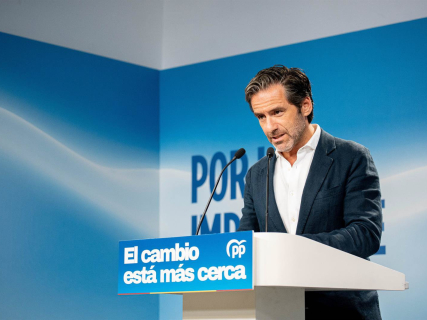










The national spokesperson for the PP, Borja Sémper, called this Wednesday “a disgrace” and “an unbearable institutional assault” that the Executive of Pedro Sánchez should resort to the decree law in the middle of an election campaign in order to move forward initiatives which, in his view, are going to “condition” the actions of the next Government of Spain. In his opinion, what is happening is “pre-democratic.”
In an interview on “RNE,” reported by Europa Press, Sémper stated that it is “deeply anti-democratic” and “shameful” that the Government has “normalized” and uses as an “electoral tool” the decree law, a figure that, he recalled, is conceived “for urgent moments.”
When asked whether the PP would maintain the package of social measures approved this Tuesday by the Council of Ministers —such as the extension of parental leave for birth or for death— or whether it would repeal them if it were to reach La Moncloa, Sémper avoided answering. He claimed that he was not going to assess the PSOE’s “electoral strategy” and limited himself to criticizing the way the Executive is proceeding.
“Things that were not done in eight years of government, now with haste and running around in 15 days during the election campaign, are intended to be used to use the Council of Ministers to project and launch a battery of initiatives that the Government itself has rejected in this latest legislature,” he denounced.
In this context, he stressed that it strikes him as “a disgrace and an unbearable institutional assault” that the Government uses the royal decree law during the campaign “to carry out electoral politics.” “It is deeply unjust, and, moreover, without general State budgets. But what joke is this?” he asked.
According to Sémper, the Executive is “committing tens of thousands of millions of euros, without having approved Budgets.” “And conditioning the future Government,” he added, insisting that this course of action is “pre-democratic.”
In fact, he pointed out that one of the first decisions that should be adopted “right after arriving” at La Moncloa would be “that of prohibiting that the Government, once elections are called, does this.” “It can’t be,” he stressed.
Thus, he has recalled that, once the elections had been called, the Government of Sánchez again approved in the Council of Ministers "two royal-decree laws that the Cortes had rejected", referring to the housing decrees. "It is anti-democratic. Things cannot be done this way, and especially when we are talking about matters that affect people's lives," he has asserted.
Finally, he has pointed out that, if Alberto Núñez Feijóo reaches La Moncloa, he will set in motion a housing plan accompanied by a new Land Law, a new Housing Law, an Anti-squatting Law, and tax changes to facilitate access to housing for the youngest population. "Housing has to be built as if there were no tomorrow," he has said, to emphasize that it is "impossible to solve a supply problem if you don’t generate it."