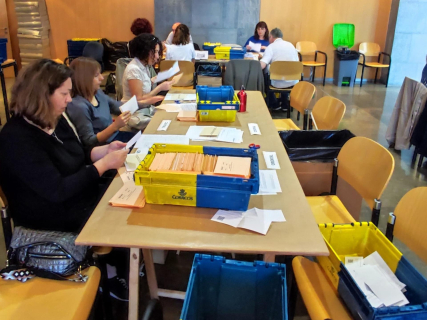

The votes that are cast in the general elections of this Sunday, 29 November, will be subject to a double recount: first in each polling station once the polling places close, and, starting Friday 4 December, in the provincial electoral boards, which will carry out the general scrutiny until Monday 7 and will incorporate the ballots of Spaniards residing abroad (CERA).
At eight in the evening of Sunday, the envelopes of those who have voted by mail—previously delivered by the staff of the postal operator—will be placed in the ballot boxes, and the members of the polling stations will cast their votes.
Next, the scrutiny, of a public nature, will begin, so that any citizen, whether or not they are eligible to vote, may attend, although the chair of the polling station will have the power to expel anyone who hinders or alters its normal conduct.
First, the votes for the Congress of Deputies will be counted and, after that, those corresponding to the Senate. Then, the polling station will verify that the number of ballots matches that of registered voters and the chair will ask whether there is any protest about the recount before proclaiming the result out loud.
Blank and void votes
During the recount, votes will be considered blank the Congress envelopes that do not contain any ballot paper. In the Senate, ballots on which no candidate has been marked will also be considered blank.
By contrast, votes will be considered void if they are cast in envelopes or ballot papers different from the official models, ballots deposited without an envelope, and those that show alterations that determine their nullity in accordance with electoral legislation.
Likewise, envelopes that include ballot papers for more than one candidacy for the Congress will be void, as well as Senate ballots on which a number of candidates higher than that permitted in each constituency has been marked.
Once the recount has been completed, the members of the polling stations must complete the records and carry out the procedures provided for sending all electoral documentation, while the Ministry of the Interior will publish during the night the provisional results of the day.
Ballots are destroyed
Ballot papers will be destroyed in the presence of the attendees, except those that have not been considered valid or that have been the subject of some challenge, which will be incorporated into the electoral documentation.
Next, the vote-counting record will be drafted, which will be made public immediately by displaying it at the entrance to the polling station. In addition, copies will be provided to the representatives of the candidate lists who request them and to the representative of the Administration, so that the Government can provide the provisional data during the election night.
The chairperson, the members (vocales), and the poll watchers (interventores) of the polling station will sign the minutes of the session, in which the claims, protests, agreements, and incidents recorded during the voting and the vote counting will be documented.
Overseas voting will be counted starting on Friday
On Friday, 4 December, the general vote count will begin in the provincial electoral boards, which must be completed, at the latest, by Monday 7. Before starting this computation, the boards will be convened as polling stations to add up the votes of Spaniards who permanently reside abroad, who are registered in the Electoral Census of Absent Residents (CERA), and who are not included in the provisional results published on election night.
The inclusion of these votes may alter the distribution of seats in the Congress and the Senate known on Sunday, as happened in the general elections of 23 July 2023, with the last seat in dispute in Madrid.
Then, the counting of overseas votes enabled the PP to secure its sixteenth deputy for this constituency, Carlos García Adanero, to the detriment of the socialist Javier Rodríguez Palacios, after the provisional results had attributed fifteen seats to the popular party and eleven to the PSOE.
The change raised the PP’s seats across Spain from 136 to 137 and reduced the PSOE’s from 122 to 121, which with this new distribution already required Junts’ “yes” for the investiture of Pedro Sánchez and not only its abstention. The subsequent appeals by the Socialists did not modify this allocation.
Claims and proclamation of elected officials
During the general vote count, the provincial electoral boards will review the records of the polling stations and will add up the valid votes, correcting any material, factual, or arithmetical errors that may be detected.
Once the vote count has been completed, representatives and proxies of the candidate lists may submit the claims they deem appropriate to the Provincial Electoral Board, within the time limits set by the Organic Law of the General Electoral Regime (LOREG).
In accordance with the electoral calendar, these complaints may be filed between December 4 and December 8, while the provincial boards will have until December 9 to resolve them and communicate their decisions. Subsequently, the representatives of the candidacies may file appeals before the Central Electoral Board, which must decide on them, in accordance with the calendar provided, no later than December 15.
The proclamation of the elected candidates will take place between December 8 and December 16, depending on the complaints and appeals submitted in each constituency. Appeals may be filed against the proclamation agreements before the Supreme Court in the three days following.
Once all formalities have been completed, the Central Electoral Board will publish in the Official State Gazette (BOE) the general results and by constituencies, within the statutory period of forty days from the proclamation of the elected members, who will take possession of their seat on December 23.