FIFA investigates a VAR referee from the World Cup for a gesture linked to white supremacism

The organization studies the images of the Australian Shaun Evans before the match between Germany and Curaçao, although it has not announced precautionary measures

1 minute

fifa shaun evans supremacista blanco

fifa shaun evans supremacista blanco

Add DEMÓCRATA to Google

Published

Last updated

1 minute

Most read

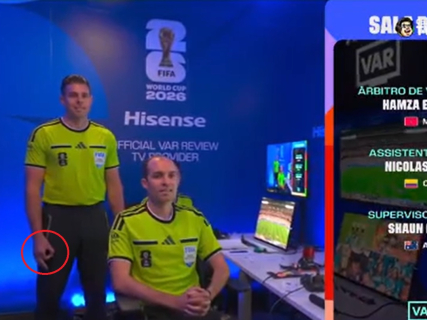
FIFA has opened an investigation into Australian referee Shaun Evans, a member of the VAR team at the 2026 World Cup, after he made a hand gesture during the pre-match broadcast between Germany and Curaçao.

The controversy originated when the international signal showed the VAR room for several seconds before the start of the match. In the images, Evans appears to be making the well-known "OK" gesture, forming a circle with his index finger and thumb while keeping the other three fingers extended.

Although this symbol has everyday uses in numerous countries, it has also been used in recent years by far-right and white supremacist groups as a sign of identification. The anti-discrimination organization Fare has stated that, according to their experts, the gesture used by Evans "clearly resembles" the symbol used in far-right circles.

No precautionary measures announced

For the moment, FIFA has not announced the opening of a formal disciplinary file nor has it informed of a possible suspension or expulsion of the referee from the tournament. Various international media outlets assure that the organization has initiated internal investigations to clarify the context of the gesture and determine if there was any discriminatory intent on the part of the official.

Evans, 38, is one of the video referees selected by FIFA for the 2026 World Cup and already participated as a VAR official in the Qatar 2022 World Cup. Neither the referee nor the Australian federation have commented on the controversy so far.

The investigation comes in a context of particular sensitivity for FIFA, which has strengthened its protocols against racism and discrimination in international competitions in recent years.

For now, the only confirmed information is that FIFA is reviewing the images broadcast before the Germany-Curaçao match. There is no official decision on the future of Shaun Evans in the tournament.


More key points, information and questions with FREN

AI-GENERATED CONTENT

What are the next steps in FIFA's internal investigation into disciplinary incidents during the World Cup?

FIFA internal disciplinary investigation: next steps

Summary answer

Based on the available information, FIFA has not announced a large "global internal investigation" with phases and a public schedule covering all disciplinary incidents from the last World Cup. What exists are specific cases, processed individually by the Disciplinary Committee (and, where applicable, by the Ethics Committee), following a standard procedure. The next steps, therefore, are the closure of the investigation phase of each case, the disciplinary decision, possible appeals, and, in some instances, the appeal to the CAS/TAS. No unified timeline has been communicated; each case progresses within the ordinary deadlines established in FIFA's disciplinary regulations.

Internal procedures activated within FIFA

After a disciplinary incident in a World Cup, the ordinary framework of FIFA's Disciplinary Code is activated, as described in recent analyses of its changes for 2026 (Disciplinary Code analysis). First, the incident is detected and documented through reports from referees, match delegates, security officials, or possible complaints from involved federations. This material is forwarded to the Secretariat of the Disciplinary Committee, which decides whether to open a case against the federation, player, referee, or other affected party.

Once the case is opened, the investigated party is formally notified of the alleged facts and the articles supposedly violated, granting a period for statements. This phase is supported by official videos, referee and competition reports, as well as any additional documentation requested. FIFA has reminded in its recent disciplinary communications that sanctions are not automatic; they require an internal examination of the facts by the competent disciplinary body, as stated in its notes on sanctions in World Cup qualifiers (statement on disciplinary sanctions).

Upcoming phases in open cases

In general terms, for any incident still under analysis, the pending phases are four: closure of the investigation, disciplinary decision, possible internal appeals, and eventually, external appeal to the CAS. Once evidence is gathered and statements analyzed, the Disciplinary Committee enters the legal and sporting deliberation phase. From there, a resolution may be issued imposing sporting sanctions (suspensions, partial stadium closures, matches behind closed doors) and/or financial penalties, in addition to warnings or additional obligations.

Against that decision, the sanctioned party may appeal to FIFA's Appeal Committee, which can confirm, modify, or revoke the sanction, always maintaining the framework of the Disciplinary Code. In certain cases, the final avenue is the Court of Arbitration for Sport (CAS/TAS), with its own procedure and schedule. When the incident involves integrity or corruption issues (for example, match-fixing), the Ethics Committee may open its own investigation, with an investigation chamber and a trial chamber, but the phases follow the same basic scheme: gather facts, legally assess, decide, and allow appeal.

Schedule and deadlines: what is known and what is not

In practice, FIFA has not published a unified global schedule grouping "all disciplinary incidents of the World Cup" and setting deadlines for closure. Searches on its official channels show disciplinary decisions communicated case by case, especially in qualification competitions and tournaments, but without a general timeline for "the World Cup internal investigation" (note on sanctions). What does exist are very short deadlines for certain specific procedures, such as official match protests, which must be submitted within 24 hours after the end of the match, according to federation circulars applying FIFA standards (circular with protest deadlines).

In parallel, FIFA itself faces external investigations unrelated to the sporting disciplinary field, such as investigations by several U.S. state prosecutors regarding ticket prices for the 2026 World Cup (information on U.S. investigation). However, this procedure is not part of the internal disciplinary investigation you asked about, but rather public authorities' requirements to the organization.

Conclusion

In summary, the "next steps" in FIFA's internal investigation into disciplinary incidents do not follow a single centralized plan, but rather the progress of each case: closure of information gathering, decision by the Disciplinary Committee, potential internal appeal, and ultimately, review by the CAS. As of today, there is no global public schedule grouping all cases from the last World Cup. If a specific incident is identified (racism, violent conduct, federation protest, etc.), it is possible to reconstruct more precisely which phase it is in and what deadlines have applied to that specific case.

What competencies and functions does a VAR referee have according to FIFA regulations?

What is the professional and refereeing background of Shaun Evans?

Shaun Evans' Background

Brief answer

I do not have specific information in the sources I work with about the professional and refereeing background of Shaun Evans. My area of specialization is politics and institutional current affairs, especially in Spain, and not sports or refereeing profiles. Since I do not have biographical databases of referees or coaches, I cannot detail his teams, categories, seasons, or positions. Below I explain in more detail what type of information I can offer and why in this particular case I cannot respond precisely.

FREN's area of specialization

FREN is a political assistant designed specifically for the regulatory and political context, with a special focus on Spain. It is oriented to answer questions about:

1. Institutional activity and regulation: evolution of laws, royal decree-laws, bills, parliamentary processing in Congress and Senate, as well as regulations approved by the central government. This includes monitoring public consultations, hearings, Council of Ministers agreements, and final publication in the Official State Gazette (BOE).

2. Political and social current affairs: party positions, parliamentary debates, government pacts, elections, parliamentary majorities and minorities, as well as main political and social controversies addressed in the institutional sphere or media.

3. Political and organizational actors: profiles of public officials, parliamentary spokespeople, ministers, party leaders, as well as relevant organizations in the institutional ecosystem (unions, employers' associations, sectoral associations when involved in regulatory or parliamentary processes).

4. Economic and social context linked to politics: information on economic reforms, social, labor, fiscal or environmental policies, always from the perspective of regulation and public activity.

Why I cannot detail Shaun Evans' career

The question you ask focuses on the professional and refereeing background of a person who, by the content of the query, seems to be in the sports field (referee, presumably of football, rugby, or another discipline). This type of information belongs to the realm of:

• Sports biographies and refereeing curricula: categories in which he has refereed, international competitions, finals officiated, promotions and relegations, as well as his training and professional experience outside refereeing.

• Strictly sports statistics: number of matches refereed, leagues and cups participated in, relevant decisions in specific matches, recognitions or sanctions within sports federations.

These areas are not part of the set of sources to which I have structured access. I work with parliamentary, executive information, media focused on politics and society, and databases of regulations and institutional activity. I do not systematically include sports databases or biographies of referees, coaches, or athletes, unless they have a relevant political or institutional role (for example, a former athlete holding a seat in Congress or a government position).

In the specific case of Shaun Evans, no profile linked to public office, parliamentary activity, or regulatory processes appears in the sources consulted, nor political or social news in which his figure is a relevant actor. For this reason, and following the instruction not to invent or complete with unverified data, I cannot offer a reliable summary of his refereeing career or previous professional background.

What type of information I could provide if there were a political link

If Shaun Evans were linked to:

• A public office (for example, Secretary of State for Sports, director of a sports regulatory body, or deputy responsible for a sports legislation committee), I could detail his role in that responsibility: initiatives promoted, interventions in debates, key votes, and position regarding regulatory reforms.

• A regulatory process or political controversy (for example, participation in a commission on sports integrity, sports violence, or professional refereeing regulation), I could explain the content of proposals, debated amendments, and the stance of different parliamentary groups.

However, in the absence of any such reference, information about his background is limited to the sports and biographical field, which is not covered by my data framework.

How you could complement this information

To know in detail the professional and refereeing career of Shaun Evans, the most appropriate would be to consult:

• Official websites of sports federations (for example, the national or international federation of the discipline he referees), where elite referee lists and sometimes brief biographical notes are usually found.

• Professional competition pages (leagues, cups, international tournaments), which often publish profiles of referees participating in their matches.

• Specialized sports media, which may have produced reports or interviews covering his career, beginnings, training, and professional milestones.

Any specific detail you find there (debut years, categories, finals officiated, parallel profession, etc.) would have greater accuracy than what I could offer in this non-political field.

Play

Test your knowledge with FREN!

How much do you know about this topic? Answer the following 3 questions.

What gesture did Shaun Evans make that prompted an investigation by FIFA?

Question 1 of 3

What has been FIFA's initial reaction to Shaun Evans' gesture?

Question 2 of 3

In which other World Cup did Shaun Evans previously participate as a VAR official?

Question 3 of 3

Hola, soy Fren. ¿Cómo te ayudo?