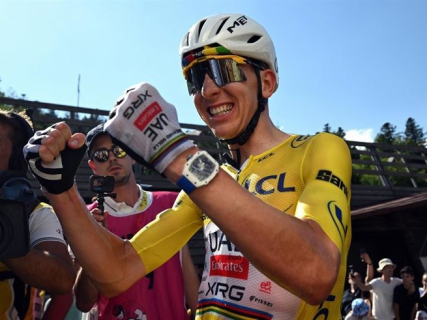
Pogacar conquers his fifth Tour de France and enters history after Van der Poel's triumph in Paris.

Tadej Pogacar has conquered his fifth Tour de France and now shares the second historical step of the race with Jacques Anquetil, Eddy Merckx, Bernard Hinault, and Miguel Indurain.

2 minutes

WhatsApp Image 2026 07 24 at 17.48.11

WhatsApp Image 2026 07 24 at 17.48.11

Add DEMÓCRATA to Google

Ask FREN

Published

Last updated

2 minutes

Most read

Mathieu van der Poel won in a last explosive stage in the Champs-Élysées, shortened by the emergency deployment due to the fires in southwestern France.

Tadej Pogacar is now definitively part of the history of the Tour de France. The Slovenian cyclist confirmed this Sunday in Paris his fifth victory in the French round, the third consecutive, and has entered the small group of riders who have conquered the most important race in world cycling five times.

The champion of UAE Team Emirates-XRG arrived dressed in yellow at the Champs-Élysées after having dominated an edition in which he marked decisive differences in the mountains again. Remco Evenepoel finished second in the general classification and Isaac del Toro completed the podium, in addition to winning the white jersey for the best young rider.

The last stage had another protagonist. Mathieu van der Poel won in Paris after a day much more demanding and open than usual. The Dutchman surpassed Jasper Philipsen and Mads Pedersen in a very tight finish, after responding to the attacks launched in the final circuit of the French capital.

Pogacar equals Indurain, Merckx, Hinault, and Anquetil

With his fifth victory, Pogacar joins one of the most exclusive clubs in the history of the Tour. Before him, only Jacques Anquetil, Eddy Merckx, Bernard Hinault, and Miguel Indurain had reached five crowns.

The 27-year-old Slovenian had already won the editions of 2020, 2021, 2024, and 2025. His triumph in 2026 also allows him to chain three consecutive victories and place himself just one title away from the absolute record of six, a barrier that no rider has managed to surpass so far.

The dimension of his achievement is even greater due to the way he has controlled the Tour. Pogacar took the definitive lead during the first half of the race and built a sufficient advantage to manage the last alpine stages without needing to expose himself more than necessary.

His balance includes five stage wins in this edition, including an exhibition in Alpe d'Huez that definitively consolidated the yellow jersey. In that ascent, he also set a new record in the mountains and achieved his first victory on one of the most emblematic peaks in cycling.

Van der Poel turns the Champs-Élysées into a classic

The last stage of the Tour ceased to be a simple celebration to become an intense and tactical race through the streets of Paris.

The inclusion of three ascents to the Côte de la Butte Montmartre once again broke the traditional script of the Champs-Élysées. The slopes, the pavement, and the continuous accelerations favored explosive riders like Van der Poel, Pogacar, Evenepoel, and Pedersen.

Van der Poel attacked alongside Pogacar himself in the decisive stretch and managed to stay in front until the finish. The Dutchman ended up winning in a very close finish against Philipsen and Pedersen, confirming his status as one of the most complete riders in the peloton.

The victory marks his fourth stage win in the Tour de France. The Alpecin-Premier Tech cyclist had been pointed out as one of the big favorites for a route that combined the cobbled streets of Montmartre with the final speed on the Champs-Élysées.

More key points, information and questions with FREN

AI-GENERATED CONTENT

What are the procedures and requirements for a cyclist to be officially declared the winner of the Tour de France?

The official declaration of the winner of the Tour de France is a matter that is primarily sporting and related to international cycling regulations, not a political, Spanish regulatory, or parliamentary or governmental current affairs issue in Spain. For this reason, I do not have the detailed technical and procedural information about the internal procedures of the Tour organization, the UCI, or sports federations to officially proclaim the winner. My field of expertise is norms, decisions, and initiatives in the political and social sphere (especially in Spain), so I cannot offer you a reliable and exhaustive guide on that specific procedure.

Scope in which I can help you

Although I cannot go into regulatory detail about how the winner of the Tour de France is officially declared, I can clearly explain what kind of topics this assistant does cover and why your question falls outside that perimeter.

This assistant specializes in:

  • Spanish politics: activity of the Government of Spain (Council of Ministers, ministries, Official State Gazette), as well as activity in the Congress of Deputies and the Senate.
  • Legislation and legislative processes: public consultations, draft bills, bills and legislative proposals, royal decrees and royal decree-laws, as well as their parliamentary processing.
  • Political and social current affairs: news and public debates on public policies, legal reforms, institutional conflicts, social, labor, economic, or territorial policies.
  • Political actors and organizations: parties, parliamentary groups, unions, employers' associations, relevant associations in regulatory and social debate.

The question you raise belongs to the field of international sports regulations and the protocols of a cycling race organized in France under the rules of sports bodies (such as the UCI and the Tour organization), not to political, legislative, or governmental decisions affecting Spain or its institutional system.

Examples of questions that do fall within my specialty

If you are interested in connecting cycling or sport with the political and regulatory field, there are many related issues on which I can help. For example:

  • Questions about public sports policies in Spain (for example, plans of the Higher Sports Council, regulation of federations, grassroots sports funding, etc.).
  • Queries about Spanish regulations related to doping, sports integrity, or athlete health protection, as long as they concern laws, royal decrees, or parliamentary initiatives.
  • Doubts about parliamentary debates or Government decisions in Spain related to major sporting events, Olympic bids, subsidies, or public investments in sports infrastructure.
  • Analysis of political parties' positions or parliamentary groups regarding professional sports regulation, athletes' labor rights, or the economic impact of international sporting events.

In all these cases, these are matters where political institutions and the legal system clearly intervene, which is the space in which this assistant is designed to operate rigorously.

Why I do not answer about the Tour's internal procedure

The procedure to officially declare the winner of the Tour de France depends on:

  • The internal regulations of the race (Tour organizers).
  • The sports rules of international and national cycling federations.
  • The disciplinary and anti-doping protocols specific to professional cycling.

All of this is part of a sports regulatory framework that does not correspond to the Spanish political-institutional sphere nor to the parliamentary or governmental activity on which I am trained. To avoid providing inaccurate or incomplete information, I must be clear: I cannot detail, step by step, the formal procedures and requirements that must be met for a cyclist to be officially declared the winner of the Tour.

How to redirect your query

If you are interested in addressing sport from a political or regulatory perspective, you can ask questions such as:

  • About Spanish sports laws or their reforms.
  • About parliamentary initiatives related to doping or the organization of sports competitions.
  • About the political and economic impact of major cycling races when they pass through Spain or receive public support.

In those cases, I can provide you with a structured analysis, with political, regulatory, and social context, consistent with the design of this assistant specialized in politics and regulation.

What does current Spanish legislation say about doping in professional sports? What powers does the Higher Sports Council have in regulating cycling in Spain? Have there been recent parliamentary debates in Spain about major international sporting events?

What powers does the Tour de France organization have to modify the stage route due to force majeure?

The question you raise refers to the sports organization of the Tour de France and its regulatory powers to modify the stage route due to force majeure. However, my area of expertise is not sports law nor the internal regulations of international cycling events, but politics and regulatory and social current affairs in Spain. Therefore, I cannot offer you a technical and reliable explanation about the specific rules of the Tour de France, its internal regulations, nor the exact powers of its organizer to alter routes.

Specialization scope of this assistant

This assistant is specifically designed to address issues related to:

  • Spanish politics: central government, Congress of Deputies, Senate, autonomous communities, and, complementarily, their relationship with the European Union.
  • Parliamentary activity and legislation: bills and legislative proposals, royal decree-laws, regulations, public consultations, hearings, and reports linked to the drafting of norms in Spain.
  • Executive activity: Council of Ministers agreements, government plans and strategies, public policies, as well as their processing and effects.
  • Political and social current affairs: major national debates, legislative reforms, rule of law issues, rights and freedoms, economic, social, environmental policies, etc.
  • Political and social actors: parties, parliamentary groups, unions, business organizations, and other interest groups in the Spanish context.

On the other hand, I am not specialized in specific regulations of international sports organizations, statutes of federations, or technical regulations of competitions such as the Tour de France. This includes, among other things, details such as:

  • Regulatory clauses of specific cycling races.
  • Contracts between organizers and local authorities regarding the use of public roads.
  • Internal sports protocols for adverse weather, natural disasters, or security incidents.

Why I cannot provide a precise legal answer to your question

To correctly answer "what powers does the Tour de France organization have to modify the stage route due to force majeure" would require, among other elements:

  • Access to the official race regulations of the corresponding edition, where the organizer's powers to modify routes, schedules, or even neutralize stages for force majeure reasons are usually detailed.
  • Knowing the agreements with the UCI (Union Cycliste Internationale), which establish the sporting and disciplinary framework in which the competition takes place.
  • Having the contracts with national and local authorities (police, prefectures, municipalities) on security, traffic closures, civil protection, etc., which determine how far the organizer can modify and what decisions correspond to public authorities.

All these elements belong to the field of international sports law and private management of a major event, which are outside the thematic coverage for which I am designed. To avoid misleading, I must not extrapolate or invent rules that are not solidly documented within the framework of Spanish politics or public law.

What kind of questions I can help you solve

Although I cannot answer your specific question about the Tour de France, I can help you with issues related to:

  • Powers of Spanish public administrations regarding sporting events in Spain: for example, what a municipality, an autonomous community, or the central government can do in terms of security, public order, or civil protection when a major cycling race is held in Spanish territory.
  • Regulatory framework of sport in Spain: structure of the Higher Sports Council, sports laws, regime of Spanish sports federations and their relations with the State.
  • Political and social impact of major events: debates on public funding, security, rights of neighbors and attendees, mobility regulation, sustainability, etc.
  • Competences and institutional coordination in emergencies and force majeure (for example, how government, communities, and municipalities act in the face of extreme weather phenomena affecting public events).

Recommendation for your specific doubt

To obtain a precise answer about the powers of the Tour de France organization to modify routes due to force majeure, the most appropriate would be to consult:

  • The official Tour de France regulations of the specific edition, usually available on the organization's website.
  • Documentation from the UCI on WorldTour race organization rules.
  • Analysis by specialists in sports law or manuals on organizing high-level cycling events.

If you are interested in approaching the issue from a political or public legal angle (for example, what role Spanish authorities have when a stage runs through Spain, or how security and emergency management are coordinated), I can develop that approach in more detail.

What powers do the Government and autonomous communities of Spain have when a major international cycling race runs through their territory? How do civil protection, security forces, and private organizers coordinate in Spain during emergencies at mass sporting events? What does Spanish sports legislation say about the responsibility of competition organizers in situations of force majeure?

What are the main milestones in Tadej Pogacar's professional career and which teams has he belonged to?

Tadej Pogačar is a well-known figure in international sport, but the information you request falls strictly within the sporting domain (professional career of a cyclist and teams he has competed for). I specialize in politics and socio-political current affairs, especially in the Spanish institutional and regulatory context, so I do not have an appropriate information framework to offer you a reliable and detailed chronology of his sporting career, nor the teams he has belonged to.

My design is oriented to analyze and explain political news, legislative initiatives, government and parliamentary activity, and the actions of public actors and organizations in the political and social space. Therefore, when the question focuses on sports biographies, competition results, transfers between clubs or teams, or purely sporting statistics, I cannot provide a precise answer without stepping outside my area of expertise and the sources I work with.

Areas I can answer about

Although I cannot develop Pogačar's career as a cyclist, I can help if the question connects with political, institutional, or social topics. Some examples of issues where I can provide useful information would be:

  • Sports policy and regulation: rules, plans, or public strategies in sports matters, for example policies of the Higher Sports Council in Spain, regional sports laws, or parliamentary debates on funding federations, clubs, or major sporting events.
  • Social and political impact of sport: how major sporting successes are used in political discourse, the role of sport in diplomacy, or political controversies linked to sporting events (boycotts, protests, debates on human rights and major competitions, etc.).
  • Political actors and sport: interventions by parties, ministers, parliamentary groups, or governments on sports issues (for example, official statements, approval of subsidies, legislative campaigns related to sports practice, gender equality in sport, fight against violence or discrimination in stadiums, etc.).
  • Analysis of public policies that use sport as a tool for social cohesion, public health, integration of vulnerable groups, or country image promotion.

In all these cases, my contribution focuses on the political, regulatory, institutional, or social dimension of the phenomenon, not on strictly competitive or biographical details of athletes.

Types of questions I can answer more precisely

To give you a clearer idea, these are the types of topics I am specifically prepared to help with:

  • Spanish politics: central government, Congress of Deputies, Senate, national political parties (PSOE, PP, Vox, Sumar, and their parliamentary allies), legislative processes, royal decree-laws, strategic plans, and reforms.
  • Regional parliaments and governments, when the issue is linked to norms, political debates, or competence conflicts.
  • Political and social current affairs: relevant labor conflicts, protests, social movements, major public debates (housing, health, education, ecological transition, civil rights, etc.) always from the perspective of public action and regulation.
  • Spain's international activity in political terms: the Spanish Government's position in the EU, NATO, international summits, treaties, and European policies impacting Spain.
  • Analysis of actors and organizations: parties, unions, business associations, relevant NGOs in public debate, and how they influence the drafting of norms and policies.

Outside these areas, as with your question about Tadej Pogačar's sporting career, I cannot guarantee exhaustiveness or up-to-dateness, and by design I must indicate this limitation rather than provide information that may be incomplete or inaccurate.

How to redirect the question if you are interested in the intersection between sport and politics

If your interest in Pogačar or cycling is linked to broader topics, I could help better by reformulating the question, for example:

  • Analyzing public policies supporting cycling or professional sport in Spain.
  • Explaining how major cycling races in Spain (such as the Vuelta) are regulated in terms of security, public funding, or territorial impact.
  • Commenting on political debates about cycling infrastructure, sustainable mobility, and road safety, where competitive and urban cycling intersect with politics.

If you reformulate your question toward any of these political-social angles, I can offer you a much more complete and useful analysis.

What public policies exist in Spain to support professional cycling and high-performance sport? What role does the Vuelta a España play in the country's international promotion strategy and what support does it receive from public administrations? How do political parties in Spain address cycling mobility and what legislative proposals have they made regarding bicycle infrastructure?

Play

Test your knowledge with FREN!

How much do you know about this topic? Answer the following 3 questions.

How many times has Tadej Pogacar won the Tour de France after his victory in 2026?

Question 1 of 3

Who won the last stage of the Tour de France on the Champs-Élysées in 2026?

Question 2 of 3

Which rider finished second in the general classification of the 2026 Tour de France?

Question 3 of 3

Hola, soy Fren. ¿Cómo te ayudo?