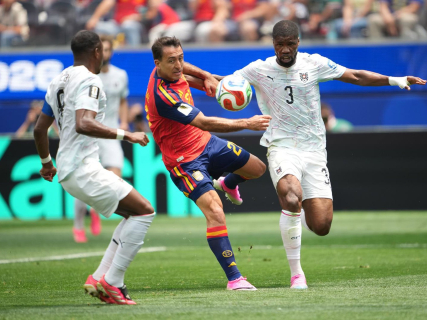
This is the lineup of Spain against Belgium for the quarter-final match

Luis de la Fuente bets on Unai Simón under sticks and an eleven with Cubarsí, Laporte, Rodri, Dani Olmo, Lamine Yamal, Álex Baena and Mikel Oyarzabal to seek passage to the semifinals

1 minute

fotonoticia 20260703173441 1920

fotonoticia 20260703173441 1920

Add DEMÓCRATA to Google

Ask FREN

Published

Last updated

1 minute

Most read

The Spanish team already has its starting eleven to face the quarter-final match of the 2026 World Cup against Belgium. Luis de la Fuente maintains the team's core and opts for an attack led by Lamine Yamal and Mikel Oyarzabal in a decisive match for a place in the semifinals.

Spain's official lineup is as follows: Unai Simón; Pedro Porro, Cubarsí, Laporte, Cucurella; Rodri, Dani Olmo, Fabián; Lamine Yamal, Álex Baena and Mikel Oyarzabal.

In defense, the coach trusts the pairing of Pau Cubarsí and Aymeric Laporte, with Pedro Porro and Marc Cucurella on the wings. In midfield, Rodri will act as the pivot, accompanied by Dani Olmo and Fabián Ruiz, while the attacking front will be made up of Lamine Yamal, Álex Baena and Mikel Oyarzabal.

Spain's path to the 2026 World Cup final if they eliminate Belgium

If Spain overcomes Belgium in the quarter-finals, their next obstacle would be France, who have already secured their place in the semifinals after defeating Morocco. Thus, Luis de la Fuente's team would face another highly demanding duel against one of the tournament favorites. A clash between two of the teams with the greatest potential in the tournament and with numerous recent precedents in international competitions, in which a ticket to the grand final of the 2026 World Cup would be at stake.

Should they also overcome that match, Spain would reach the World Cup final, scheduled for July 19, where they would face the team that survives on the other side of the bracket. The finalist from that part of the competition will emerge from Norway, England, Argentina and Switzerland, teams that are playing the other two quarter-final matches.
 

More key points, information and questions with FREN

AI-GENERATED CONTENT

What are the functions and competencies of a national football team coach according to the regulations of the Royal Spanish Football Federation?

I cannot directly and in detail answer your question about the functions and competencies of a national football team coach according to the Statutes and Regulations of the Royal Spanish Football Federation (RFEF), because my scope is restricted to issues of politics, public institutions, parliamentary and social activity, not to the technical interpretation of internal sports federation regulations. However, I can help you understand the political and institutional dimension of the RFEF, its relationship with the Higher Sports Council (CSD), and the role of sport in the Spanish public agenda.

Why I cannot go into technical detail

The issue you raise is essentially about private internal regulation of a sports federation (statutes, general regulations, technical committees, etc.). Although the RFEF performs delegated public functions – and that does have a political reading – the specific content of exactly what the coach does, how technical powers are attributed to them, or what each article of the federation regulations says exceeds the type of analysis I am designed for.

My specialization is the monitoring and explanation of:

  • Public laws and regulations (for example, Sports Law, royal decrees on federations, betting regime, etc.).
  • Government and Parliamentary activity linked to sport: Council of Ministers agreements on football financing or entity recognition, such as when the Government regulates the distribution of state sports betting affecting the RFEF, as reported by Demócrata in a reference to the Council of Ministers on May 5, 2026 (Council of Ministers).
  • Political and institutional conflicts involving the RFEF, autonomous communities or municipalities, such as the controversy over the 2030 World Cup venues described in this analysis, or the use of territorial symbols and identities in football addressed in the Parliament of Navarre (debate about Athletic).

What I can explain around this topic

Although I cannot break down the specific articles about the national coach, I can help you from several connected political and legal angles:

  • RFEF–State relationship: how the CSD supervises the RFEF and has created oversight commissions, such as the one chaired by Vicente del Bosque to normalize the Federation, recorded by the Ministry of Education, Vocational Training and Sports in an official note (Ministry note).
  • Public responsibilities of the RFEF: for example, its role in organizing the National Team in major tournaments (2026 World Cup, Finalissima, Supercup in Saudi Arabia) and the associated social and political debate, widely covered by the newspaper Demócrata, such as in the analysis on identity and the National Team in the 2026 World Cup (Demócrata report).
  • International sanctions and discipline: FIFA proceedings against Spain or the RFEF for racist chants or political interference (for example, the chants against Egypt reported by Demócrata in this report, or the debate about the possible expulsion of the United States from the World Cup due to political pressures, analyzed in another article).
  • Territorial impact and financing: government measures affecting the financing of professional and non-professional football (for example, the distribution of betting revenues benefiting the RFEF, as explained in this reference), or economic agreements linked to competitions such as the Supercup in Saudi Arabia (economic analysis).

Examples of useful official and media sources

If you want to deepen on the regulatory side on your own (something I cannot "interpret" article by article), these may be useful:

Institutional news showing collaboration between administrations and the RFEF are also illustrative, such as the Colón fan zone in Madrid (Madrid City Council note) or the themed Metro train dedicated to the National Team (Community of Madrid), reflecting how football enters the public agenda.

In summary: I cannot give you a technical article-by-article ruling on the functions of the national coach according to the RFEF Statutes and Regulations, but I can help you fit the role of the RFEF and the National Team within the Spanish political, institutional, and social framework, relying on public regulations and media coverage such as the newspaper Demócrata.

What political and institutional role does the RFEF have within the Spanish public sports system? How does the Sports Law and its regulatory development regulate the relationship between the CSD and federations like the RFEF? What recent political debates has the Spanish National Football Team generated in Congress and in the autonomous communities?

What professional career and clubs has Luis de la Fuente had before assuming the role of national coach?

I only have information and capabilities to address topics of politics, public institutions, parliamentary and governmental activity, as well as social issues linked to public life. The detailed sports career of Luis de la Fuente as a player and coach of football clubs falls strictly within the sports domain, not political or institutional, so I cannot provide you with a complete and reliable overview of his clubs, stages, and statistics in that regard.

That said, I can explain the fit of a figure like Luis de la Fuente within the institutional context of sport in Spain, especially from his appointment as national coach, and how he relates to the functioning of the Spanish sports system and its public implications. This can help you situate his current role within the soft power structure and international representation of the country, although I do not go into the detail of his club resume.

Scope of competencies: why I cannot detail his club career

My function is focused on:

  • Spanish politics: central government, Cortes Generales, political parties, elections, pacts and alliances.
  • Normative and institutional activity: laws, royal decree-laws, regulations, government plans, parliamentary debates.
  • Social current affairs linked to the public: major social debates when they have political or regulatory translation (health, education, housing, equality, etc.).
  • Organization of the State and administrations: competencies, relations between administrations (central, regional, local) and with public or mixed bodies.

The question you raise is situated on a different plane:

  • Individual sports history: clubs where Luis de la Fuente played, specific years, technical statistics, promotions or relegations, club titles, etc.

That kind of information requires a specific sports and press archive database, which is not part of the political-institutional scope I am designed for. To obtain it rigorously, the most appropriate is to turn to specialized sports sources: football databases, sports biographies, official club and national team websites, or sports media.

The institutional role of a national coach

Although I cannot detail the list of clubs of Luis de la Fuente, it is relevant from a political and social perspective to emphasize that the position of national football team coach has a public dimension that transcends sport:

  • Country representation: the senior men's national team is one of Spain's main symbols abroad, similar to other national teams or Olympic delegations.
  • Social influence: their decisions and image impact debates on identity, territorial cohesion, language use, relations among players of different origins, and sometimes on issues of equality or discrimination.
  • Relationship with public powers: although the team depends on the RFEF (Royal Spanish Football Federation), a private law entity, it relates intensively with the Higher Sports Council (CSD) and the competent Ministry in sports matters, especially when there are institutional crises, controversies, or federation model reforms.

In this context, the appointment of a person as coach is not made through a political procedure (it is not a government or parliamentary appointment), but it does have relevant effects on the image of Spanish sports institutions and, by extension, on the country's projection.

Relationship between sport, politics, and public opinion

The figure of the coach can also intersect with politics on several levels:

  • Parliamentary or media debates: when internal conflicts occur in the RFEF, player strikes or protests, or controversies about institutional behaviors, the coach may be at the center of public debate.
  • Political use of sport: the team's performance is often symbolically used by different political forces, either as an example of collective success or as a point of friction over territorial identities or models of the country.
  • Public policies on grassroots sport and training: the careers of coaches who have passed through youth categories of the national team are linked to debates on how the youth system is structured, what training model is promoted, and how grassroots sport is financed by administrations.

All this means that elite sport, and particularly the national team, cannot be completely separated from the political and social sphere. However, the fine detail of Luis de la Fuente's career in specific clubs remains a purely sports matter beyond my specific scope.

What kind of questions I can answer

To better leverage my capabilities, I indicate some examples of related questions where I can help:

  • Questions about public sports policies in Spain (sports laws, relationship between RFEF and CSD, grassroots sport financing, etc.).
  • Political or parliamentary debates that have mentioned the RFEF, national teams, or professional sport.
  • Analysis of the social and political impact of major sports events held in Spain (World Cups, European Championships, Games, etc.).
  • Positions of parties or public officials regarding the federation model or crises in Spanish football.

If you reformulate your question towards any of these areas (for example, the institutional role of the national coach, relations between the RFEF and the Government, or the State's sports policy), I can give you a much more precise and useful answer within my specialization.

What role does the Higher Sports Council have in supervising the RFEF and the Spanish national football team? What does current Spanish legislation say about the organization and control of sports federations like the RFEF? At what recent moments has Spanish football generated debates or interventions in Congress or the Government?

What are the requirements and criteria for a team to reach the quarterfinals in a FIFA World Cup according to FIFA regulations?

The regulations on how a football team reaches the quarterfinals of a World Cup are part of the FIFA sports regulations and the specific bases of each tournament. However, my area of expertise is not sport, but politics and institutional current affairs in Spain (and, complementarily, European and international). Therefore, I cannot offer you a technical and detailed explanation, article by article, of the FIFA regulations nor the official sporting qualification criteria.

My design is oriented to answer questions about politics, parliamentary life, government action, parties, public and social actors, regulatory processes, and sociopolitical news. Everything related to internal sports federation regulations, competitions, team performance, or game rules is outside that scope. Although the World Cup is an event of enormous social impact, the detail of its sports rules is not within the type of information I handle with sufficient rigor.

Very generally, and only at a conceptual level (without entering specific FIFA regulation articles), it can be said that access to the quarterfinals of a World Cup depends on:

  • Passing the group stage: normally, teams are placed in groups in a first phase and must finish among the best classified (usually the top two of each group) according to points obtained, goal difference, and other tiebreaker criteria.
  • Winning the round of 16 match: after the group stage, advancing teams play a knockout match; the winner of the round of 16 qualifies for the quarterfinals.
  • Complying with disciplinary regulations: cards, sanctions, and suspensions can affect player lineups but usually do not prevent a team, as such, from playing the quarterfinals if it has qualified sportingly (though they could prevent specific players from participating).

In any case, these are only very general features that any fan knows; for a legally exact answer, one would have to refer to the competition regulations and specific FIFA circulars, which establish:

  • The tournament format (number of teams, group structure, knockout match pairings).
  • Classification criteria within groups (points, goal difference, goals scored, head-to-head results, possible "fair play points", etc.).
  • Tiebreak rules in knockout matches (extra time, penalty shootouts) and conditions under which a match can be replayed or declared lost by a team.
  • Consequences of improper lineups or serious infractions (match loss, tournament exclusion, etc.).

As an assistant specialized in politics and regulation, I could help you, for example, understand the role sport plays in public policies (sports laws, grassroots sport financing, federation regulation, competencies of the Higher Sports Council in Spain, etc.) or analyze political debates linked to major sports events (economic impact, security, sports diplomacy). But I do not have an authorized base to detail the internal normative content of FIFA with the same level of precision.

If you seek the strictly regulatory answer to your question, the most appropriate is to consult directly:

  • The FIFA World Cup Regulations of the last edition played, where the competition and qualification system is detailed.
  • The Football Laws of the Game approved by the IFAB (International Football Association Board), which govern technical aspects of the game, though not so much the tournament format.
  • The competition circulars or manuals that FIFA provides to federations and participating teams.

In summary, I cannot break down the specific articles nor all official criteria to play the quarterfinals of a World Cup according to FIFA regulations, because that exceeds the information scope I am designed for. However, I can help you with any issue related to norms and public policies in Spain (for example, the Sports Law), with the institutional organization of sport at the state or regional level, or with the political and social analysis of major sports events.

What does current Spanish legislation say about the organization and financing of sports federations like the RFEF? How is the relationship between the Higher Sports Council and national sports federations regulated in Spain? What recent political debates have there been in Spain regarding management and transparency in professional football?

Play

Test your knowledge with FREN!

How much do you know about this topic? Answer the following 3 questions.

What is the main change in Spain's lineup against Belgium in the quarter-finals?

Question 1 of 3

Which team will Spain face in the semi-finals if they beat Belgium?

Question 2 of 3

On what date is the 2026 World Cup final scheduled?

Question 3 of 3

Hola, soy Fren. ¿Cómo te ayudo?