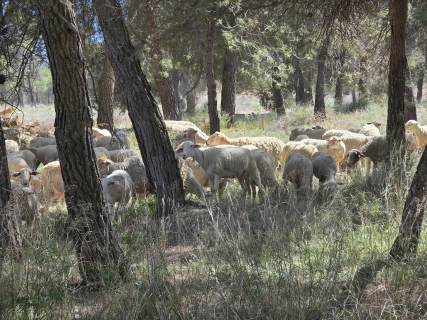

ASAJA Region of Murcia has conveyed to the regional government the idea of launching a Regional Plan for Preventive Management of Forests and Risk Areas based on extensive grazing of sheep and goat herds, with the intention of integrating livestock farming into the tasks of preventing forest fires.
The agrarian organization argues that directed grazing helps to reduce the vegetation that acts as fuel, generate strips of discontinuity in the plant mass, and safely conserve key areas such as forests and forest lands, sloped hillsides, roads and forest tracks, environments close to urban centers and isolated homes, as well as road and highway margins, always coordinated with the owners of these infrastructures.
ASAJA proposes that sheep and goat farmers become "strategic allies" of the Administration in the fight against fires and emphasizes that the environmental service they would provide must be recognized and financially compensated, as the organization itself has pointed out.
Furthermore, it highlights that moving and maintaining a herd in the designated areas involves extra costs related to the transportation of the animals, supplementary feeding, labor, water supply, surveillance, livestock handling, or the necessary infrastructures, among other concepts. Therefore, it suggests designing a compensation system adjusted to the real costs of this service.
The entity considers that the implementation of the plan requires close coordination between the ministries of Environment and Water, Agriculture, Livestock, and Fisheries. The former would have the mission of delimiting priority areas and integrating grazing into the regional fire prevention strategy, while the latter should facilitate the involvement of the livestock sector and articulate the instruments for providing the service.
ASAJA sees it as essential to ensure the water supply to livestock through a network of watering points and tanks, mobile storage and distribution systems, as well as the transportation of water with tankers when necessary.
The organization recalls that extensive grazing also generates other positive effects, such as the natural fertilization of the land thanks to the livestock's droppings, the dispersion of seeds, and the recovery of certain areas, while helping to sustain livestock activity and life in the rural environment.
In the same way, it suggests that the Administration analyze the cost per hectare of preventive grazing compared to other prevention methods, such as mechanical clearing, silvicultural treatments, or the maintenance of defense strips, understanding that it can be an especially efficient option in areas of difficult access or with steep slopes.
Among the suggested actions is the creation of a Regional Network of Preventive Grazing against Fires, aimed at locating both the intervention areas and the available livestock farms, organizing movements, and coordinating work with the services responsible for fire prevention and extinction.
ASAJA has sent its proposal to the ministries of Water, Agriculture, Livestock and Fisheries, and the Environment, to which it requests to establish a working group to analyze the technical, economic, and territorial feasibility of the plan, which in a first phase could be launched through a pilot program in different points of the Region.