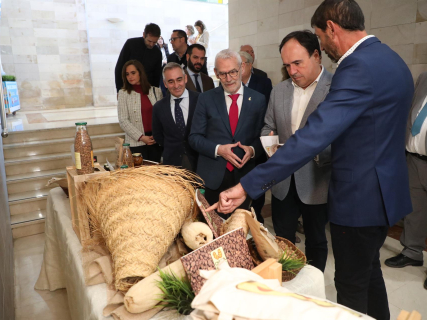

The Auditori d'Alboraia (Valencia) has been this Wednesday the setting for the central event for the fortyth anniversary of the Denominación de Origen Chufa de Valencia. Under the slogan "40 years guaranteeing what is authentic", the gathering has brought together farmers, washerwomen, marketing companies, processors, representatives from different administrations, and "all the people who made possible its history".
"Forty years later, we defend the same thing as those farmers who in 1986 protected the chufa of our land, its origin, its quality, and the work of those who cultivate it".
With these words, the president of the Regulatory Council, Francesc de Borja Espinosa, has spoken, who has wanted to publicly recognize the effort of the entire sector. During the ceremony, a tribute was paid to the five presidents that the DO Chufa has had, as the entity has detailed in a statement.
The mayor of Alboraia and host of the event, Miguel Chavarría, has presented the first recognition, posthumously, to Daniel Tortajada Aguilar, who chaired the denominación between 1986 and 1992. His son, Daniel Tortajada Forner, has been in charge of collecting the distinction. The organization has also had a remembrance for Miguel Muñoz Traver, president in three different periods, whose award, also posthumous, will be delivered to his family members.
The general director of Agricultural and Livestock Production, Mª Àngels Ramón-Llin, has handed over the recognition to Justo Panach Pascual, who was in charge of the DO between 1996 and 2005. For his part, the conseller of Agriculture, Water, Livestock and Fishing, Miguel Barrachina, has granted his to Antonio José Gimeno.
The event has also been joined by the government delegate in the Comunitat Valenciana, Roger Llanes, who has highlighted the importance of chufa cultivation and the value of l'horta valenciana; and the 'president' of the Generalitat Valenciana, Juanfran Pérez Llorca, who has highlighted the role of the DOP Chufa de Valencia in defending and promoting what he has defined as "one of the great signs of identity of the Comunitat Valenciana".
Likewise, he has emphasized that the farmers of the Comunitat know how to "take very good care of our products" and has stressed that "when you make a good product, you are also taking care of the health of all people".
In his address, the 'president' has warned that Valencian tiger nut "competes in a complex market with other countries that do not comply with some safety measures". Along these lines, he has pointed out that "Europe is destined to work on the designations of origin of European products as a guarantee of health and quality".
Likewise, he referred to the joint stance of several autonomous communities to demand equal treatment and reciprocity for the agri-food products that are imported into the European Union, with the aim of "demanding more control over origin and ensuring that the products that arrive are made with the same conditions as those under which a farmer from the Comunitat Valenciana does it".
Objectives and challenges of the DO Chufa
With the commemoration of this anniversary, the DO Chufa of Valencia brings to a close four decades of its journey and looks ahead to its future "with the same objectives that saw it born": to safeguard the origin of the tiger nut, ensure its quality, and support the work of those who produce it.
For the designation, issues such as generational renewal, the commitment to innovation, and the strengthening of control over origin in the face of imports will mark the new stage, in which "the seal will continue to be the best guarantee that what reaches the table is authentic tiger nut from Valencia".
Four decades of work in the huerta
With this anniversary, the Denominación de Origen Chufa de Valencia puts the finishing touch to forty years of activity. Since 2006 it has certified more than 73 million kilos of tiger nut, of which more than 5 million correspond to the last campaign, grown on about 5,000 hanegadas of l'horta.
At present, the DO brings together 321 operators: 237 farmers, three washing facilities, 13 marketers, 45 artisan processors, and five industrial ones. In addition, 18 processors have taken tiger nut beyond the traditional horchata, developing products such as chocolate, beer, nougat, ice creams, honey, or liqueurs.