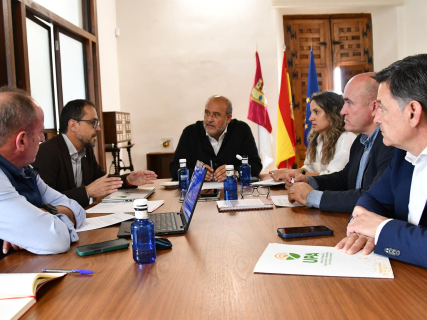

The Government of Castilla-La Mancha and the agricultural organizations Asaja and UPA have closed a package of measures that will be incorporated shortly into the Fire Prevention Order that the Department of the Environment will publish in the coming days, with the aim of making agricultural work compatible with forest protection during the fire campaign.
After a new meeting between the parties involved, the first vice president of the regional Executive, José Luis Martínez Guijarro, has emphasized that this agreement is the result of joint work with the sector, seeking, through coordination and cooperation, to balance agricultural activity with the essential prevention of fires in a context of summers that are increasingly harsh due to climate change, as the Board reported in a press release.
Among the modifications planned, the area from which restrictions are applied during periods of high and extreme risk is increased. The threshold goes from the five hectares that the regulatory Order had until now to 20 hectares. In this way, agricultural holdings adjacent to forest areas smaller than 20 hectares may harvest without hourly limitations.
The main novelty that will be incorporated into the new Order is that, in forest areas of more than 20 hectares, it will be allowed to establish a 10-meter-wide perimeter strip, without being cultivated or sown with sunflower, alongside the woodland, which will allow the harvesters to work without any type of restriction and at any time of day.
For the rest of the cases—that is, agricultural land near forest stands of more than 20 hectares that do not have that protection strip—the current system of limitations linked to the Potential Fire Propagation Index (IPP), very high and extreme, is maintained.
In this framework, for the days classified with extreme IPP, the obligation to have 400 liters of pressurized water is made more flexible, and three alternative options are opened: to have a vehicle with a tank of at least 400 liters of water and an injection system, to have a blower machine with a blowing power greater than 30 Newtons, or to have a pyrotechnic cartridge trigger against fires with, at least, eight cartridges.
Assessment of Asaja Castilla-La Mancha
The Regional Executive Committee of Asaja Castilla-La Mancha has valued that the regional Administration has accepted several of its demands, "which represents an important advance for farmers".
The president of Asaja, José María Fresneda, argues that the modifications respond to the work and the organization’s demands, although he warns that there are still matters to be resolved.
"Now we can say that we have improved a lot the conditions for farmers when it comes to harvesting, because progress has been made in the compatibility between fire prevention and the development of agricultural activity".
However, and as the organization points out in a statement, they regret "the time lost and the harvests that have already been affected" by limitations which, in their view, did not adequately reflect the reality of the countryside.
Among the elements that it considers necessary to correct, Asaja points to the calculation of the Potential Propagation Index (IPP), which it judges poorly designed because it is based on forest masses and not on agricultural surfaces.
"Also, limitations still exist for those farmers who cannot afford to leave a ten-metre strip uncultivated. In addition, the measure’s lack of adaptation to certain production systems is added, such as direct sowing, where leaving that strip can generate difficulties that have not been taken into account", he indicated.
The organization recalls that the improvements approved this year continue the line of the advances achieved in the past campaign, but it emphasizes that its ultimate goal is that harvesters are excluded from this regulation.
"A harvester is a work tool and an increasingly high production cost, but essential for the farmer. What matters to us is being able to carry the harvest through".
Position of UPA Castilla-La Mancha
UPA Castilla-La Mancha has assessed the changes positively, especially the modification of the reference threshold in forest land with a minimum continuity of 20 hectares, "it used to be at 5; leaving a strip in the proximity of the hillside of about 10 metres of bare or well-sown soil with sunflowers".
"There are some questions that we will have to see whether there can be compensation for leaving this strip uncultivated, but I think this is more of an opportunity for our farmers, that by carrying out this operation they will be able to organize themselves better when it comes to the harvest," the regional secretary, Julián Morcillo, has defended, who has also pointed out the relevance of these measures for the beekeeping sector.
"To make it easier for them to access their apiaries on days with extreme IPP, and to tend to their livestock in a normal way," he has highlighted.