Where is it a holiday tomorrow, November 2: the nine communities that extend the All Saints' Day long weekend

Andalusia, Madrid, the Canary Islands and six other autonomous communities will have a holiday this Monday. In the rest, it does not appear as an autonomous community holiday, although it is advisable to check the local calendar

EuropaPress 7061088 calendario laboral espana 2026 seran fiesta toda espana jueves enero ano

EuropaPress 7061088 calendario laboral espana 2026 seran fiesta toda espana jueves enero ano

Add DEMÓCRATA to Google

Ask FREN

Published

Last updated

2 minutes

Most read

Elecciones 29N · Encuestas

La media de las encuestas

Media a 1 de noviembre de 2026 · 14 institutos

  • PP30,8 %
  • PSOE27,3 %
  • Vox18,9 %
  • Frente Amplio6,4 %
  • Podemos2,7 %
  • ERC2,4 %
010203040ene 2024jul 2024ene 2025jul 2025ene 2026jul 2026

Media del último estudio de cada instituto en 30 días y su evolución semanal desde el 23J. Partidos con al menos un 2 %.

Todas las encuestas

Elecciones generales del 29 de noviembre · Demócrata

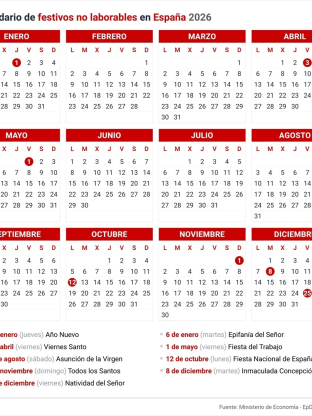
Monday, November 2, 2026 will be a holiday in nine autonomous communities. Since All Saints' Day falls on a Sunday, these territories include the following Monday in their work calendar, which allows those who usually do not work on weekends to string together three days of rest.

The long weekend, however, does not extend to all of Spain. The calendar published in the Official State Gazette distinguishes between the communities that maintain Monday as a day off and those that have opted for other holidays within their powers.

In which communities Monday, November 2 is a holiday

The day after All Saints appears as a work holiday in these nine territories:

* Andalucía.
* Aragón.
* Asturias.
* Canarias.
* Castilla-La Mancha.
* Castilla y León.
* Extremadura.
* Comunidad de Madrid.
* Navarra.

That is how it appears in the official list of work holidays for 2026. Therefore, Monday will be a holiday in cities such as Sevilla, Zaragoza, Oviedo, Las Palmas de Gran Canaria, Toledo, Valladolid, Mérida, Madrid or Pamplona, as they are included in these communities.

Where November 2 is not a regional holiday

Monday is not included as a regional holiday in Baleares, Cantabria, Cataluña, Comunidad Valenciana, Galicia, La Rioja, Región de Murcia and País Vasco. Nor does it appear as a holiday of general scope in Ceuta and Melilla.

In these territories, it is also necessary to check the local holidays of the municipality before concluding that it is an ordinary working day. The regional calendar does not on its own include all municipal particularities.

Why some communities have a long weekend and others do not

The celebration of All Saints remains on November 1. What changes this year is the associated work rest, because that date coincides with a Sunday.

The official calendar identifies November 2 as the day after All Saints and includes it in the communities that have not exercised the power to replace that holiday with another.

That is why there is no identical transfer throughout Spain. The differences are due to the configuration of the work calendars, to which up to two local holidays per municipality are added.

Madrid will have another holiday Monday on November 9, but only in the capital

In Madrid there are two consecutive dates that it is worth distinguishing. Monday, November 2 will be a public holiday throughout the autonomous community. One week later, Monday the 9th, the feast of Nuestra Señora de la Almudena will arrive, included in the calendar of Madrid capital.

Those who work in the city and usually rest on Saturdays and Sundays will be able to connect another three-day weekend. That second holiday does not automatically extend to the other municipalities of the region.

Does being a holiday mean that all stores close?

The condition of a public holiday does not allow one to infer by itself the schedule of each supermarket, store or shopping center. To organize a purchase, it is advisable to consult the specific establishment and its opening calendar.

Nor do all workers necessarily have that day off: the services and activities that operate during holidays maintain their own shifts. The three-day long weekend corresponds to those who can add the Monday rest to that of the weekend.

More key points, information and questions with FREN

AI-GENERATED CONTENT

What is the legal procedure for an autonomous community to move a national holiday to a Monday?

An autonomous community can move certain national holidays to a Monday by approving its labor holiday calendar, within the limits of state legislation. It cannot do so with any holiday: it is necessary to distinguish between moving the rest day to a Monday and substituting a national holiday with another traditional regional holiday.

1. The legal authorization

The basis is article 37.2 of the Workers' Statute. After recognizing the Government's possibility to move national holidays that fall on weekdays to Monday, it adds regarding autonomous communities: "They may also make use of the power to move to Monday provided for in the previous paragraph."

Therefore, there is a direct legal authorization for regional moving. It is not necessary to approve a regional law for each change, but it is necessary to formalize the decision through the competent instrument to establish the community's labor calendar.

2. What limits must be respected
  • Four protected holidays: the power to move holidays that fall on weekdays must respect New Year's Day, May 1st, October 12th, and Christmas. It does not allow freely moving these celebrations when they fall on a working day.
  • Holidays on Sunday: the general rule is to move the rest day to the immediately following Monday. The community may substitute that Monday rest with a traditional local holiday, according to article 45 of Royal Decree 2001/1983.
  • Annual limit: paid and non-recoverable holidays cannot exceed fourteen, including two local ones. These are not fourteen additional regional holidays: the calendar combines national, regional, and local holidays.

Also, moving does not mean substituting. Article 45 allows substituting traditional regional holidays for Maundy Thursday, Epiphany, and Saint Joseph or Saint James the Apostle, as well as the Monday rest days corresponding to national holidays that coincide with Sunday. This substitution has a different scope than the moving power recognized by the Statute.

3. How the decision is formalized

The legal and administrative process is as follows:

  1. Determine the case. The regional authority must identify the holiday, check if it falls on a weekday or Sunday, and specify whether it intends to move the rest day or substitute it with another celebration.
  2. Prepare the calendar. It must include the resulting date and verify respect for protected holidays and the annual maximum. Moving does not by itself create an additional holiday.
  3. Approve and publish the regional decision. The competent body must adopt the corresponding instrument according to each community's organization and publish it in its official bulletin. The cited state regulation does not establish a single form of approval for all communities.
  4. Communicate the holidays to the State. Article 45.4 requires sending the list of traditional holidays and the choice between Saint Joseph and Saint James to the competent labor ministry before September 30. If the substitution list was adopted permanently, it is not necessary to resend it annually.
  5. State publication. The Directorate General of Labor publishes the communicated holidays in the BOE. This is a publicity action, not a discretionary authorization of the move.

In short, the path is state authorization, formal regional decision, and official publicity. The specific internal procedures depend on the community, but its calendar cannot exceed the Statute's limits nor confuse moving with substitution.

What powers does a regional president have in configuring the labor calendar of their territory?

In Spain, the regional president does not decide the labor calendar alone, but does have significant influence through the regional government they lead. Their powers derive from the Constitution, the Statute of Autonomy, and especially from basic state labor legislation (in particular, the Workers' Statute), which sets a common framework within which autonomous communities act.

Broadly speaking, the labor calendar consists of:

  • National holidays, set by the State and partly unmodifiable.
  • Regional holidays, decided by each community within state limits.
  • Local holidays, proposed by municipalities and incorporated into the calendar.
1. What an autonomous community can do about holidays

The state law establishes a maximum number of annual holidays and reserves some dates as "non-substitutable" holidays (for example, certain deeply rooted national holidays). Within this framework, each autonomous community has the power to:

  • Determine which days will be regional holidays (for example, the community day) up to the quota allowed by state law.
  • Substitute some "substitutable" national holidays with other dates of special local significance (traditions, important local festivals, etc.).
  • Coordinate with municipalities the designation of local holidays that complete each municipality's labor calendar.

These decisions are not made by the president "by acclamation": formally, they are adopted through agreements or decrees of the regional Government Council, which is the collegiate body governing the community and which the president leads.

2. Specific role of the regional president

As head of the regional executive, the president practically has these powers or levers over the labor calendar:

  • Political drive and guidance: sets the general line on whether to prioritize maintaining more traditional holidays, concentrating long weekends, promoting tourism activity, etc.
  • Direction of the Government Council: presides over meetings where decrees setting the community's holidays and, if applicable, substitutions of national holidays are approved.
  • Coordination with competent ministries: usually, the technical proposal is prepared by the ministry of labor, employment, or equivalent; the president can request adjustments, negotiate territorial or sectoral balances, etc.
  • Political and social interlocution: can open or close debate with social agents (unions and employers), economic sectors (e.g., tourism or commerce), and local entities about the most appropriate holiday configuration.

In summary, the president does not sign a "labor calendar" isolated from the institutional structure, but leads the government that has the power to set regional holidays and to decide how to use the substitution possibilities allowed by state law.

3. Limits of their powers

There are clear limits the regional president cannot exceed:

  • Cannot alter the basic state framework: cannot freely increase the total number of holidays nor eliminate national holidays declared unmodifiable by law.
  • Cannot unilaterally change private labor conditions

It is important here to distinguish:

  • The calendar of working and holiday days (which is partly set at the regional level).
  • From other labor aspects such as weekly working hours, overtime, vacations, or leaves, which are regulated by state law and collective agreements. The president cannot modify these for the private sector by a simple regional political decision.
4. Other related powers

Besides holidays, the president and their government indirectly influence the work calendar through:

  • Regional public service: the community sets the labor calendar for regional administration staff (working days, internal non-teaching days, etc.), always respecting legal minimums.
  • School calendar: in communities with full education powers, the regional government approves the academic calendar (start and end of the school year, vacations, non-teaching days), which affects the organization of time for many families and sectors.
  • Sectoral regulation: can issue rules on commercial hours, tourism campaigns, or economic activities that, while not strictly "labor calendar," condition work organization in certain sectors.
5. Conclusion

The regional president has a relevant but framed capacity to influence the labor calendar of their territory. They do not freely design all working and holiday days, but through the Government Council, they can decide which regional holidays the community establishes, how to use the substitution possibilities for national holidays, and how to coordinate with municipalities and social agents. All this always within the limits set by the State's basic labor legislation, which reserves for itself the design of the general framework of the work calendar in Spain.

Could you explain in more detail what margin communities have to substitute national holidays with regional ones? How does the regional president's competence over the labor calendar differ from that of the central Government? What role do municipalities play and how does a regional president coordinate local holidays with regional ones?

What was the result of the last regional elections in the Community of Madrid?

The last regional elections in the Community of Madrid were held on May 28, 2023. The People's Party, led by Isabel Díaz Ayuso, won with 70 of the 135 seats in the Assembly and obtained an absolute majority. Más Madrid and PSOE each obtained 27 deputies, while Vox secured 11.

Results of candidacies with representation

Four candidacies entered the Madrid Assembly. The distribution of votes and seats was as follows, according to the official 2023 results:

  • People's Party: 1,599,186 votes, 47.32%, and 70 seats. It was the most voted candidacy and the only one to reach an absolute majority on its own.
  • Más Madrid-Verdes Equo: 620,631 votes, 18.36%, and 27 seats. It ranked second by number of votes, although tied with PSOE in deputies.
  • Spanish Socialist Workers' Party: 614,296 votes, 18.18%, and 27 seats. It came third by votes, 6,335 votes behind Más Madrid.
  • Vox: 248,379 votes, 7.35%, and 11 seats. It was the fourth candidacy by votes and parliamentary representation.

What the result meant

The decisive figure was 68 deputies, the threshold for an absolute majority in a chamber of 135 members. The PP obtained 70: therefore, it was two seats above that minimum. It did not exactly reach the threshold, but a sufficient majority to surpass all other groups combined on its own.

The main political consequence was that the PP had the deputies necessary to sustain a government alone, without needing votes from Vox or another party to reach that majority. The other three groups totaled 65 representatives: 27 from Más Madrid, 27 from PSOE, and 11 from Vox. The composition resulting from the polls can also be consulted at the Madrid Assembly.

Another relevant aspect is the difference between leading in votes and obtaining more deputies. Más Madrid received more votes than PSOE, but that advantage did not translate into an additional seat: both ended with 27. Thus, the second and third candidacies were equal in parliamentary representation.

Candidacies that were left out

Podemos-IU-Alianza Verde obtained 161,032 votes and 4.76%, but did not gain representation as it fell below the 5% electoral threshold. Ciudadanos received 52,925 votes, 1.57%, and also did not obtain deputies. The remaining candidacies without seats were:

  • PACMA: 23,451 votes and 0.69%.
  • Por un Mundo Más Justo: 7,219 votes and 0.21%.
  • Feminist Party of Spain: 5,376 votes and 0.16%.
  • Communist Workers' Party of Spain: 4,148 votes and 0.12%.
  • Spanish Falange of the JONS: 2,779 votes and 0.08%.
  • Union for Leganés: 2,544 votes and 0.08%.
  • Humanist Party: 2,404 votes and 0.07%.

In short, the electoral result was PP 70, Más Madrid 27, PSOE 27, and Vox 11. These figures correspond to the elections held, not to estimates from subsequent polls: the central conclusion of May 28, 2023, was the PP's absolute majority in the Madrid Assembly.

Play

Test your knowledge with FREN!

How much do you know about this topic? Answer the following 3 questions.

Why is Monday, November 2, 2026, a holiday in some autonomous communities?

Question 1 of 3

What happens in Madrid city the week after November 2, 2026?

Question 2 of 3

What does the news indicate about the closing of shops on holidays?

Question 3 of 3