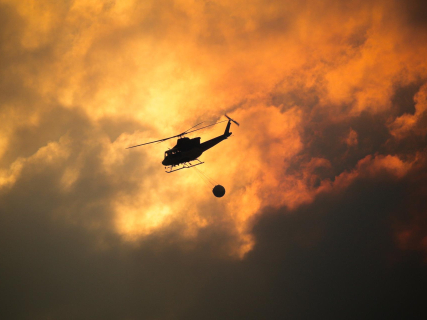

Between January 1 and October 31, 2026, forest fires swept through 5,318.9 hectares in Galicia, a figure far removed from the nearly 120,000 hectares devastated during the wave of fires in 2025.
This balance places 2026 as the fourth year with the least burned area in the last decade in the community, only ahead of 2018 (2,599.66 hectares), 2024 (2,644.70) and 2021 (4,403.18). On the opposite side are the major waves of 2025 (118,763.65), 2017 (62,096.26) and 2022 (51,642.58).
In her report to the Galician Parliament on the closing of the high-risk period —which this year ran from July 1 to October 31—, the conselleira do Medio Rural, María José Gómez, underlined that in 2026 there were "fewer fires", "less area" affected and a "faster response than last year". She stressed that these data are presented "without any triumphalism", because "there is no room for self-satisfaction".
Of the total land affected in 2026, about 3,100 hectares correspond to tree cover and the rest to scrubland. Only two large fires were recorded (more than 500 hectares): the one in Ponteareas, with 886 hectares burned in April, and the one in Calvos de Randín, with 520 hectares in September.
Gómez recalled that in 2025 there were 1,470 fires, compared with 1,227 this year, which represents a decrease of 16.5%. The destroyed area was reduced by 95.6% compared with the previous year.
She detailed that 933 outbreaks occurred, so that eight out of ten fires did not exceed one hectare. The average response time was 20 minutes.
Situation 2, which is declared when there is risk to homes, was activated on seven occasions in 2026, far below the 105 times in 2025, that is, 98 fewer.
The conselleira stressed that these results come in the hottest summer since 1961, accompanied by 22% less rainfall.
Likewise, she contrasted the Galician trend, "very below historical references", with the rise in the area affected in Spain as a whole in 2026, where almost twice the average of the last ten years burned.
Investigation of causes and role of the electrical and railway networks
One of the aspects on which the conselleira do Medio Rural placed emphasis was the work of the Unidade de Investigación de Incendios Forestais, which analyzed 819 of the 1,227 fires recorded, 70% of the total, of which 438 were due to non-forest incidents. Since the creation of the UIFO, 142 people have already been investigated in Galicia for causing fires.
In this context, she pointed out that 30 incidents linked to the electrical grid and another 16 related to the railway network were detected. She added that Adif has been requested for its fire prevention work planning.
Among the additional data, she highlighted the new ALume application, launched this year so that citizens can report fires through an 'app', which received 400 alerts.
Gómez recalled that last year she already stated that "Galicia does not burn, Galicia is burned," "with intent or without it".
Labor reinforcements and budget for prevention
The conselleira recalled that this year two agreements were signed with the union representation to improve the service's working conditions, with an investment of 6 million euros. She emphasized that the coverage of positions in the device exceeded 99%.
In addition, she advanced that the Dirección Xeral de Defensa do Monte will have more than 226 million euros in 2027, 5.8% more, and that the 25 million destined to biomass management in the protection strips of population centers will be maintained.
She also indicated that 301 of the 313 Galician municipalities are adhered to the agreement for strip clearing, so she urged the remaining dozen to join. Of the total, "183 municipalities requested actions, if they do not request actions it is understood that things are fine". At the same time, she lamented that the Federación Galega de Municipios e Provincias (Fegamp) does not participate.
Opposition criticism and political debate
During the parliamentary debate, Montserrat Valcárcel (BNG) maintained that this year there is less burned surface because "there was nothing left to burn" and warned "whoever confuses a year of luck with a success in management".
She reproached the Xunta for limiting the fire season to "summer" and cited as an example that this year's fire plan (Pladiga) was approved in April, when the worst fire of the year was recorded in Ponteareas.
The BNG called for data on all fires that occur in Galicia to be published, and not only those that exceed 20 hectares, as the regional government does. It also asked that the nine-month brigades be allowed to work all year and denounced the "precarity" of having hired a reinforcement of 42 brigades for only 90 days.
For her part, Carmen Rodríguez Dacosta (PSdeG) criticized the Xunta for "not complying with the legal deadlines" to present the 2027 Pladiga, which, she warned, should be known now and "not on the eve of summer." She described as "intolerable" that the Galician Executive supplied defective self-rescuers to the brigadistas and that their food be limited to "a chorizo sandwich."
Rodríguez Dacosta demanded that Medio Rural detail by districts and municipalities which prevention works have been "actually carried out". She questioned that the conselleira asks Adif for information about clearing and "does not do the same" with her own actions. "Do what you ask of the State," she concluded.
In defense of the regional government, Miguel Ángel Viso (PP) valued the balance "without triumphalism" presented by the Xunta and called for "not to remove from the debate" the "responsibility of whoever deliberately causes a fire".
Armando Ojea (Democracia Ourensana) summed up the campaign by noting that, with the "amount of hectares that burned last year, there was little left to burn" and recalled that mayors "of all political persuasions continue to request aid".
In her replies, the conselleira accused the opposition of being "ensconced in pessimism". She defended that the "absolute priority" is safety, which is why "action was taken immediately" when problems with the self-rescuers were detected, which were replaced, and added that Galicia "is one of the few communities that has them" and "they are not mandatory".
She closed her intervention "with the conviction of having done the job" in this campaign and announced that "shortly she will begin the parliamentary processing" of Galicia's future anti-fire law.
Memory of the victims and controversy over Angrois
All the participants in the appearance, including the conselleira herself, dedicated a few words to the victims of the Urda accident. However, Montserrat Valcárcel asked that they "not have to go through the ordeal that the victims of Angrois had to go through" and reproached the PP for blocking "on up to four occasions" the investigation in the Galician Parliament.
In response, Viso (PP) replied to the Bloc that "their party was a handclapper to a government that was dedicated to spending the money on escort girls instead of road maintenance".