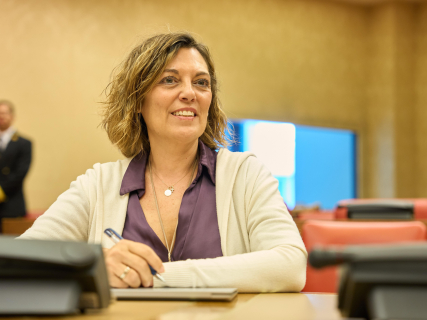

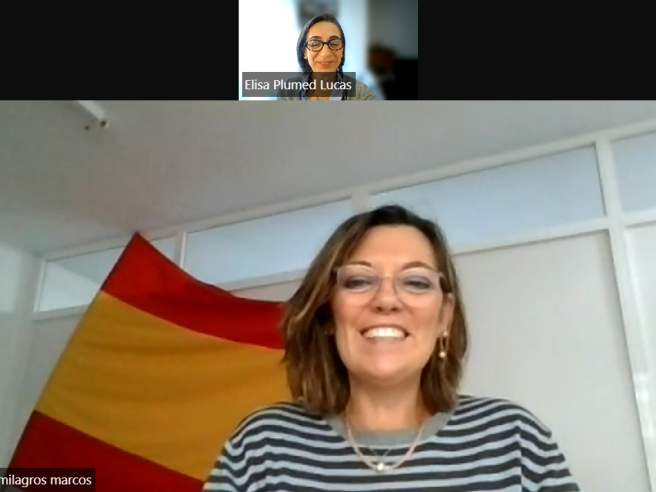
Democrat interviews, via a video call, Milagros Marcos, former advisor for Agriculture of Castilla y Léon, coordinator for Rural Environment, Depopulation and Forest Policy in the Partido Popular and head of the list for the province of Palencia. The actions from the first week of the campaign are reflected in Marcos, who apologizes for having “a terrible cold” that does not allow her to be at one hundred percent. During the conversation she explains that the electoral proposals of her party come from various white papers in which they have worked in the PP over the past year.
Q. What are the three main proposals of the Partido Popular for the primary sector?
A. The PP not only has an electoral program; it has a government program, which is the White Paper for the rural and coastal world. This White Paper sets out a National Pact for the rural world, signed and endorsed with farmers, ranchers, timber managers and fishing. A pact that goes beyond a single legislature, that establishes commitments with the Autonomous Communities, with the Federation of Municipalities and Provinces, because they are the ones who are in the territory, and that makes key a sufficient level of funding to activate profitability in the primary sector. If there are no people, it will be difficult for us to be able to maintain the primary sector. That is why we carry a package in which we propose a law for generational renewal, employment and talent.
Q. In addition to that National Pact with the rural world, what other measures does she highlight from her program?
A. Improve the income and the position of farmers and ranchers in the food chain so that they earn with their work, ensure them with water and a PAC well funded that allows them to sell and gain competitiveness.
Q. Her party proposes to lower taxes for those who live in the rural environment. Who will it affect: municipalities with fewer than 15,000 or 5,000 inhabitants? How will they define rural environment?
R. That is already defined in European regulation. We don’t have to reinvent the wheel; we don’t have to be strict in the definitions, but apply common sense in the territory. What we want is for municipalities to have economic activity again, to activate the economy in the rural world. We propose a taxation of practically zero on the transfer of land, so that young people can be incorporated and so that they can also buy a home. And a law that reduces bureaucracy with a new mechanism in which there is a one-time information principle, with the aim of very powerful administrative simplification.
The Socialist Government has confused environmental protection with inaction.
P. They also point to a National Water Pact. Is it related to the National Hydrological Plan? How does the PP propose it for 2026?
R. Just as we have a working document on the rural world, we have very serious work on the challenge of water, one of Spain’s major problems. In our white paper we propose a national strategy for irrigation and for new irrigation that has been paralyzed during this time by the Socialist Party. There was money from European funds, but the Ministry for Ecological Transition has not approved environmental impact assessments and we have the majority of works paralyzed. The same happens in other areas: the review of the Forest Law has harmed the primary sector; we have four million fewer head of livestock and two million more head of wild boar. There are rules that go against economic activity in the rural world; they have benefited wildlife over extensive livestock farming, which is the one that clears the territory. The Socialist Government has confused environmental protection with inaction.
P. The Popular Party promises that it will apply to third countries what is known as mirror clauses...
R. No.
P. No? Then, what do they mean when they say that imported food must meet the same requirements as those in Europe?
R. Reciprocity, so that the sector becomes profitable again. And for that there are two lines: a properly financed CAP in which farmers and livestock farmers do not lose purchasing power, andcompete in the markets on equal terms. And at this point in the markets, it is necessary to review the Law on the food chain, for which we propose that there be criteria that calculate production costs, and that the sixth-generation clauses that we have managed to have incorporated into the Mercosur Agreement be applied in all trade agreements. So that if there is a 5% alteration in the price or in the volume of food compared to what is proposed in the agreement, it is automatically put on hold. And it also includes reciprocity, which means that the same rules are complied with regarding the use of substances that guarantee food safety.
We do not want to close borders, but Europe has to protect its strategic autonomy.
P. And doesn’t this last one mean mirror clauses?
R. No, because in them it is also asked that the wage cost or the environmental measures be the same and there you can’t infer it. We do not want to close borders, but Europe has to protect its strategic autonomy.
P. Several professional farming organizations submitted their requests for the countryside to the political parties that contest the general elections. Among them was the need to rein in production costs or the creation of a Statute of the professional farmer. How are they going to take these proposals into account?
R. The entire White Paper that we have been working on in the PP is aimed at boosting primary activity, the farmer’s profitability; therefore, farmers’ participation has to be direct. Production costs in Spain are a barbarity; they have skyrocketed exponentially. We are proposing to maintain the aid, but the one proposed by the European Union, because it allows financing up to 70% of the increase in the cost of fertilizers and diesel when the socialist government has left it at 30-40%.
P. In the PP’s electoral program, in each block there is an unknown surprise measure and they urge people to be attentive during the campaign to find out what it is. What is the number 200 measure that corresponds to the rural world?
R. That no regulation affecting the countryside will demand more than what is requested from Europe.