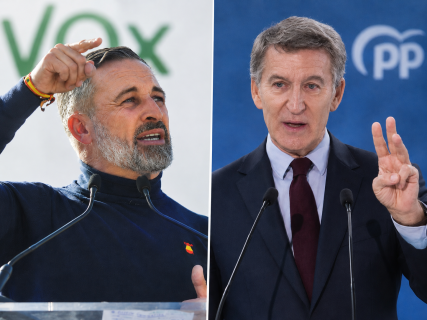

The explanation is in expectations. Each match arrives with a different benchmark to measure its result and with a different need to convert seats into power. The 130 for the PP and the 60 for Vox are the political thresholds of this analysis. For the PSOE, the promise of victory has raised the bar above mere resistance.
As was the case with Jorge Azcón’s 29 in Aragón or Juanma Moreno’s 55 in Andalucía, a single figure can change the interpretation of the whole night. In the general election, the distribution between parties must be read together with the total for the investiture.
Feijóo’s 130: winning fewer seats and gaining more power
The first number the PP will have to watch is 130. It is the reference in which it is placed by the average of parliamentary projections published by Demócrata on November 21, versus the PSOE’s 112 and Vox’s 64.
Breaking through that barrier, opening a clear gap from the socialists, and having a majority alongside Vox would allow Feijóo to present the result as a victory. Even if it came in below the 137 deputies obtained in 2023, it would still have achieved what then slipped away: a sufficient route to reach La Moncloa.
The comparison requires looking at where the right-wing is growing. If an important part of its advance is concentrated in Vox, the PP could fall back individually and benefit from a stronger bloc. The price would be a greater dependence on Abascal.
That is why surpassing 130 would have political value, but it would not solve the test on its own. Staying at 129 with a viable majority would be more useful for Feijóo than reaching 140 without enough support. The bar serves to interpret expectations; the total determines the chances of governing.
The distance from Sánchez will add another reading. A clear victory would reinforce Feijóo’s authority within the PP and in the negotiation with Vox. A minimal advantage would leave more room for discussion about who came out strengthened from the campaign.
The PP’s campaign: young people, the Basque Country, and a favorable debate
The popular campaign has managed to combine three recognizable fronts: contesting the young vote, projecting territorial presence, and turning the debate into a test of the Government. That consistency makes it possible to assess favorably its communications execution so far, although its electoral effectiveness will be proven at the ballot box.
The reuse of the “Anotop At” gaffe turned a Feijóo mistake into campaign material. To that pursuit of closeness were added his interviews on *The Wild Project* and *El sentido de la birra*, as well as the video sent to *Línea de Cal*: an exhibition aimed at audiences who do not necessarily follow rallies or the news. [www.europapress.es](https://www.europapress.es/nacional/noticia-pp-recupera-campana-lapsus-anotop-at-feijoo-buscar-voto-joven-redes-sociales-20261112224745.html?utm_source=chatgpt.com)
The move to the Basque Country added another register. On November 17, Feijóo visited Eibar and Bilbao after the assault suffered by the candidate Jon Echeverría in Hernani. There he backed his candidates and asked for the vote from disenchanted PSOE and PNV supporters.
The face-to-face on November 19, organized by the Academia de Televisión and broadcast by several channels, also left him with a favorable assessment. Ateneo del Dato placed Feijóo as the winner among 45.2% of those polled, compared with 31.9% for Sánchez. In that same survey, only 1% said they would change their vote.
The distinction matters: the PP has gained an advantage in how the meeting was rated, but it still needs to convert it into ballots. The analysis by Poder Digital for Demócrata also recorded a better overall reception of Feijóo on the social networks examined, although Sánchez stood out in social policy and the economy.
The image of a street that calls for change is part of the battle the PP is trying to win. To consolidate it, it needs something more than crowded events or shared videos: finish first, break away from the PSOE, and gather a majority. If it achieves all three, the setback compared to 2023 will lose weight in the political balance.
Sánchez and the 100 seats: a bar too low to sell a victory
The PSOE has a different problem: preventing the comparison from being made against a reference chosen so that any result looks like a comeback. Surpassing 100 deputies cannot be turned into an automatic pass.
That scenario appeared in public polls. Sigma Dos published on November 2 a range of between 97 and 103 seats for the socialists, despite placing Frente Amplio between nine and eleven. Therefore, the figure cannot be attributed exclusively to a PSOE leak, nor treated as an unbreakable floor.
Political criticism remains valid: measuring the PSOE only against its lowest forecasts greatly lowers the bar. For example, a result of 108 seats would exceed 100 and would still represent a loss of 13 compared with 2023.
The weakness of the alternative left is also not a minor detail. It offers Sánchez an opportunity to concentrate support and raises the bar on his ability to mobilize. But those voters may stay home, choose another candidacy, or switch blocs; they do not belong to the PSOE in advance.
The 2023 reference helps to understand the mechanism. The last 40dB. tracking. published before 23J projected 110 socialist seats. The final result was 121, which facilitated a read of recovery. The possibility of building a majority afterward turned that resistance into continuity in government.
Now, surpassing a low expectation will be insufficient if the PSOE ends up far from the PP and loses any option of investiture.
The socialist campaign: too many changes of register for a mobilizing message
The PSOE has shown it can recover during other campaigns. The one of 29N, however, offers reasons to question the continuity of its message: it has had to fit crises, defend its handling, explain changes in strategy, and recover afterward the mobilizing tone.
Óscar Puente’s departure was one of those turns. As RTVE reported, the minister himself said that he had informed Sánchez of his resignation minutes before announcing it. A few days later, the president turned that renunciation into an argument of exemplary conduct against the PP and Vox.
The maneuver sought to regain the initiative, but it forced the campaign argument to be rebuilt around a crisis that the government was managing. In communication terms, that need to adapt the message consumes time and displaces the proposals.
The debate added another strain. The socialist sources cited by laSexta explained that Sánchez had chosen a strategy of moderation, linked to the ideas of William E. Connolly, to attract undecided voters and voters far from confrontation. They admitted that it was a risky bet, different from what part of his electorate expected.
Then came the return to a mobilizing speech in Santiago de Compostela, reported by Demócrata. The problem is not that a candidate speaks to different audiences. The problem is that the connection between his messages is clear enough that the moderation of one day does not seem like a lack of response and the confrontation of the next does not seem like a correction.
The priority of concentrating progressive votes makes sense in the face of a fragmented left. It also makes sense to try to attract moderates. The difficulty for Sánchez is to show that he can do both things without losing momentum or throwing his own voters off.
In any case, the polls keep the PSOE competitive. The Demócrata cut records a distance of seven tenths from the PP in 40dB., compared with Data10’s 5.7 points. That difference prevents confusing a critical assessment of the campaign with a defeat already decided.
The victory Sánchez promises: a bet with more risk than resistance
Sánchez has personally raised the bar. On November 15, he said in La Séptima: "There is going to be mobilization; we are going to win the elections". On the 21st, on Onda Cero, he again appeared confident that the PSOE would be the leading force.
The expectation also finds support in some projections. The SW Demoscopia report for La Séptima delivered on November 19 placed the PSOE first, with 133 deputies.
The benefit of promising a victory is that it is mobilizing: it invites participation in an election that is presented as open. The cost appears if a clear defeat arrives. After announcing that it can be won, it becomes harder to ask party members to celebrate having surpassed the lowest forecasts.
Here is the difference from 2023. Back then, improving expectations helped turn second place into resistance. This time, if the PSOE ends up clearly behind and without an alternative majority, the gap between what was promised and what was obtained could increase internal disappointment.
A tie or a narrow defeat with chances of governing would have another interpretation. For Sánchez, the position in the standings and continuity in La Moncloa remain two different outcomes.
Vox’s 60: grow a lot and seem that it has grown only a little
Vox faces a particular pressure: to compete against an expectation of very high growth. Reaching 60 deputies would mean adding 27 compared with 2023 and exceeding by eight its maximum of 52, obtained in November 2019.
That leap would be a historic success. But when polls accustom the public to figures close to or higher than that, an also very high result can seem insufficient. The parliamentary average published by Demócrata on November 21 places Vox at 64 seats.
Abascal has tried to contain that risk. On November 10, he avoided anticipating his entry into a Government and recalled that the expectations for change in 2023 were not met. That prudence allows maintaining a certain distance from the premature distribution of posts.
It is in that sense that a lateral position can be spoken of with respect to the presidential dispute between Sánchez and Feijóo. This does not equate to an invisible campaign: Abascal has sought his own exposure, including his interview with Broncano.
Vox’s assessment will also depend on its usefulness to the PP. Securing 55 deputies and being indispensable for an investiture can give it more power than reaching 60 without there being an alternative majority. The record and the capacity to condition the next Government must be measured separately.
The setback for Vox: Jordi Wild does not explain a poll by itself
The 40dB tracking. published on November 17 placed Vox at 17.5%, about a point less than a week earlier. It also detected a reduction in transfers coming from former PP voters.
The coincidence with the controversy over the cancelled interview with Jordi Wild has fueled a simple explanation for the movement. But a timeline does not allow attributing all the variation to that episode.
Sampling changes, estimation adjustments, or real movements of voters may also play a role. The hypothesis of a statistical correction deserves consideration, although it would need methodological documentation to be presented as the cause.
What will matter for election night will be to check whether the PP gains ground within the right and how much Vox retains. A shift between the two can change the balance of a negotiation without substantially modifying the prospects for alternation.
| Reference | Seats | What will have to be checked |
|---|---|---|
| PP | 130 Political threshold | If it surpasses it, it moves away from the PSOE and gathers support to govern. |
| PSOE | 121 2023 result | If it improves its result, it fulfills the promise of coming in first and preserves a possible majority. |
| Vox | 60 Political threshold | If it meets expectations and turns its growth into the ability to condition the PP. |
| Absolute majority | 176 First investiture | If there is an agreement that brings together those votes. In a second vote, more yeses than noes are enough. |
Broad Front: national weakness is decided province by province
Broad Front arrives with limited parliamentary capacity in several projections. The SW Demoscopia report delivered on November 19 attributed eleven seats to it. The comparison with the 31 of Sumar in 2023 must consider that the composition of that space and the candidacies have changed.
Its test consists of maintaining representation where it competes for the last seats. A national figure can hide very different results: keeping MPs in several provinces or accumulating votes that do not translate into representation.
For Sánchez, the consequence is direct. Absorbing the vote of the alternative left can strengthen the PSOE, but harm the sum if an allied MP disappears without socialist compensation.
That is why, a good individual result for the PSOE does not guarantee a good result for the overall progressive group. Broad Front will have to demonstrate that it maintains a sufficient parliamentary contribution to participate in a majority.
Territorial parties: they can grow and lose influence in Madrid
Nationalists and regionalists are measured with different criteria. ERC and Junts compete for their position in Catalonia; EH Bildu and PNV compete in the Basque Country; BNG and Coalición Canaria have their own territorial references. Their electoral success does not depend only on what happens to the PSOE.
Their ability to influence the next Government, on the other hand, will be conditioned by the sum of PP and Vox. If both reach a sufficient majority, several territorial parties could improve their results and find themselves with a Congress that needs them less.
If they do not, supports and abstentions will gain importance again. But those seats cannot be incorporated automatically into a Sánchez majority: each formation will have its own conditions and its own incentives to negotiate.
The 176 and the last seats: where it will be decided who governs
The absolute majority in the Congress is 176 deputies. An agreement that reaches that figure makes it possible to get past the first investiture vote; in the second, it is enough to obtain more votes in favor than against. That is why staying at 175 does not automatically mean being left out of Government.
These scenarios make it possible to visualize the difference between meeting expectations, coming first, and having a majority. They are arithmetic examples, not forecasts. The count will require following the last deputies from each constituency. A seat that goes from Frente Amplio to the PSOE changes the internal distribution of a possible bloc; one that goes from a progressive candidacy to PP or Vox directly alters the sum for the investiture.
When the differences are narrow, it will also be necessary to check which provinces are behind in the scrutiny and what remains pending from the external vote and the general count. The provisional figures from election night do not replace the final result.
| Example | PP + Vox | What it would imply |
|---|---|---|
| PP: 131 Vox: 60 | 191 15 above the majority | Both would exceed their thresholds and could invest Feijóo if they reach a pact. |
| PP: 129 Vox: 60 | 189 13 above the majority | Feijóo would not break 130, but would keep a sufficient path to govern with Vox. |
| PP: 131 Vox: 44 | 175 1 below the majority | The PP would exceed 130, but would need other support or sufficient abstentions. |
| PSOE: 134 PP: 130 Vox: 46 | 176 Absolute majority | The PSOE would be first in seats, but PP and Vox could form an alternative majority. |