
"Let's see if this ends already" or "how long this is taking" are some of the most repeated phrases these days. In political backrooms, newsroom offices of newspapers, but also on the street. Living through a constant pre-election campaign means that, when the official campaign arrives, the forces and patience are already at their lowest.
Although it seems unbelievable, political parties only have nine days to ask for the vote openly for 29N, and they still have another five days to appeal directly to the electorate. On the morning of November 13, Spain woke up papered with posters and with the faces of the candidates for the presidency of the Government on every corner. With the law in hand, the campaign had begun: 15 days, with their days and their nights, regulated by the Organic Law of the General Electoral Regime (LOREG).
But if these two weeks feel long for ordinary mortals, it is worth remembering that for almost two decades, the campaign was even longer.
I present myself
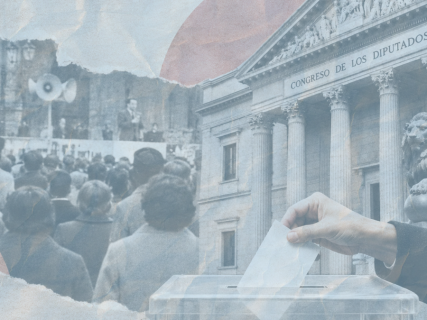
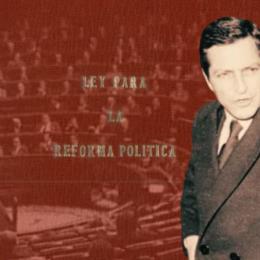
On May 24, 1977, Spain made its debut in the electoral race. There were 21 days left until the first general elections since the Second Republic and (almost) everything had yet to be done. It was necessary to organize a campaign practically from scratch, in which parties newly legalized took part, organizations with little electoral experience, and thousands of candidates unknown to a large part of the citizens. The roadmap was the Royal Decree on Electoral Rules, which gave concrete form to the Law for Political Reform promoted by the Government of Adolfo Suárez.
The streets began filling with posters, the parties multiplied their rallies, and television became one of the great showcases on the road to democracy, as recalled by the Congress blog in "21 days to invent yourself". On the occasion of the anniversary of those first elections, several constituent deputies recalled in DEMÓCRATA how that campaign was, for which they did not have a "manual of instructions".

Featured story
Without an instruction manual, this is how the campaign for the first elections was designed
4 minutes
The LOREG is coming
Eight years later, the approval of the LOREG established a common framework for Spanish electoral processes after a decade in transition. It was 1985, the socialist Government had already been in power with an absolute majority for two years, and the legal framework of the State was beginning to take shape. Entry into the European Economic Community was just around the corner, and the country had to align its institutions and processes with those of our neighboring countries.
However, that law still did not set a single duration of fifteen days for the election campaign. The original wording established that the campaign would last a minimum of fifteen days and a maximum of twenty-one. There was therefore a legal margin of six days that would disappear years later.
Official duration of the election campaign:
1977 - 21 days
1979 - 21 days
1982 - 21 days
1986 - 21 days
1989 - 18 days
1993 - 15 days
The situation changed in March 1994, when a reform of the LOREG was approved. In its first article it addressed precisely the duration of the campaign and replaced the previous interval with a provision of barely three words: "It lasts fifteen days." Since then, that period has been the general rule for Spanish elections.
Spend less on elections
The reduction of the campaign was one of the measures of an electoral reform whose main concern was economic. The statement of reasons for the law explicitly included the need to reduce election expenses and improve the mechanisms used to control them.
The most relevant measure, along with the new schedule, was a 20% reduction of the maximum limit on election spending. The Executive also decided to intervene on some of the main spending items of the parties. Outdoor advertising was limited to 25% of the maximum election budget, while advertisements in periodicals and private radio stations could not exceed 20%. In addition, the reform prohibited placing banners and placards outside the free spaces reserved by town councils and kept for posters other authorized commercial spaces.
Featured story
“Girls’ yes”: half a century since the day when the Francoist Cortes voted their own end
3 minutes
Candidacies retained the possibility of contracting advertising in private media, although the law required that the rates not be higher than commercial rates and that no political formation suffer discrimination in contracting conditions.
With eight it serves:
The rule of the fifteen days has an exception since 2016, when Spain found itself compelled to hold an election repetition for the first time in its history.
The elections of the 20 December 2015 left a fragmented Congress and, given the impossibility for any candidate to secure the necessary support, the Cortes were dissolved.
After that experience, the parliamentary majority agreed on the need to reform the LOREG to establish a shorter procedure in future deadlocks of investiture.
Accordingly, when general elections must be repeated because Congress fails to invest a president of the Government, the election campaign is reduced to eight days.
The change also affected party funding: the electoral subsidies per vote and seat and the maximum limit on electoral spending were reduced by 50%.
This "express campaign" was applied for the first time for the general elections of 10 November 2019, when Spaniards were called to the polls again for the second time in six months.