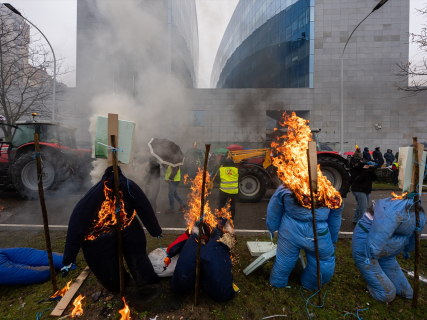

Tension returns to the Castilian-Leonese countryside (if it ever dissipated). Farmers and ranchers from Castilla y León are called this Tuesday to a new major mobilization in Valladolid in a unified protest with which the sector wants to show its strength again in the face of a situation it considers unsustainable. The call comes after months of accumulated discontent due to production costs, low prices, regulatory pressure, and the feeling that neither the central government nor the regional government are offering sufficient responses.
The protest is not an isolated mobilization nor a simple rehash of past tractor demonstrations. The main agricultural organizations in the community have closed ranks to stage a joint protest at a particularly sensitive time for a large part of the primary sector, with farms reporting loss of profitability and a progressive deterioration of economic conditions for continuing to produce.
These are the keys to understanding what is happening.
Who is calling for the mobilization?
The protest has been jointly called by the main agricultural professional organizations of Castilla y León: ASAJA Castilla y León, Alianza UPA-COAG, and UCCL (Unión de Campesinos de Castilla y León).
Unity of action is not a minor detail. These organizations do not always come together with the same approach, so the image of a united front seeks to reinforce the political message of the seriousness of the moment the sector is going through.
When and where is the protest?
The mobilization is called this Tuesday May 20 in Valladolid, with the start scheduled for 11:30 AM from Plaza de Zorrilla.
The route includes key symbolic and institutional points, with a presence before the Government Delegation and the Ministry of Agriculture, Livestock and Rural Development, in a message directed at both the central Executive and the regional administration.
What do farmers and ranchers demand?
The core of the discontent is economic. Agricultural organizations denounce a structural profitability crisis derived from several accumulated factors:
- Increase in production costs.
- Rising fuel prices.
- Increase in fertilizers and supplies.
- Low prices at origin.
- Bureaucratic pressure.
- Growing difficulties in maintaining viable farms.
But the discontent goes beyond the short term. The sector denounces that producing costs more and more, selling continues to be unrewarding, and generational replacement is becoming increasingly difficult.
Why are they protesting now?
Because they consider that the situation has become chronic and that political responses are not resolving the underlying problem. Agricultural organizations have been warning for months that many farms are operating at the limit, especially after complicated campaigns marked by drought, market instability, and generalized cost increases. The underlying message is clear: it is not just about one-off aid, but about the survival of the production model.
What do the agricultural organizations say?
The president of ASAJA Castilla y León, Donaciano Dujo, has insisted in various public appearances on the need for urgent measures to guarantee profitability and stability for the sector.
From the Alianza UPA-COAG and UCCL, the discourse is along the same lines: they denounce a lack of effective responses and demand structural changes that allow farmers and ranchers to work under economically sustainable conditions.
The common message is that the countryside cannot continue to absorb extra costs while uncertainty increases.
From whom do they demand answers?
From both levels of power. On the one hand, from the Government of Spain, for regulatory issues, energy costs, agricultural policy, and decisions that affect the economic framework of the sector.
On the other hand, from the Junta de Castilla y León, from which they demand more forceful regional support, dialogue, and specific measures for the Castilian-Leonese countryside.
Could there be more mobilizations?
Yes. If there are no advances or concrete commitments, the farmers and ranchers of Castilla y León leave the door open to new protests. The mobilization in Valladolid seeks to send a clear political message, but also to measure their capacity for pressure in a community where the economic and symbolic weight of the agricultural sector remains enormous.