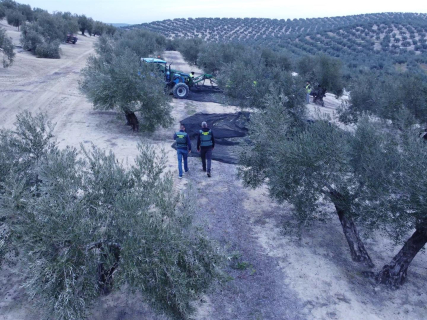

The Government delegate in Extremadura, José Luis Quintana, has pointed out that olive thefts have decreased by more than 40 percent during the last two campaigns, and has highlighted the work carried out by the Civil Guard to achieve this decrease.
In relation to the Security Board held this Thursday in Almendralejo, he explained that in that meeting the data from the previous campaign was reviewed. In that analysis, it was confirmed that, while in the last two campaigns no declared theft of grapes has been recorded, in the case of olives, thefts have decreased by more than 40 percent.
Given this difference, he has questioned "why olives are stolen and grapes are not stolen" and has pointed out that there is "a cause," which links to the fact that grapes "always go to a winery where they are transformed," while olives "if they go to buying posts there is a greater risk."
"Because the things that are stolen are because they have an outlet in the market, if they do not have an outlet in the market, they are not stolen. That is a reflection that I leave there and we, as the General Administration of the State and, in this case, the Civil Guard, what we try to do is prevent all types of thefts, in this case of olives," he stated, also emphasizing the need to "not let our guard down" with any other product, with the aim of preventing crimes "and, of course, trying to make it as minimal as possible."
He warned that, as long as there are buying and selling posts for olives, "we have a risk," given that "as long as someone buys that olive we have a risk." In this context, he recalled that the Junta de Extremadura approved last year a decree that regulates the traceability of this product in the community, "which has given its benefit," although he believes that it should advance "much further to try to avoid it."
"Why are other products not stolen? That is the question we should ask ourselves. Tomatoes are not stolen, we are in the middle of the campaign. Grapes are not stolen. So, that is the question we will have to ask ourselves," he reiterated, defending the improvement of security within the competencies of each administration and emphasizing that it is a food for which, in his opinion, "all controls aimed at traceability defend the sector."
Regarding the deployment of the Civil Guard, he specified that the operation will be the same as last year, given that "it has worked." At the same time, he recalled that the monitoring of "where the olives go" and the control of their traceability is not the direct responsibility of the State, whose role is focused on prevention. For this reason, this Security Board has been convened "to try to minimize as much as possible the potential thefts."
Quintana made these statements in response to questions from the media during his visit to Casas de Millán, where he traveled to learn firsthand about the damage caused by the recent forest fire recorded in the area.