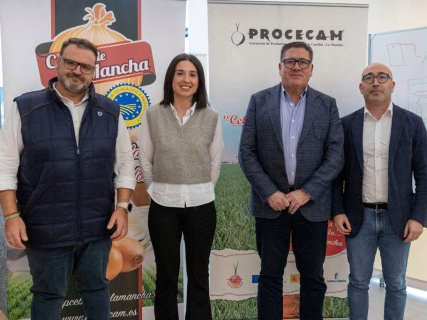










The general director of Agropecuary Planning, Lydia Benítez, has highlighted the high quality and the high level of professionalization of the onion sector, considering them decisive elements to strengthen its competitiveness and ensure its future.
Benítez expressed these ideas at the closing of the General Assembly of the Onion Producers Association of Castilla-La Mancha (Procecam), a framework in which the "Technological Transfer Workshop in the Onion Sector 2026" was also held.
During her remarks, the director recalled that Castilla-La Mancha groups in its territory 40% of the hectares devoted to onion cultivation in Spain and that, in terms of production, 51.1% of the national onions come from this region, exceeding 654,000 tons, "figures behind which there is a lot of work, but above all a great capacity for adaptation".
In this 2026, the sown area of onions across the whole country has remained around 24,000 hectares, "although it is true that the yield has been somewhat lower due to issues such as drought and heat, which have caused the campaign to start early," Lydia Benítez noted.
According to what the regional Government has conveyed, to these adverse weather conditions another challenge is added "that especially concerns the sector," namely the reduction in the available plant-protection tools for combating pests and diseases.
"However, thanks to the great cooperation of the association with the Administration, we have managed one more year the exceptional authorization of an insecticide to treat the onion fly, which has made it possible to have this tool during the spring months, helping to interrupt the pest cycle and to protect the productions".
In the face of the challenges that the onion sector faces, Benítez has defended the need to firmly commit to innovation, applied research, and the transfer of knowledge. In this regard, she emphasized that meetings like the one held today play a key role, by facilitating access to new techniques, improving conservation and storage, advancing the early detection of problems, learning about new varieties, and transferring all that know-how to the daily work of farmers.
Strengths of the onion sector in Castilla-La Mancha
Although she has acknowledged the difficulties, Lydia Benítez has also wanted to highlight the strengths of the sector by stating that "Castilla-La Mancha has land, has knowledge, and has professionals capable of competing in the most demanding markets. And organizations like PROCECAM are essential to turn all those strengths into opportunities".
Among those assets, she has highlighted the Protected Designation of Origin Cebolla de La Mancha, "a collective achievement of which we must feel especially proud, which represents support for the quality, the origin, and the differentiated characteristics of our product", which, for the director, above all, is an "opportunity to differentiate ourselves in the markets and generate added value".
The regional head has reiterated the willingness of the regional Executive "to continue supporting the sector, listening to its needs, and working together to face the challenges that lie ahead of us, such as adapting to climate change, improving productive efficiency, technological innovation, opening up markets, and strengthening the profitability of our farms".