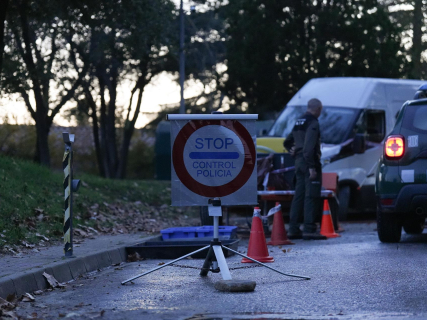

Various agents in the meat supply chain have made a favorable assessment of how the outbreak of African swine fever (ASF) has been managed, when one year has been reached since the first case was detected in Catalunya, on 28 November, but they warn that the poor trend experienced this year will also continue through 2027.
The general secretary of the Federación Empresarial de Carnes e Industrias Cárnicas (Fecic), Ignasi Pons, has told Europa Press that both the current year and the next have been negative for the entire sector, recalling that the emergence of the outbreak caused “turbulence” that has weighed down the economic results of companies across the entire livestock-meat chain.
Pons has stressed that the blow has been especially intense for companies in the province of Barcelona, conditioned by regionalisation, the mechanism through which health and commercial restrictions are limited to areas with positive cases and which, in Catalunya, covers 19 municipalities.
From Unió de Pagesos (UP), the head of the pig sector, Rossend Saltiveri, has warned that the sector will end 2026 in the red numbers and has added that expectations for 2027 “are not very good to begin with,” while the director of the Associació Catalana de Productors de Porcí (Porcat), Ricard Parés, has highlighted the consequences that another negative year will entail for SMEs.
Pons has detailed that 2026 has been an unfavorable year, with losses close to 20 euros per animal, although the companies still had the buffer of the good results from the previous financial year, while “2027 will be a bad year after a bad year,” he warned.
The head of livestock farming for the Federació de Cooperatives Agràries de Catalunya (FCAC), Jordi Saltiveri, has added that the next financial year will be “very complicated” at least until mid-year, and has expressed his confidence that no new positive cases will be detected in December.
Economic impact in Catalunya and Spain
According to an economic estimate prepared by Unió de Pagesos, since the first focus was confirmed, the organization calculates real losses of 275 million in Catalunya, a figure that rises to 1.044 billion across Spain, while the annual average price of pork in Mercolleida is 1.21 euros per kilo, 23.3% below the average for the previous year.
With this drop in quotation prices, added to an increase of 0.3% in the average cost of production, to 1.37 euros per kilo, the result is a negative production margin of 16 cents per kilo, equivalent to losses of 18.47 euros per live pig.
"We can’t keep producing at a loss. First, PPA must be eradicated, and then there is a market situation that we must regulate as a sector," Saltiveri has claimed, warning of a serious imbalance between supply and demand.
China, foreign markets and internationalization
Along these lines, Saltiveri (Fcac) has explained that, after the initial closure of several international destinations due to the PPA outbreak, a surplus of meat was generated that was intended to be diverted to other European countries, which caused a mismatch between supply and demand and pushed prices down.
According to the head of the organization, in Europe the 'per capita' consumption of meat has reached its ceiling and, although it is managed to keep it, the size of the intra-Community market cannot replace the extra-Community one. He added that the biggest blow has come with the closure of the Chinese market, a country that has also warned that it is increasingly "self-sufficient" in meat production and that, over time, it will also become a supplier to other Asian markets.
Wild boar population and health risk
Despite the impact on companies’ accounts, all the representatives agree on highlighting positively the actions of the Generalitat de Catalunya and coordination with the rest of the administrations, which has helped to curb the spread of the outbreak.
Instead, they have focused their criticisms on the high presence of wild boars, with densities of up to 24 animals per square kilometer compared with the maximum of between 7 and 8 specimens recommended by the regulations, according to Saltiveri (UP), who has called for the eradication of all wild boars in the high-risk area and the maintenance of strict monitoring.
On the other hand, Saltiveri (Fcac) has pointed out that the population of these animals is out of control, while Parés (Porcat) has assured that they constitute a plague throughout Europe and has recalled that they represent a health risk, and therefore he has defended the need to address the management of wild fauna in the continent "in depth."