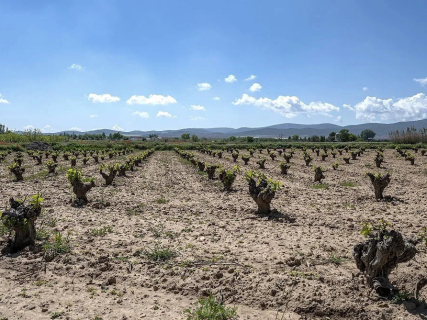










The Guadiana Hydrographic Confederation has decided to keep for the 2027 campaign the maximum allocations that were already applied in 2026 within the Annual Extraction Regime, after checking that the restrictions in force have not managed to halt the accumulated declines in the groundwater bodies.
In this context, the body has urged local entities to reduce by 15% the allocations intended for supply and industry and, "for consistency with this, it is also recommended to reduce by 15% the allocations for domestic, industrial and livestock uses with recognized rights in the water body".
These conclusions have been presented at the meetings of the Boards of Operation of the Groundwater Bodies (MASb) of Mancha Occidental I and Mancha Occidental II, in which representatives of the Ministry for Ecological Transition and the Demographic Challenge, of the Geological and Mining Institute of Spain, of the Board of Communities of Castilla-La Mancha, of the Water Users Communities and of the Hydrographic Confederation itself participated.
After presenting the monitoring data on the piezometric evolution and the chemical status of the aquifer, the CHG states that "the limitations applied to date have not allowed the accumulated declines to be reversed in a significant way". As detailed in a press release, the winter rains of 2026 have generated piezometric rises in most of the control points of the peripheral zones and in the area around the river Gigüela, but water levels continue to fall in the central areas of the tertiary aquifer, which forces caution when assessing recovery.
Therefore, in order to set the 2027 allocations, the recovery observed in 2026 must be weighed together with the prior declines and the current emergency situation in UTE 01 Mancha Occidental. With this scenario, the river basin authority proposes to adjust extractions with allocations of 1,350 m3/ha for woody crops and 1,800 m3/ha for herbaceous crops, keeping the limits already recognized when they are lower, without this implying additional cuts.
In addition, it is established that, if "according to the evolution of the scarcity indicator, the emergency/alert situation is reversed to a pre-alert situation in UTE 01 Mancha Occidental, the adjustments proposed in the previous sections will be lifted and the allocations of the extraction regime for the 2019 campaign will be applied".
In the face of the proposal by the CHG, the Community of Users argues that the allocation should be set at "2,000 m3/ha for herbaceous crops, and 1,500 m3/ha in the case of woody crops". The Department of Agriculture, Livestock Farming and Rural Development, on behalf of the Board of Communities of Castilla-La Mancha, supports this position and "adheres to the proposal put forward by the Community of Users".
Proposed annual extraction regime for 2027
In the specific proposal for the Annual Extraction Regime for 2027, the results of monitoring the piezometric evolution and the chemical status of the groundwater body once again show that "the limitations applied to date have not allowed the accumulated declines to be reversed, so the maximum allocations applied in 2026 must be maintained for 2027".
Based on this diagnosis, the river basin authority proposes an adjustment to extractions by setting allocations of "1,275 m3/ha for woody crops and 1,700 m3/ha for herbaceous crops". Irrigation areas that already have recognized allocations below those thresholds will keep their current limits, without the new proposal implying further reductions.
Likewise, "it is recommended that Local Entities reduce supply and industry allocations by 15%, and for consistency with this, a 15% reduction is also recommended in allocations for domestic, industrial and livestock uses with recognized rights in the water body". The application of these adjustments will be conditioned on the evolution of the scarcity indicator: if UTE 01 Mancha Occidental moves from emergency/alert to pre-alert, "the proposed adjustments in the previous sections will be lifted and the allocations of the extraction regime for the 2019 campaign will be applied".
For its part, the Community of Users insists that the allocation must be "2,000 m3/ha for herbaceous crops, and 1,500 m3/ha in the case of woody crops, as had been done until 2019 and as established as the maximum reference allocation in the review of the Programme of Action" and requests that, if this alternative is not accepted, "it be considered that, when in accordance with the evolution of the scarcity indicator the emergency situation is reversed to alert in UTE 01 (complementary indicators), the proposed adjustments be lifted and the allocations of the extraction regime for the 2019 campaign be applied".
"Likewise, on the part of the Department of Agriculture, Livestock Farming and Rural Development, on behalf of the Board of Communities of Castilla-La Mancha, it adheres to the proposal made by the Users' Community," thereby reinforcing the request to return to the reference allocations prior to 2019 when the conditions of scarcity allow it.