









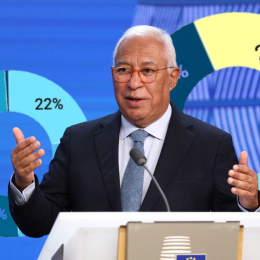
The president of the European Council, António Costa, presented on 21 November last a new negotiating box, the document that brings together the figures and the main points of friction in the next Multiannual Financial Framework (MFF), the Union’s budget for 2028-2034. His commitment proposal is an attempt to save the usual division. The traditionally called “frugal” countries, such as Germany, the Netherlands, Sweden or Austria, consider the Commission’s original proposal excessive and are calling for more cuts. The “friends of cohesion,” a group of 17 countries that includes Spain, see it as not very ambitious for the challenges facing Europe.
The leaders will debate this new proposal at the extraordinary European Council on 26 and 27 November with the aim of reaching an agreement as soon as possible, and everything suggests that Spain will face the closing of the negotiations with a caretaker Government after the elections of 29 November. The MFF is the roadmap that sets how much the EU can spend over the seven years and on what priorities. It requires unanimity of the Twenty-Seven and approval from the European Parliament, which is why negotiations often run on until the last summits. In July 2025, the Commission proposed a budget equivalent to 1.26% of European gross national income, a modest real increase once the repayment of NextGenerationEU debt is taken into account.
Costa’s proposal now cuts it by a 10%, down to around €1.58 trillion at constant prices. The adjustment is not homogeneous: cohesion and agricultural policy are left virtually intact, while the competitiveness heading loses 16%.
Behind these figures there is a less visible question: how the budget is financed. More than two thirds of the EU’s income usually comes from national contributions calculated according to each country’s income. This feeds into the logic of the juste retour: each State compares what it puts in with what it receives, and the negotiation becomes a fight over net balances.
To balance this dynamic and give the Union greater financial autonomy, Costa proposes a basket of five new own resources, from a new rate for digital companies to the carbon border adjustment mechanism and routes of charges on electronic waste, which could keep national contributions at around 0,8% of national income. Its approval will require unanimity in the Council and ratification by all Member States. Spain supports the creation of new own resources and, as it consolidates in the position of net contributor, has increasingly more at stake.
Two pathways to channel European funds
The new budget will be channeled through two main windows. The first, the National and Regional Cooperation Plans, will bring together cohesion, agriculture and fisheries in a single plan per country that seeks to continue the model of the national Recovery Plans. Its financing will be linked to compliance with reforms and investments. Spain would be the third-largest recipient of these funds, with around 88.100 million euros according to the Commission’s initial proposal.
The second route will group programs managed directly from Brussels, such as the European Competitiveness Fund, Horizon Europe, or the Connecting Europe Facility, whose resources will be allocated to projects through competitive calls.
From financial allocation to real investment
While, what is truly relevant about the post-2027 European budget will lie in how these funds are transferred to the real economy. An ambitious budget loses much of its impact if it gets stuck in administrative obstacles or replaces national investment rather than complementing it.
In the face of energy and geopolitical risks, Europe needs to finance decarbonization and innovation in a sustained manner, reduce its dependence on fossil fuels, and make its productive economy more resilient. To achieve this, every public euro must serve to attract private capital, thereby multiplying public investment. If, as Costa proposes, the adjustment falls mainly on competitiveness and innovation, that ability to multiply each euro will be even more decisive.
As we set out in the Green Finance Institute España report, "the success of the MFP 2028-2034 will depend on its ability to convert financial allocation into catalytic capital, ensuring that every euro coming from the European taxpayer acts as a lever capable of cushioning risks and mobilizing private investment at the scale necessary, indispensable to achieve the resilience of our economy and climate neutrality by 2050".
This requires going beyond grants and deploying risk-sharing instruments, facilitating financing in all phases of project development, and channeling capital through the financial system. The experience of programmes such as InvestEU shows that the use of budgetary guarantees makes it possible to substantially increase the leverage ratio.
Likewise, the implementation of income stabilization mechanisms such as the Contracts for Difference for Carbon, planned in the new Banco de Descarbonización Industrial, is critical to provide certainty to industrial sectors that are difficult to decarbonize and to deploy clean technologies.
Multilevel governance to reach the territory
This capacity for mobilization must also be supported by true multilevel governance. The trend towards a "single national plan" model entails the risk of centralizing management and moving investment decisions away from territorial reality. Coordination with the autonomous communities and local entities will be fundamental to carry out investments in key policies such as the renovation of buildings, sustainable mobility, green infrastructure, and water management. Their effective participation, together with strengthening their technical capacities, will make it possible to identify viable projects and distribute European investment more effectively across the entire national territory.
Europe does not only need a bigger budget, but one capable of multiplying the impact of every public euro, mobilizing private investment, and reaching the places where the citizen needs it most. For Spain, the challenge is to turn European funds into a lever for productive transformation that drives decarbonization, strengthens its strategic autonomy, and improves competitiveness. Only through a combination of catalytic financial instruments, effective implementation, and sound territorial governance will the MFP 2028-2034 be able to rise to the economic, climate, and geopolitical challenges of the next decade.