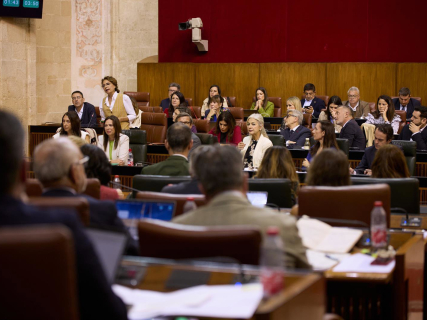

The Socialist Group has registered in the Parliament of Andalusia a non-legislative proposal (PNL) with which it aims for the Junta to "assume immediately an active position in the defense of the political rights of Andalusians residing abroad and of the descendants of the exile who have acquired Spanish nationality under the Law 20/2022, on Democratic Memory", within the framework of the so-called 'grandchildren's law'.
As the text of the initiative details, consulted by Europa Press after its appearance this week in the Official Gazette of the Parliament, it is a proposal "relating to the defense of the right to vote of Andalusians abroad and of the descendants of exile".
In its proposal, the Socialist Group suggests that the regional chamber urge the Andalusian Executive to adopt that "active position" by assuming "the responsibilities of assistance and defense of their rights and interests recognized in the Statute of Autonomy for Andalusia".
To this end, the PSOE-A proposes that the Junta drive, "through its Legal Services, all judicial actions that are legally appropriate, including the request for the appearance of the regional Administration in the contentious-administrative appeals filed before the Third Chamber of the Supreme Court".
Likewise, the PNL calls for the Andalusian Government to set in motion "to urgently enable a special, free program for assistance and legal defense, which includes specialized advice, documentary support and funding, through the legally suitable instruments, for the individual or coordinated procedural defense of the affected persons, as well as assistance in the procedures for registration and electoral-roll claims and cooperation with the competent electoral and consular authorities, with the aim of removing the administrative obstacles that hinder the effective exercise of the right to vote".
In the statement of reasons, it is emphasized that Law 20/2022, of 19 October, on Democratic Memory, "opened new avenues for acquiring Spanish nationality for certain descendants of the exile and other persons affected by historical discrimination in Spanish legislation", and it is maintained that "this recognition represents progress in democratic reparation and in the recovery of the ties of citizenship that persecution and exile helped to break".
In keeping with this, PSOE-A asserts that "those who have legally acquired Spanish nationality have the right to have and see respected and guaranteed the political rights that correspond to them in accordance with the Constitution and electoral legislation".
Vox and Iustitia Europa’s challenges over the 'grandchildren law'
In this context, the Socialist Group refers to the contentious-administrative appeals that Iustitia Europa and Vox filed with the Third Chamber of the Supreme Court against Agreement 204/2026, of 16 July, of the Central Electoral Board, concerning the interpretation and application of the eighth additional provision of Law 20/2022 on Democratic Memory.
The initiative recalls that the High Court "granted the precautionary measures requested by both parties, ordering the suspension of certain registrations in the Electoral Census of Absent Residents (CERA) and the electoral effects of other registrations already carried out, with respect to persons who acquired Spanish nationality through the right of option provided for in the first sentence of paragraph 1 of said additional provision".
The Socialist Group warns that "these measures affect the exercise of the right to vote in the general elections" of next 29 November, "with the exceptions expressly provided for those who prove by means of a consular certificate the circumstances required by the judicial rulings, and without the merits of the dispute having been resolved yet".
In addition, it is recalled that the Ombudsman filed "an application for amparo with the Constitutional Court, alleging possible violations of the fundamental rights to equality, political participation and effective judicial protection", and it is emphasized that "the judicial dispute remains open and requires that the affected persons have real possibilities of defense before the competent judicial bodies, especially when electoral time limits may make it impossible to vote in a specific call irreparable".
The PNL stresses that "the defense of these rights presents an especially significant dimension for Andalusia", whose "history is deeply marked by emigration and exile", because "thousands of Andalusians had to leave their land due to political persecution and Francoist repression, finding refuge in France, North Africa and numerous countries in Latin America".
At this point, the text appeals to the Statute of Autonomy for Andalusia, which "expressly recognizes institutional responsibilities in this matter", and it recalls that "its article 5.2 contemplates the political rights of Spanish citizens residing abroad whose last administrative residence was in Andalusia and of their descendants registered as Spaniards, in the terms established by state legislation".
Likewise, the non-legislative proposal indicates that article 6.2 "enables" the autonomous community to "provide assistance" to Andalusians who live outside and "contribute to guaranteeing the exercise and defense of their rights and interests".
For the PSOE-A, "the defense of these rights cannot remain in an institutional statement", but rather it "must translate into legal actions, effective assistance, and public resources that enable the affected persons to exercise the actions and claims that legally correspond to them".
The Socialist Group emphasizes that "the Government of the Junta of Andalusia has competences and instruments to provide legal advice, facilitate documentation, promote cooperation with state and consular authorities, and examine the procedural possibilities for intervention in judicial proceedings when sufficient standing exists".
As a conclusion, the PNL maintains that "Andalusia has a historical responsibility toward those who were forced to leave their land and toward the generations that have kept their memory alive", and that "that responsibility must also be expressed through concrete actions of legal protection, institutional cooperation, and the guarantee of rights".