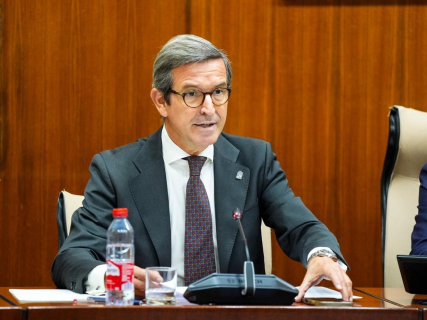

The budgets of the Ministry of University, Industry, Energy and Innovation for 2027 provide for 1,979.5 million euros for the Andalusian public university system, "the largest allocation received by these institutions to date". This amount increases by 10.5% compared with 2026, with 187.3 million more, as detailed by councillor Jorge Paradela in his appearance before the parliamentary committee to explain the accounts and the strategic lines of his department. "Universities are an absolute priority. We have protected them to the maximum" in this budget, Paradela has underlined.
The councillor has specified that the total budget of the Ministry, including its agencies, rises by 2.6% compared with 2026, which means almost 75 million additional, to exceed 2.916 billion, of which 882 are allocated to investments. Paradela has stressed that these funds are aimed "at strengthening the public university system, excellence research and innovation, at supporting the growth and productivity of industry, at advancing energy efficiency and renewables, at promoting sustainable mining and at enhancing Andalusia's position as a great industrial and technological region thanks to knowledge, clean energy and strategic resources".
The head of University and Industry has indicated that the allocation for the university sphere already represents 3.6% of the Junta's global budget for 2027, which, in his view, shows "the enormous effort this Government dedicates to the public higher education system". Most of those nearly 1,980 million are channeled through the financing model, endowed with 1,925 million, that is, 137 more than in the previous financial year, "thus exceeding the increase of at least 120 million announced in September by President Juanma Moreno", as the councillor has pointed out, who has also highlighted that this amount implies an increase of 7.6% compared with 2026. "This is, therefore, a percentage increase that exceeds that recorded by the set of regional accounts for 2027, which reaches 6%".
Alongside the financing model, the universities will have 50 million in dedicated loans aimed at extraordinary investments in infrastructure, equipment and facilities, as well as to "reduce debt". Paradela has defended that these loans constitute a "useful instrument" in "interesting conditions" for academic institutions. The accounts also allocate more than 244 million to boost industrial and mining activity, almost 50% more and 80 million more than in 2026, with the aim of consolidating the growth of Andalusian industry and advancing toward the goal of attracting industrial investments that will make it possible to mobilize another 20,000 million by 2030.
Among the new features, the Andalusia Reindustrialization Fund is included, with 50 million, conceived to attract large-scale projects and promote industrial development based on sustainability and technology. In addition, the Consejería de Universidad e Industria will launch a 30 million call to modernize industrial estates, which is added to a previous one of 50 million, thus reaching 80 million, "the greatest effort mobilized so far to upgrade industrial estates", he emphasized.
The budget document also includes an allocation of 42 million to complement the Regional Economic Incentives (IER) in order to support projects by large industries. In turn, the Just Transition Fund will have 100 million, 20.8% more, destined for driving initiatives in Almería, Cádiz and Córdoba linked to the stone and marble industry, green hydrogen or sustainable aviation. The Integrated Competitiveness and Energy Incentives program (INCEA), with 250 million, will make it possible to launch in 2027 the Renewable Hydrogen and Sustainable Mining lines. At the same time, the 19 Crece Industria Plans will continue to be implemented, which will direct 23 million to companies in strategic sectors.
Trade Agency will have 170 million, which represents an increase of 38% compared to 2026. In the mining field, the Junta will continue with the Strategy for a Sustainable Mining in Andalusia 2030, aimed at strengthening the entire value chain and raising mining research investment by at least 15%. The measures for the organization of energy activity total almost 282 million. In this area, the Andalusian Energy Agency will manage 265 million, of which 250 will be allocated to energy improvement actions in industries, companies, households and local administrations. Paradela has insisted that these accounts aim to take advantage of Andalusia's renewable potential and move toward a decarbonized economy, promoting sustainable reindustrialization.
Regarding research, the Consejería foresees almost 60 million in various incentive calls. There are 18.2 million contemplated for scientific equipment, more than 14 million for applied research, ten million for predoctoral and postdoctoral contracts, almost nine million for Excellence Units, close to five million for basic research and 2.5 million for International Excellence Campuses. In terms of entrepreneurship, grants will be launched to promote entrepreneurial culture, the creation and acceleration of companies and open innovation in startups. Andalucía Emprende will have 41.8 million to strengthen entrepreneurial culture and support new business projects.
During the parliamentary debate, the opposition groups have reproached the councillor for using his first intervention to make "electoral campaigning", in which he referred to "erratic policies and the lack of certainty". "Faced with the fragility of a Government that has replaced the lack of parliamentary majority with permanent concessions to the pro-independence parties, transmuting the false majority of progress --that is, we are more-- into an outside the Cortes, we find ourselves with the antithesis represented by the Andalusian model and the investment policies of the Government of Juan Manuel Moreno" were the words of Jorge Paradela.
In the face of these criticisms, Por Andalucía has reminded the counselor that this budget --the first of the PP-Vox Government-- incorporates "vile measures" such as, in his view, the elimination of aid to NGOs that assist migrant people. "We were not expecting this electoral campaign in an appearance as important as that of the budgets," the Andalusian PSOE has pointed out, to which Paradela has replied that "I have not come to campaign but it must be emphasized that there are budgets" in contrast to what has happened in Spain, "four years without them". Por Andalucía has labeled as a "clear trap" the 10.5% increase that Paradela has highlighted for public universities, considering that this increase "includes loans" for 50 million euros, a "curious way of financing," Adelante Andalucía later ironized.
From the PSOE they have defended that the draft budget for the next fiscal year "does not seize the opportunity" to coordinate industrial policies with those linked to talent, knowledge and research. They have also predicted a budget modification in May 2027 --coinciding with the next municipal elections-- to comply with the agreement arising from the technical commission created to address the application of the financing model and the safeguard clause that guarantees that universities will never receive fewer resources than the previous year. Vox has highlighted that the accounts of the Consejería seek to "protect what is ours" in the industrial sphere in the face of Morocco and Algeria, while from the PP they have defended that the figures in the budget "are not paper, they are real figures".