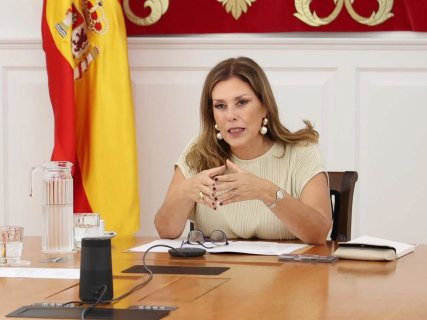

The Parliament of the Canary Islands, which exercises coordination of the Working Group on Migration Policy of the Conference of European Regional Legislative Assemblies (CALRE), held this Wednesday a telematic session in which the proposals of the different parliaments involved were examined, with the aim of moving forward on drafting a communiqué on the migration situation at the EU’s external borders.
The meeting was chaired by Astrid Pérez, President of the Parliament of the Canary Islands and of CALRE, who emphasized the need for Community institutions to address the specific reality of the territories that directly bear the pressure of migration, according to information from the regional chamber in a press release.
"The protection of the external borders cannot rest solely on the regions that are in the front line. It is a responsibility of the entire European Union, which must guarantee a coordinated, supportive response with sufficient resources, never losing sight of the protection of human rights and the dignity of people," she said.
Among the main issues, the situation in Ceuta was discussed, especially in the wake of the migration episodes of last July 30. To delve into this context, the group had the intervention of Javier Celaya Brey, a deputy for Ceuta in the XV Legislature of the Congress of Deputies, who set out his experience and detailed the main challenges facing the autonomous city as an external border of the EU.
During the meeting, Astrid Pérez also presented data that illustrate the scale of the migration phenomenon in the Canary Islands. By November 1, 2026, 12,616 people had arrived by sea, of whom 5,379 did so only in the month of October. This is added to the burden on the child protection system: as of October 28, the islands had under their guardianship 2,622 unaccompanied migrant minors, compared with an ordinary capacity of 782 places.
The president also recalled the high human cost of the Atlantic route, in which 635 people lost their lives or disappeared between January and May, according to data from Caminando Fronteras.
In the debate, among other representatives and parliamentary posts, Rubina Leal, president of the Legislative Assembly of Madeira, intervened; Carlo Borghetti, chief executive officer of the Regional Council of Lombardy; Angelo Gennaccaro, president of the Provincial Council of Bolzano, as well as representatives of Trentino-Alto Adige. Throughout the session, the contributions sent by the Courts of Aragon and the Parliament of Brussels Capital were also analyzed.
Among the priority lines put forward to enrich the text are the strengthening of Europe’s capacity to respond in exceptional situations, closer cooperation and solidarity among the Member States, the strengthening of control and management of external borders, the fight against people trafficking networks, and the intensification of collaboration with countries of origin and transit.
The meeting concluded with the commitment to integrate the contributions of all delegations into the statement on migration, which will be sent to the members of the group for their review. The purpose is to establish a common position that makes it possible to convey the voice of the regional parliaments to the European debate on one of the most relevant challenges currently facing the EU.