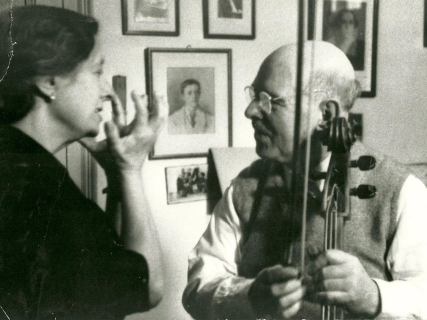

The Parliament has expressed this Thursday its recognition and admiration for the figure of Pau Casals, underlining that he managed to unite a career "with a worldwide dimension in the field of music with his commitment to humanism, peace, democracy, and the unwavering defense and appreciation of his country," and has shown its support for the commemoration of the 150th anniversary of his birth this year.
The institutional declaration of the Catalan Chamber, supported by PSC-Units, Junts, ERC, Comuns, and CUP, describes him as "one of the universal Catalans who most honors Catalonia" and, in addition to recalling that he was a cellist, conductor, composer, and pedagogue, emphasizes his firm commitment to democracy, values, and freedom.
The text underlines that he defended these principles for Catalonia "with high esteem, precisely in moments of maximum difficulty for its survival."
The declaration recalls that he performed in some of the most prestigious auditoriums on the planet and that his career developed in "a wartime context about which he did not wish to remain indifferent," refusing to give concerts in Nazi Germany and, later, in allied countries, considering that they had not acted against the Franco regime.
After his exile in France in 1939, the document especially recalls his intervention on October 24, 1971, at the United Nations Day concert in New York, where he delivered a speech "that has survived to this day in collective memory, in which he claimed his Catalan identity and the Catalan nation."