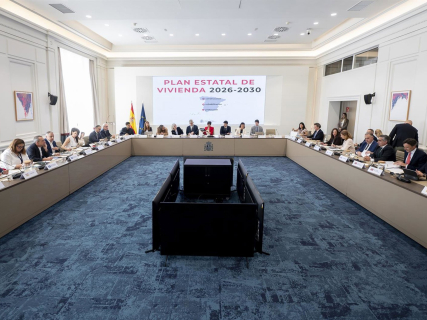

The executives of all the autonomous communities, meeting this Thursday at the sectoral housing conference, have given their approval to the distribution of the funds from the State Housing Plan, so that they will receive the allocations in the coming months and will be able to launch the actions during the second half of the year.
The Ministry of Housing and Urban Agenda has confirmed this unanimous support at the end of the meeting, an outcome that the minister, Isabel Rodríguez, had already taken for granted after the previous statements by the regional representatives.
From the department, they emphasize that this is an "important" agreement not only because of its material scope, but also "because of the powerful message it sends to citizens," by demonstrating that different administrations have decided to "row together."
Before entering the sectoral conference, Rodríguez told the media that the pact constitutes good news "especially for citizens" who are awaiting solutions, along with "effective proposals that provide certainty and security to what is currently their main concern."
"There have been many months of work, of dialogue," recalled the minister, who highlighted that the design of the plan has involved the participation of public administrations, the social fabric, and sector agents, and that up to 400 proposals have been received from social entities.
Rodríguez insisted that the agreed-upon plan reserves 40% of the resources to stably increase the stock of protected housing, something that shows that "when there is a will and work is done on it," it is possible to reach agreements between different levels of government.
Likewise, she ruled out that the distribution of funds could be conditioned by electoral processes that have already taken place or by a potential early election at the state level. In this way, the communities that ratify the agreement this Thursday could have the amounts available from July.
The Ministry is confident that this understanding "will mark a turning point" and that, from now on, the autonomous communities will "collaborate loyally with the Ministry of Housing" to deploy all the tools of the Housing Law aimed at making rents cheaper and "curbing speculation."
The new plan has an allocation of up to 7 billion euros, triple that of the previous one, and guarantees the permanent nature of the financed public housing.
The Ministry's proposal maintains the same distribution criteria as the previous State Plan. In addition to the 40% allocated to protected housing, 30% is reserved for the rehabilitation of the existing residential stock through specific aid, and the remaining 30% will be directed to support youth emancipation, reduce the financial effort rate of households, and act in stressed areas.
The plan also incorporates the principle of indefinite protection for public housing, so that properties acquired or promoted with these funds will be classified as permanently protected.
In the 2026-2030 period, the State will assume 60% of the planned investment and the autonomous communities will contribute the remaining 40%. This implies a somewhat greater effort for the autonomous regions compared to previous plans, in which they covered 25% of the budget and the rest was borne by the State.
NO SPECULATION WITH PUBLIC HOUSING
The plan is framed under the "umbrella" of the Housing Rights Law and is structured around three axes: build, rehabilitate, and protect.
To this end, the Government reinforces the protection of public and protected housing to prevent speculation with it, conditioning financing on properties always being used for the general interest; it introduces an anti-fraud clause in awards and commits to offering public data on the residential market, so that they do not depend on "private portals with private interests".
In an exercise of participatory governance, the Housing Advisory Council will annually evaluate the degree of compliance with the plan.
Furthermore, as explained by the Minister of Housing, Isabel Rodríguez, the plan will also assume a supervisory function over all administrations, so that the central Executive does not lose control of the development of promotions financed with public resources, through transparency channels and semi-annual monitoring mechanisms.
EFFORT BY CC.AA.
In absolute terms, Andalusia is positioned as the community with the largest allocation from the new plan, with 1,197 million euros, which implies an increase of 877 million compared to the previous program. Next are the Community of Madrid, with 1,113 million (+815 million), and Catalonia, with 1,015 million (+473 million).
Castilla y León will have 378 million euros, after adding an additional 277 million, while Canarias will reach 371 million (+272 million). Galicia will have 399 million, with an increase of 293 million, and Castilla-La Mancha will receive 280 million (+205 million).
The Valencian Community will receive 798 million (+558 million); Aragón will receive 266 million (+195 million); the Balearic Islands, 168 million (+123 million); and Asturias, 231 million (+175 million). The Region of Murcia will obtain 308 million, which represents an increase of 258 million.
Cantabria will have 133 million (+98 million); Extremadura, 210 million (+154 million); and La Rioja, 266 million (+195 million).
As for the autonomous cities, Ceuta will have 7 million euros, with an increase of 4.7 million, and Melilla will also receive 7 million, after adding 2.8 million more than in the previous period.