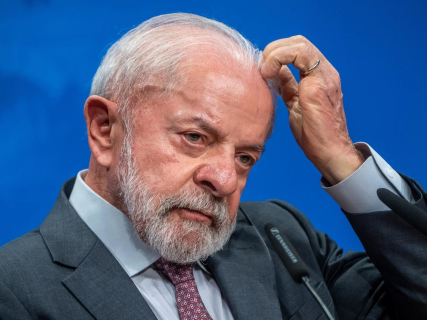
Latest polls from Brazil: Lula leads the first round, but the second remains open

The polls consulted place Lula da Silva ahead of Flávio Bolsonaro in the first round, although with different distances. Datafolha outlines a tight second round and Futura offers a favorable scenario for the opposition candidate.

2 minutes

fotonoticia 20260919175527 1920

fotonoticia 20260919175527 1920

Add DEMÓCRATA to Google

Ask FREN

Published

Last updated

2 minutes

Most read

The latest national polls in Brazil consulted before the elections on October 4 show Luiz Inácio Lula da Silva in first position, but do not depict a uniform advantage nor allow for the presidential race to be considered resolved. The distance from Flávio Bolsonaro changes according to the institute and the voting scenario.

In the studies published on September 17, Datafolha places Lula at 39% and Flávio Bolsonaro at 36%; AtlasIntel/Bloomberg raises both supports to 44.1% and 41.7%, respectively; and Futura offers a closer result, of 38.3% versus 37.7%. The data is collected in the comparison of polls published by UOL.

What the latest first-round polls say

The following table records the publication date, not necessarily all the days of fieldwork. That distinction is important: a poll released later may include interviews conducted before those of another study.

Institute Publication Lula Flávio Bolsonaro
Datafolha 09/17/2026 39% 36%
AtlasIntel/Bloomberg 09/17/2026 44.1% 41.7%
Futura 09/17/2026 38.3% 37.7%
Quaest 09/14/2026 36% 31%
BTG/Nexus 09/14/2026 42% 37%

Source: compilation by UOL. The table shows only the two indicated candidates; the rest corresponds to other candidacies and responses, according to each poll.

The second round offers a different picture

In a direct confrontation, Datafolha places Lula at 46% and Flávio Bolsonaro at 44%. Futura, on the other hand, places the opposition candidate at 48.1%, compared to the current president's 43.7%, according to the compilation of second-round scenarios by UOL.

The comparison illustrates why leading the first round does not guarantee winning in the second. When the number of options is reduced, supports can be redistributed and the decisions of some interviewees change.

Sample, method, and margin of error

Datafolha worked with 2,002 interviews and reports a margin of two percentage points; Futura, with 2,000 telephone interviews and a margin of 2.2 points; AtlasIntel, with 5,018 interviews via digital capture and a margin of one point, according to the records collected by UOL.

When Brazil votes and what is needed to win

The first round takes place on October 4, according to the Superior Electoral Court. The legislation requires an absolute majority of valid votes to resolve the presidential election in that round; blank and null votes are not included in that calculation base, according to Brazilian electoral law.

The conclusion of the consulted studies is limited but clear: Lula retains the numerical leadership of the first round, while the direct dispute with Flávio Bolsonaro remains open.

More key points, information and questions with FREN

AI-GENERATED CONTENT

What is the process for the official proclamation of results in Brazil's presidential elections and what deadlines are established by electoral legislation?

In Brazil, the official proclamation of the results of the presidential elections is a legal-administrative procedure carried out by the Electoral Justice, headed by the Superior Electoral Court (TSE). Although the provisional count is known on the same night of the voting, the official proclamation only occurs after a series of formal acts and within deadlines set by electoral legislation and by the calendar approved by the TSE itself for each electoral cycle.

1. Basic legal framework

The process is mainly based on:

  • Federal Constitution of 1988, especially article 77 (election of president and vice president, first and second round).
  • Electoral Code (Law No. 4,737/1965), which regulates the counting, totaling, and proclamation.
  • Election Law (Law No. 9,504/1997), which complements rules on campaigning, voting, and counting.
  • TSE Resolutions, which each electoral year approve the detailed electoral calendar, setting specific dates for definitive counting, filing of challenges, and certification.

2. From provisional results to official totaling

On the day of voting, after the closing of electronic ballot boxes, polling station bulletins are generated at each electoral section. These data are transmitted to the TSE's totaling system, which publishes provisional results within a few hours.

However, the official totaling requires additional steps:

  • Formal receipt of the records by the Regional Electoral Courts (TRE) in each state.
  • Verification and correction of inconsistencies (incomplete records, material errors, etc.).
  • Judgment of possible appeals related to specific tables or sections (for example, challenges to ballot boxes or records).
  • Submission of the state totaling to the TSE, which consolidates the national result.

Only once this phase is completed is the TSE able to proclaim the result, declaring who has been elected president and vice president (in the first or second round, as applicable).

3. Official proclamation and possible challenges

The official proclamation is made through a formal decision of the TSE, which may take the form of an agreement, resolution, or similar act, in which:

  • The final count of valid votes is recorded.
  • The winning candidate (or ticket) is declared, according to constitutional rules (absolute majority of valid votes, excluding blank and null; or second round between the two most voted).

In parallel, the legislation allows the filing of appeals against certification or the validity of the result (for example, actions challenging the elective mandate, electoral judicial investigations, etc.), which are processed within specific deadlines and conditions. These appeals, however, do not automatically prevent the proclamation or subsequent certification, unless expressly decided by the TSE itself.

4. Legal deadlines and electoral calendar

Brazilian legislation establishes deadlines in a combined manner:

  • The laws (Constitution, Electoral Code, Election Law) set the general rules and some time intervals (for example, first and possible second round, start of the term in January of the following year).
  • Each electoral cycle is complemented with a TSE resolution approving the electoral calendar, where the following are determined:
    • The deadline for the definitive counting and official totaling of votes.
    • Deadlines for the filing and resolution of appeals regarding the electoral process.
    • The cutoff date for the certification of the elected president and vice president (solemn act in which they receive their diplomas).

In practice, the electoral calendar sets that:

  • The counting and official totaling must be completed within a relatively short period after the first or second round (usually days or a few weeks), so that the official result is defined with sufficient advance notice.
  • The certification of the presidential ticket is carried out before the inauguration, generally in December of the election year, so that the term can begin on the constitutionally scheduled date in early January.

5. Key idea about deadlines

In summary, the official proclamation of results in Brazilian presidential elections is not limited to the announcement on election night, but is the outcome of a process regulated by the Constitution, the Electoral Code, and the Election Law, operated by the TSE. The specific deadlines — both to close the totaling and to challenge and certify the elected — are set in the electoral calendar approved by the TSE for each election, within the general framework that the entire procedure must be completed before the start of the new presidential term.

How does the provisional count on election night differ from the official totaling carried out by the Superior Electoral Court? What types of appeals or challenges can be filed against the results of presidential elections in Brazil and within what deadlines? What exact role does the certification act of the elected president play and how is it related to the official proclamation of results?

What powers and functions does the Superior Electoral Court of Brazil have in the organization and supervision of presidential elections?

I can only guide you in a very general way, but I cannot offer you a detailed and technically reliable explanation about the Superior Electoral Court (TSE) of Brazil nor about the precise distribution of its powers in the organization and supervision of presidential elections.

I specialize in the functioning of institutions and political and normative activity in Spain (General Courts, regional governments, Spanish legislation, parliamentary procedures, Spanish political actors, etc.). For other countries, especially when it comes to technical-legal issues as specific as the formal powers of an electoral court in its own legal system, I can no longer guarantee sufficient accuracy or up-to-date information.

Very generally — and without being able to enter into Brazilian legal detail —, superior electoral courts in systems like Brazil's usually:

  • Act as the highest authority of electoral justice, resolving appeals and controversies about the electoral process.
  • Supervise the material organization of elections (calendar, registration of candidacies, campaign rules, counting, proclamation of results), normally in coordination with subordinate electoral administrative bodies.
  • Guarantee the legality of the campaign, financing, and electoral propaganda, imposing sanctions when rules are violated.
  • Judge certain challenges to candidacies or results, with direct effects on who can run or assume office.

However, these are typical characteristics of electoral courts in some Latin American countries, not an exhaustive or guaranteed description of the specific Brazilian case. For academic, professional, or technical work on the Superior Electoral Court of Brazil and its functions in presidential elections, you should directly consult:

  • The official website of the Superior Electoral Court of Brazil, where there are usually specific sections about competencies and the electoral process.
  • The Brazilian Constitution and Brazilian electoral legislation (Electoral Code, complementary laws on elections and political parties), which formally determine those competencies.
  • Manuals or doctrinal articles on Brazilian constitutional and electoral law, which explain how those functions are articulated in practice and how the TSE relates to other bodies.

On the other hand, I can help you in depth, with much more detail and certainty, on issues such as:

  • Competencies and functioning of the Central Electoral Board in Spain and of the provincial and district electoral boards.
  • Legal framework of Spanish general elections (Congress and Senate) or other electoral processes in Spain: European, regional, local.
  • Organization of electoral campaigns and control of propaganda and electoral financing in the Spanish system.
  • The role played by different Spanish institutional bodies in the calling, organization, and supervision of elections.

If you are interested in a comparison between the Brazilian and Spanish models, I can explain in quite some detail how the Spanish system works and, from there, help you structure a comparative scheme that you can complete yourself with specific information from reliable Brazilian sources.

What have been the results of the latest presidential elections in Brazil and which parties currently make up the National Congress?

Based on the information available in the sources consulted, it can be stated with certainty that in the latest presidential elections in Brazil — those of 2022 — the winner was Luiz Inácio Lula da Silva, while Jair Bolsonaro was defeated. However, the retrieved news does not include detailed numerical data (exact vote percentages or total number of votes) nor a complete and updated breakdown, party by party, of the seats in the Chamber of Deputies and the Senate. Therefore, it is not possible to offer you an accurate table of results and parliamentary composition without resorting to external information not contained in the sources of this search.

Results of the 2022 presidential elections

The analyzed news repeatedly refer to the October 2022 presidential elections and their political and judicial consequences. Specifically, it is indicated that:

  • The 2022 elections “culminated with the victory of Luiz Inácio Lula da Silva,” according to a piece reporting the conviction of Jair Bolsonaro for his participation in an attempted coup after those elections (news on Demócrata).
  • Bolsonaro is mentioned as former president and as the loser of those elections, which reinforces that the 2022 second round meant a change in the Presidency, from Bolsonaro's government to Lula's.

However, the texts do not reproduce the official table from the Superior Electoral Court (TSE) with the percentage of votes for Lula and Bolsonaro nor with the total number of votes or turnout. In the absence of those data in the consulted sources, I cannot offer exact figures without leaving the scope of available information.

Parties present in Brazil's National Congress

The second part of your question refers to which parties currently make up the National Congress (Chamber of Deputies and Federal Senate). The reviewed news focus mainly on political and judicial conflicts, but allow identifying some relevant forces represented in the Brazilian Parliament:

  • The Workers' Party (PT), of Lula, appears as one of the main formations, both in the Executive and in parliamentary opposition to initiatives favorable to Bolsonaro.
  • The Liberal Party (PL), politically linked to Jair Bolsonaro and his son Flávio Bolsonaro, is cited as a force with presence in the Chamber of Deputies and as the main reference of the right and far-right bloc in Brazil.
  • Other parties acting in Congress are also mentioned, such as the PSOL (Socialism and Liberty Party), which has at least the deputy Glauber Braga — protagonist of several incidents in the Chamber — and various formations that have supported or questioned constitutional changes on parliamentary immunity.

However, the journalistic pieces do not provide a complete numerical table of the number of seats per party nor precisely distinguish between the distribution in the Chamber of Deputies and the Senate. They refer to specific votes (for example, to annul a veto by Lula or to process reforms affecting the penalties of those involved in the 2022 coup attempt), but without detailing how many seats each parliamentary group has.

What can and cannot be concluded

With the information available in the sources I have been able to consult in this search:

  • Yes, it can be stated that Lula da Silva won the 2022 presidential elections and that Jair Bolsonaro lost them, leading to a change of government.
  • Yes, it can be identified that parties such as the PT, the PL, and the PSOL, among others, are part of the National Congress and participate in major legislative decisions.
  • No, it is possible to reconstruct, based on these texts, the exact distribution of seats by party in the Chamber of Deputies and the Senate, nor to offer the official percentages of the presidential second round.

To obtain those data with full accuracy, the safest is to go directly to official Brazilian sources: the Superior Electoral Court for presidential results and the institutional pages of the Chamber of Deputies and the Federal Senate for the current composition by party. Those websites continuously update changes in benches, replacements of parliamentarians, and reorganization of blocs.

I regret not being able to offer you the exact numbers you seek based on the information available in this search, but I hope this summary is useful as a starting point and to politically situate the Brazilian scenario after the 2022 elections.

Play

Test your knowledge with FREN!

How much do you know about this topic? Answer the following 3 questions.

When are the first round presidential elections in Brazil held according to the news?

Question 1 of 3

What requirement does Brazilian electoral law establish for a candidate to win in the first round of the presidential election?

Question 2 of 3

What is the margin of error communicated by Datafolha in its survey?

Question 3 of 3

Hola, soy Fren. ¿Cómo te ayudo?